ISRA FACTSHEETS
ISRA FACTSHEETS
AUSTRALIA AND SOUTHEAST INDIAN OCEAN
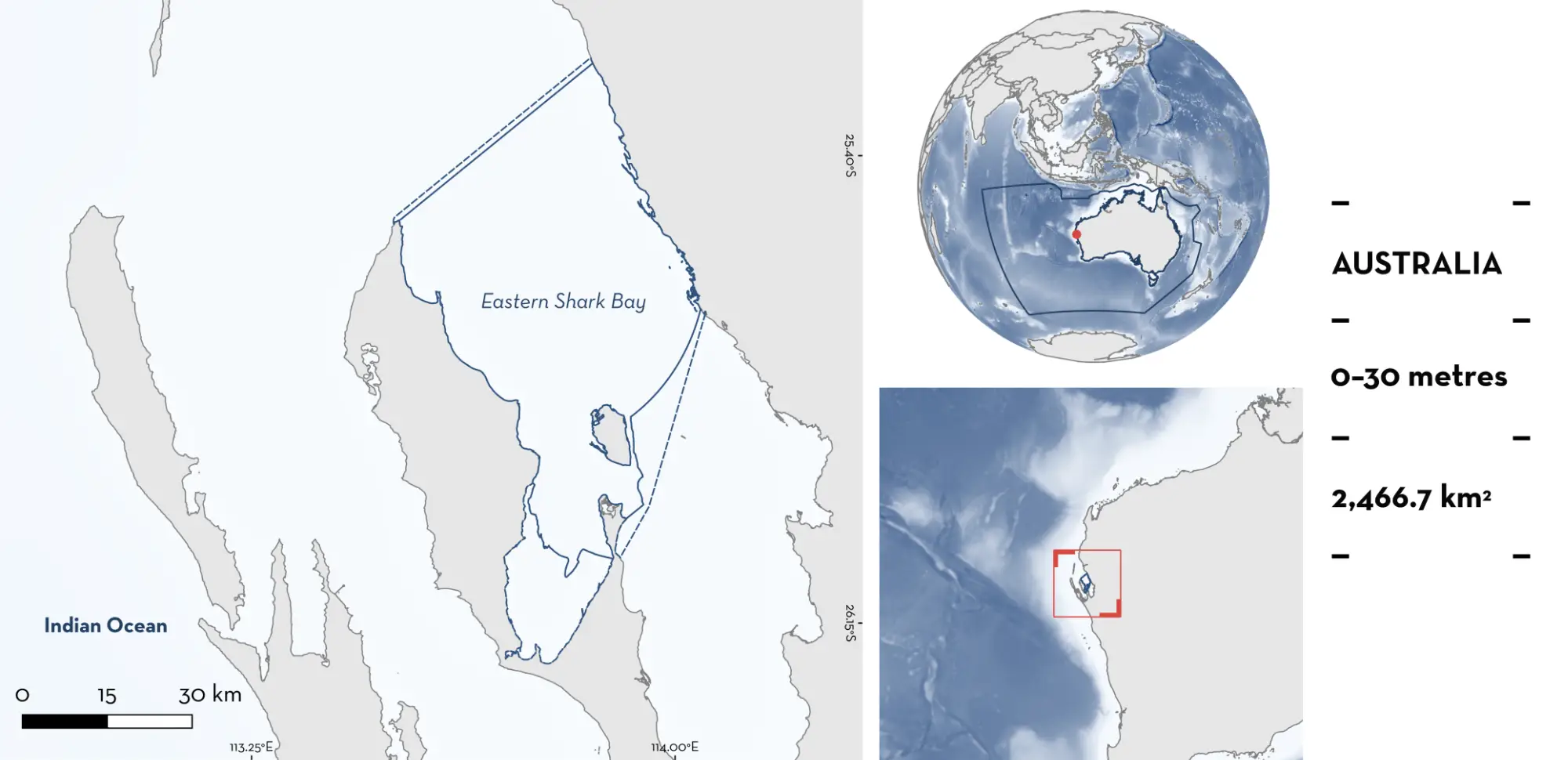
Eastern Shark Bay
Summary
Eastern Shark Bay is located in Shark Bay, Western Australia, Australia. Shark Bay is a large, semi-enclosed coastal embayment that contains one of the largest reported seagrass beds in the world. Because evaporation exceeds freshwater input, this area functions as an inverse estuary. This area overlaps with the Shark Bay Marine Park. Within this area there are: feeding areas (Tiger Shark Galeocerdo cuvier).
Download factsheet
Eastern Shark Bay
DESCRIPTION OF HABITAT
Eastern Shark Bay is located in Shark Bay, Western Australia, Australia. Shark Bay is a large, semi-enclosed coastal embayment that contains one of the largest reported seagrass beds in the world and the largest in Australia (Walker 1989; Burkholder et al. 2013). The area is dominated by the seagrass Amphibolis antarctica which covers ~85% of the area characterised by seagrasses, with smaller areas of Posidonia australis (Walker et al. 1988; Burkholder et al. 2013). Other substrates include sand and colonizing seagrass, interspersed with macroalgae, pavement, and microbial mats.
Shark Bay has a semi-arid climate characterised by two main seasons: warm to hot austral summers (October–March) and mild winters (April–September). The bay’s waters are warmer than adjacent oceanic waters in summer and cooler in winter (Nahas et al. 2005). Average sea surface temperatures (SST) are higher in summer (mean = 24.6 ± 1.0°C) than in winter (mean = 20.8 ± 1.7°C). Because evaporation exceeds freshwater input, Shark Bay functions as an inverse estuary, with nearshore waters consistently more saline than the surrounding ocean (Logan & Cebulski 1970; Burling et al. 1999). During summer, salinity rises sharply. In winter, reduced wind-driven mixing and tidal forcing cause hypersaline water (salinity >40) from the southern parts of both gulfs of Shark Bay (outside of this area) to flow along the seabed, forming dense plumes that generate strong longitudinal salinity gradients extending from oceanic to inner bay waters (Logan & Cebulski 1970; Hetzel et al. 2015). Although mean sea surface salinity shows little seasonal fluctuation overall, hypersaline water during summer remains largely confined to the southern regions of Shark Bay (outside of this area) (D’Antonio et al. 2025).
The seagrass beds of the area sustain globally significant populations of large marine vertebrates, namely Dugong Dugong dugon, Green Turtle Chelonia mydas, and Loggerhead Turtle Caretta caretta (Marsh et al. 1994; Preen et al. 1997; Heithaus 2001a; Heithaus et al. 2005, 2012; Gales et al. 2004; Wirsing et al. 2007). This area also functions as key foraging grounds for Elegant Sea Snake Hydrophis elegans and teleost fishes.
This area overlaps with the Shark Bay Marine Park (WA DBCA 2025).
This Important Shark and Ray Area is benthic and pelagic and is delineated from inshore and surface waters (0 m) to 30 m based on the depth range of Qualifying Species in the area.
CRITERION C
SUB-CRITERION C2 – FEEDING AREAS
Eastern Shark Bay is an important feeding area for one shark species.
Between 1994–1999, 48 stomach contents were analysed showing that Tiger Sharks feed mainly on Elegant Sea Snake, Dugong, Green Turtle, and Loggerhead Turtle with a percentage of occurrence between 25–60%, depending on the prey item (Heithaus 2001a; Simpfendorfer et al. 2001).
Between 1997–2004, 49 Tiger Sharks were monitored using a combination of acoustic telemetry (n = 8) and Crittercams (animal-borne video and environmental data collection system; n = 41) (Heithaus et al. 2002, 2006). Prey availability was also monitored. Foraging behaviour was observed in 12 (55%) of 22 sharks. At least five sharks were recorded successfully capturing prey. Nine sharks encountered 19 identifiable potential prey items (e.g., sea turtles, sea snakes, rays, including rhino rays) (Heithaus et al. 2002). Sharks exhibited a preference for shallow habitats, as 36% of their time was spent in shallow habitats. Randomisation techniques to test habitat preference showed that sharks strongly preferred shallow habitats where dugongs, turtles, and fish are abundant.
Several prey species were regular recipients of Tiger Shark-inflicted injury: 74% of Indo-Pacific Bottlenose Dolphins Tursiops aduncus (Heithaus 2001b), 25% of female Loggerhead Turtles, and 50% of male Loggerhead Turtles (Heithaus et al. 2005, 2012). Two Dugongs showed scars from failed shark attacks, while three Tiger Sharks were directly observed harassing, attacking, killing, and consuming dugongs of various ages (Wirsing et al. 2007).
Between 1997–2005, 159 samples (from fin, whole blood, and red blood cells) were collected from Tiger Sharks in this area (Ferreira et al. 2017). Stable isotope values (δ13C) indicated that sharks feed primarily within coastal, seagrass-associated food webs, rather than pelagic habitats. Their isotopic signatures closely matched those of prey such as Dugongs and sea turtles, confirming a diet based on seagrass-derived carbon sources. A similar study that collected samples from shark fins (n = 166) between 2005–2012 in this area established that Tiger Sharks also obtained most of their energy from seagrass-based food webs (Heithaus et al. 2013).
Tiger Shark prey (Dugongs, Green Turtles, Loggerhead Turtles, and Elegant Sea Snakes) are most abundant in shallow habitats (Heithaus 2001a, 2004; Heithaus et al. 2002, 2005, 2012). Sea turtles, Dugongs, and dolphins modify their habitat use in response to changing Tiger Shark abundance (Heithaus & Dill 2002; Heithaus et al. 2005, 2012; Wirsing et al. 2007). When sharks are scarce, these species forage in shallow, food-rich seagrass areas, and when sharks are abundant, they shift toward safer, deeper habitats. Fear risk effects (i.e., impacts of perceived predation risk on prey behaviour and ecology, even without actual predation) confirms that Tiger Sharks actively hunt in these productive shallow habitats, supporting the importance of this area as a feeding ground (Heithaus et al. 2012).
Between 1997–2004 using drumlines equipped with a single hook, 911 Tiger Shark (101–445 cm total length [TL], mean = 284.4 cm TL) were captured in this area (Heithaus 2001a; Wirsing et al. 2007; Heithaus et al. 2012). Based on size-at-maturity (250–350 cm TL for females; 226–305 cm TL for males) (Ebert et al. 2021), Tiger Sharks found in this area are larger juveniles and adults. Catch rates were highest in warm months, and when prey abundance is high (Heithaus et al. 2012; D’Antonio et al. 2025). Tiger Shark catch rates here are notably higher than in comparable studies targeting large sharks elsewhere (Heithaus et al. 2012).
In 2022, 10 Tiger Sharks (247–406 cm TL; 80% female) were captured using baited drumlines and tagged in Shark Bay during summer and winter (D’Antonio et al. 2025). Most of the location estimates for the filtered tracking dataset were located in this area. Tiger Sharks were typically found within a narrow range of salinities (35.2–39.7), avoiding areas with hypersaline waters (salinities >40) located south of this area. Habitat modelling suggests that Tiger Shark habitat is associated with dense and shallow seagrass beds (D’Antonio et al. 2025).
Since 2020, social media posts provide evidence that this area continues to be used as a feeding area. Also, since 2020, common prey (e.g., Indo-Pacific Bottlenose Dolphins and sea turtles) have been observed with bite marks, most probably originating from Tiger Sharks (D’Antonio pers. obs. 2022–2025). Finally, an ongoing study provides evidence that this area continues to be an important feeding ground for this species (SOS 2025).
Download factsheet
SUBMIT A REQUEST
ISRA SPATIAL LAYER REQUEST
To make a request to download the ISRA Layer in either a GIS compatible Shapefile (.shp) or Google Earth compatible Keyhole Markup Language Zipped file (.kmz) please complete the following form. We will review your request and send the download details to you. We will endeavor to send you the requested files as soon as we can. However, please note that this is not an automated process, and before requests are responded to, they undergo internal review and authorization. As such, requests normally take 5–10 working days to process.
Should you have questions about the data or process, please do not hesitate to contact us.