ISRA FACTSHEETS
ISRA FACTSHEETS
AUSTRALIA AND SOUTHEAST INDIAN OCEAN
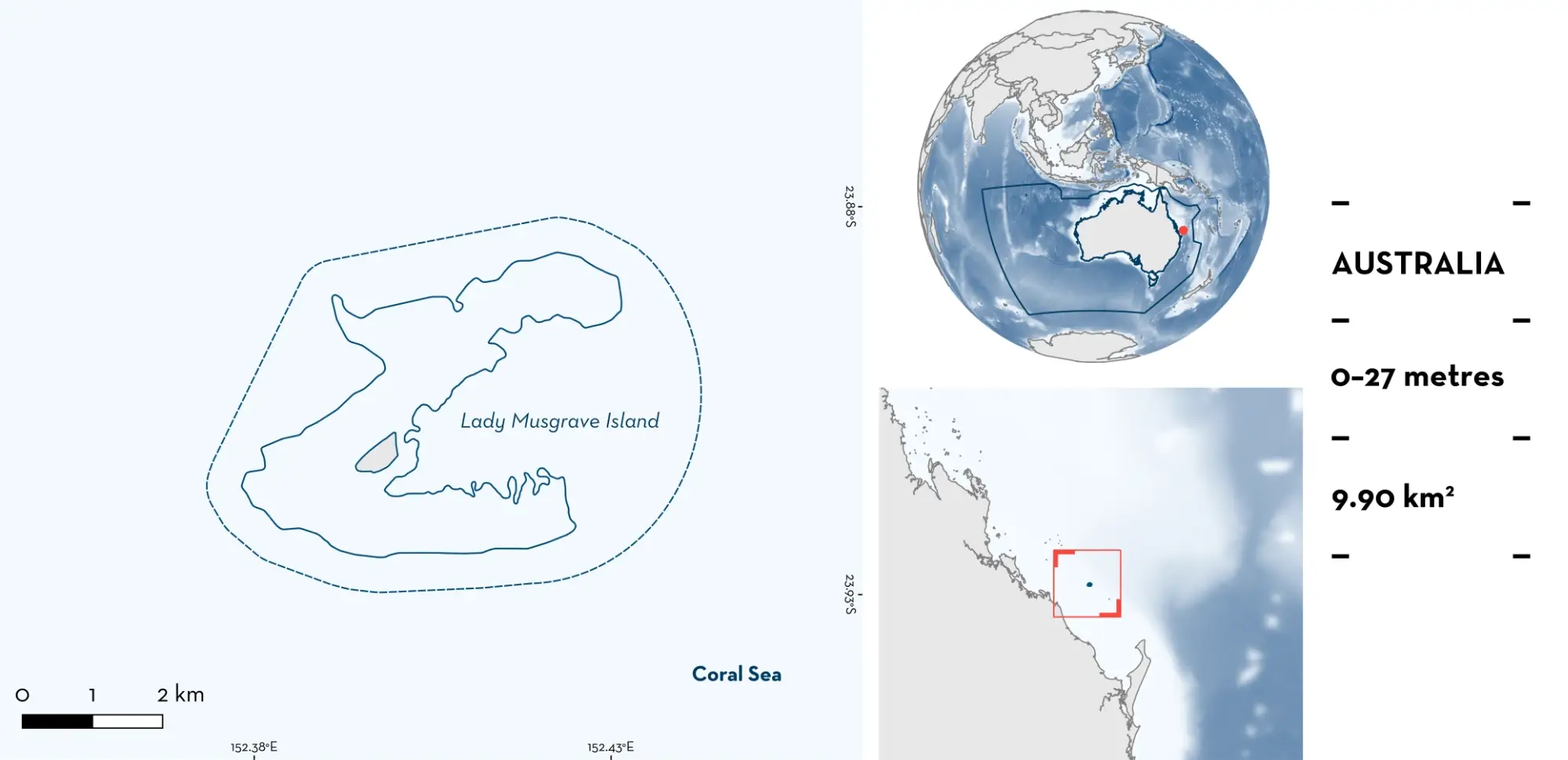
Lady Musgrave Island
Summary
Lady Musgrave Island is located in Queensland, Australia. It is part of the Capricorn–Bunker Group at the southernmost end of the Great Barrier Reef. The reef platform forms a closed ring structure enclosing a deep lagoon with remnant and scattered reef patches. The habitat includes the reef edge, the algal rim, coral, and sandy substrates. Wave energy in the area is primarily generated by the prevailing southeasterly trade winds, while currents are influenced by tidal fluctuations and the remnants of the East Australian Current. The area overlaps with the Capricornia Cays Key Biodiversity Area and Great Barrier Reef Marine Park. Within this area there are: threatened species (e.g., Blacktip Reef Shark Carcharhinus melanopterus); and undefined aggregations (e.g., Reef Manta Ray Mobula alfredi).
Download factsheet
Lady Musgrave Island
DESCRIPTION OF HABITAT
Lady Musgrave Island is located in Queensland, Australia. It is part of the Capricorn–Bunker Group, a system of scattered reefs that rise from a ridge along the ~58 m isobath on the continental shelf. It lies at the southernmost end of the Great Barrier Reef, ~56 km offshore from the Queensland coast (Hamylton et al. 2016). The reef platform forms a closed ring structure enclosing a deep lagoon with remnant and scattered reef patches. The habitat includes the reef edge, the algal rim, coral, and sandy substrates (Maxwell 1968). The northern side of the reef platform is intersected by a dredged channel, ~40 m wide and 9 m deep, constructed in the early twentieth century (Steers 1937).
Wave energy in the area is primarily generated by the prevailing southeasterly trade winds, while currents are influenced by tidal fluctuations and the remnants of the East Australian Current (Ridgway & Hill 2009). Lady Musgrave experiences a semidiurnal mesotidal regime, with a tidal range of around 2 m across the Capricorn–Bunker Group region (Hamylton et al. 2016).
The area overlaps with the Capricornia Cays Key Biodiversity Area (KBA 2025) and the Great Barrier Reef Marine Park – Marine National Park Zone (Parks Australia 2025).
This Important Shark and Ray Area is benthic and pelagic and is delineated from inshore and surface waters (0 m) to 27 m based on the bathymetry of the area.
CRITERION A
VULNERABILITY
Two Qualifying Species considered threatened with extinction according to the IUCN Red List of Threatened Species regularly occur in the area. These are the Vulnerable Blacktip Reef Shark (Simpfendorfer et al. 2020) and Reef Manta Ray (Marshall et al. 2022).
CRITERION C
SUB-CRITERION C5 – UNDEFINED AGGREGATIONS
Lady Musgrave Island is an important area for undefined aggregations of one shark and one ray species.
Opportunistic records indicate that there is regular occurrence of Blacktip Reef Shark aggregations in the shallow waters around the island. Social media records (n = 9; eight with month and year of record) are mostly aerial footage of aggregations of ~7–20 individuals spanning between October–January from 2016–2025 (2016 = 2; 2022 = 1; 2023 = 2; 2024 = 2; 2025 = 1). Additional social media records (n = 2) show Blacktip Reef Sharks chasing sea turtle hatchlings in February 2022 and January 2023 (one additional record reports Blacktip Sharks feeding but it is not possible to identify the prey).
Blacktip Reef Sharks have been reported to congregate in reef flat shallows during high tides to feed on turtle hatchlings in the Great Barrier Reef (Loop et al. 1955). This feeding behaviour has been reported from other locations, for example in the South China Sea, digestive tracts of three juvenile Blacktip Sharks were analysed and contained partially digested bodies of sea turtle hatchlings (Bashir et al. 2020). Lady Musgrave Island is one of the major nesting sites for Green Turtles (Chelonia mydas), with nesting between October–April and hatching between December–May, and it is also a nesting area for Loggerhead Turtles (Caretta caretta) with nesting between October–March and hatching between December–May (DES 2021). Further information is needed to understand the nature and function of these aggregations.
Based on recreational dive observations and a photo-identification library (Project Manta unpubl. data 2025), aggregations of Reef Manta Rays are regularly observed in this area. Between 2020–2025, aggregations of 3–4 Reef Manta Rays were regularly and predictably observed year-round during drift dives along the outer reef (J King pers. obs. 2020–2025). Aggregations were observed on ~50% of dives (~60-minute dive times), with peak activity in August (when aggregations of >4 animals are observed on ~80–90% of dives). Individuals observed are predominantly mature females, with visually estimated sizes ranging from 300–400 cm disc width (DW) and often frequenting cleaning stations where they are cleaned by cleaner wrasses (Labroides dimidiatus) (J King pers. obs. 2020–2025). Additionally, in early September 2023, one mating chain composed of three males and one female was recorded (R Long pers. obs. 2023).
Between 1980–2025, over 1,700 individual Reef Manta Rays were identified on the east coast of Australia using photo-identification (Project Manta unpubl. data 2025). This was based on 10,037 sightings from citizen science and research surveys. Between 2002–2025, within Lady Musgrave Island, 73 (4.3%) individuals were identified based on 88 sightings recorded year-round and submitted by citizen scientists. Survey effort along the east coast of Australia is not standardised; dedicated surveys were conducted at North Stradbroke Island and Lady Elliot Island, with the latter representing 69.5% of total sightings (n = 6,979). No dedicated surveys were conducted in this area. Of the Lady Musgrave Island sightings, 36 records had the behaviour recorded, with 22 animals observed cleaning (n = 22), courting (n = 8), feeding (n = 5), and cruising (n = 1; Project Manta unpubl. data 2025). A potential neonate/young-of-the-year was observed in December 2011, identified by a visual size estimate of <200 cm disc width (DW). The size-at-birth for this species is 130–150 cm DW (Last et al. 2016). One pregnancy was also recorded in August 2018, identified based a distended abdomen (Project Manta unpubl. data 2025). Further information is needed to understand the nature and function of these aggregations.
Download factsheet
SUBMIT A REQUEST
ISRA SPATIAL LAYER REQUEST
To make a request to download the ISRA Layer in either a GIS compatible Shapefile (.shp) or Google Earth compatible Keyhole Markup Language Zipped file (.kmz) please complete the following form. We will review your request and send the download details to you. We will endeavor to send you the requested files as soon as we can. However, please note that this is not an automated process, and before requests are responded to, they undergo internal review and authorization. As such, requests normally take 5–10 working days to process.
Should you have questions about the data or process, please do not hesitate to contact us.