
ISRA FACTSHEETS
ISRA FACTSHEETS
AUSTRALIA AND SOUTHEAST INDIAN OCEAN
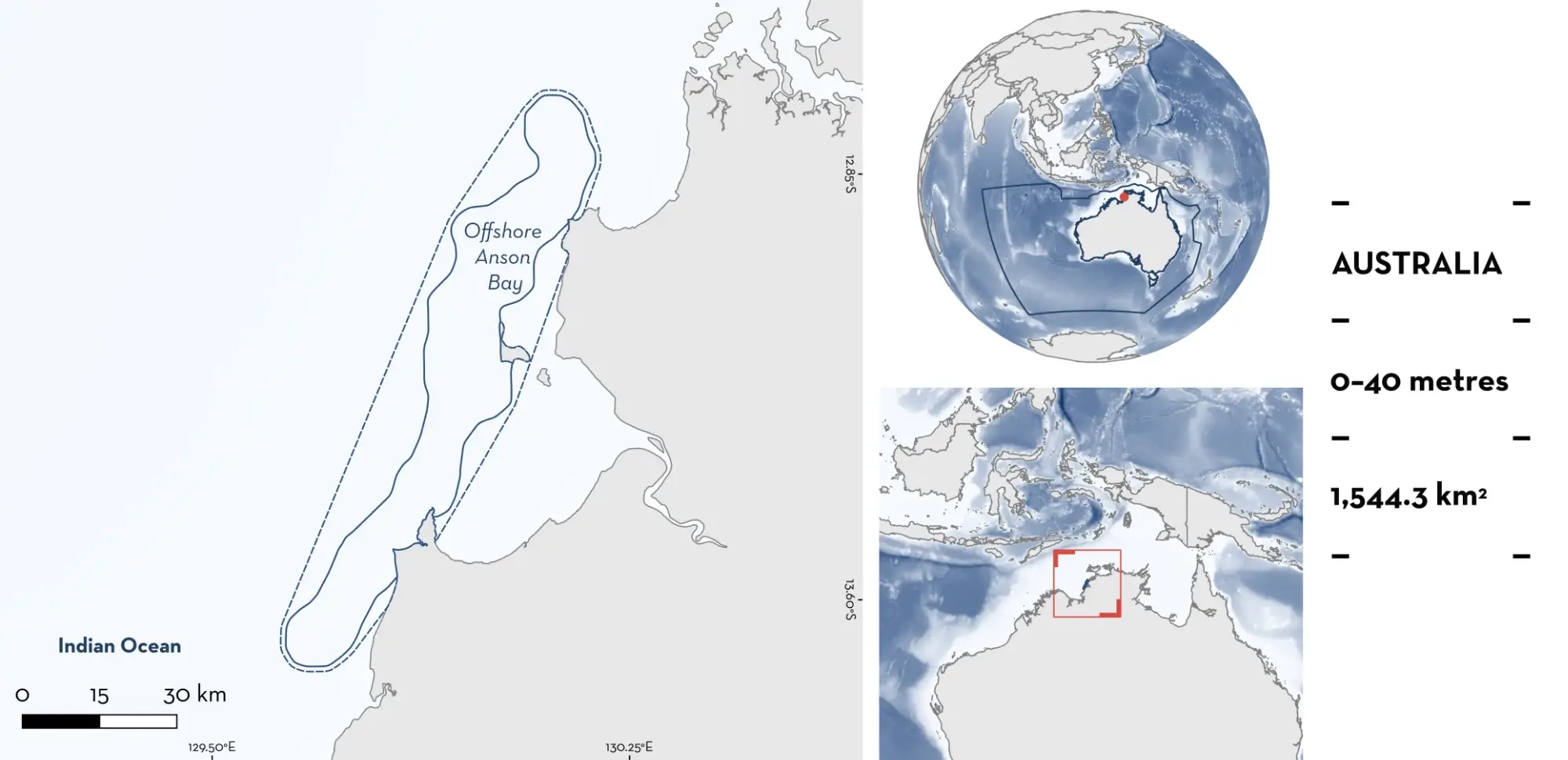
Offshore Anson Bay
Summary
Offshore Anson Bay is located off the west coast of the Northern Territory, Australia. It features shallow epipelagic waters over soft substrates and patchy reefs, with adjacent coastal zones dominated by mangrove and saltmarsh habitats. The area is influenced by strong tidal currents and seasonal freshwater inflow from the Daly River, which drive estuarine plume formation, salinity gradients, and primary productivity. Within this area there are: threatened species (e.g., Longhorned Pygmy Devil Ray Mobula eregoodoo) and undefined aggregations (e.g., Shorthorned Pygmy Devil Ray Mobula kuhlii).
Download factsheet
Offshore Anson Bay
DESCRIPTION OF HABITAT
Offshore Anson Bay is located off the west coast of the Northern Territory, Australia. The area extends from offshore of Dundee Beach to offshore of northern Thamarrurr, encompassing waters to the west of Anson Bay and the Peron Islands. It lies on the shallow tropical continental shelf, with depths mostly between 10–20 m, reaching ~40 m centrally, and consists of epipelagic waters overlying soft sediment substrates and patchy reefs (Lucieer et al. 2025). The area meets the coastline at the north and south of Anson Bay, which is dominated by mangrove and saltmarsh (Lucieer et al. 2025).
The region experiences a monsoonal climate with strong semi-diurnal tides and a tidal range exceeding 7 m, producing high current velocities and dynamic sediment transport. It is strongly influenced by the adjacent Daly River, one of the largest perennial rivers in the Northern Territory, which delivers large volumes of freshwater, sediments, and nutrients into Anson Bay during the wet season (typically November–April, peaking January–March; Cartwright et al. 2025). These seasonal pulses form plumes that extend into offshore Anson Bay, creating salinity gradients and promoting enhanced primary productivity.
This Important Shark and Ray Area is pelagic and is delineated from inshore and surface waters (0 m) to 40 m based on the depth range of habitat in the area.
CRITERION A
VULNERABILITY
Two Qualifying Species considered threatened with extinction according to the IUCN Red List of Threatened Species regularly occur in the area. These are the Endangered Longhorned Pygmy Devil Ray (Rigby et al. 2022a) and Shorthorned Pygmy Devil Ray (Rigby et al. 2022b).
CRITERION C
SUB-CRITERION C5 – UNDEFINED AGGREGATIONS
Offshore Anson Bay is important for undefined aggregations of two ray species.
Fishery-dependent data from a commercial pelagic net fishery operating in this area provide evidence for regular assemblages of Longhorned Pygmy Devil Rays and Shorthorned Pygmy Devil Rays. Since 2019, it has been a requirement that catches of this species group are reported in mandatory fishery logbooks. Animals captured have been reported as ‘pygmy devil rays’, a grouping comprised of both Longhorned Pygmy Devil Rays and Shorthorned Pygmy Devil Rays (NT DAF 2024), with Longhorned Pygmy Devil Ray being the dominant species (Notarbartolo di Sciara et al. 2020; CL Dudgeon unpubl. data 2025; J Pini-Fitzsimmons unpubl. data 2025).
Between 2018 and 2023, 952 interactions with pygmy devil rays were reported across the fishery, with annual interactions ranging between 2–408 individuals (average ± standard error = 190.4 ± 70.9 per year; NT DAF 2024). Reported interactions have increased over this period, but this is likely due to the introduction of mandatory reporting and increased awareness amongst fishers. As a result, the annual average reported catch since the 2020/2021 fishing season is 287.3 ± 66.2 individuals per year (NT DAF 2024). Hotspot analyses undertaken for the fishery’s ecological risk assessment show that >90% of interactions occurred in Offshore Anson Bay (visually estimated from the heatmap in NT DAF [2024]). Point data are not available for these interactions, but the heatmap across the fishery (which covers territorial waters of the Northern Territory apart from some spatial closures) indicates that no other fished area matches the extent of interactions seen within this area.
The environment within the area reflects the nearshore habitat preferences of these species (Broadhurst et al. 2018; Notarbartolo di Sciara et al. 2020; Fernando & Stewart 2021). The aggregative behaviour of pygmy devil ray species is well documented (Notarbartolo di Sciara et al. 2017; Carpenter 2023; Palacois et al. 2023) and has been recorded in both Longhorned Pygmy Devil Ray and Shorthorned Pygmy Devil Ray (Murie & Marshall 2016; Broadhurst et al. 2018; Palacois et al. 2023). The high level of fishery interactions in Offshore Anson Bay is considered indicative of this aggregating behaviour and is not seen on this scale elsewhere in the Northern Territory. Interactions between pygmy devil rays and the commercial pelagic net fishery operating within this area frequently involve = > 2 individuals of the same species per net (CL Dudgeon unpubl. data 2025; J Pini-Fitzsimmons pers. obs. 2025), demonstrating that the rays aggregate by species within the area. Further information is required to understand the nature and function of these aggregations.
Download factsheet
SUBMIT A REQUEST
ISRA SPATIAL LAYER REQUEST
To make a request to download the ISRA Layer in either a GIS compatible Shapefile (.shp) or Google Earth compatible Keyhole Markup Language Zipped file (.kmz) please complete the following form. We will review your request and send the download details to you. We will endeavor to send you the requested files as soon as we can. However, please note that this is not an automated process, and before requests are responded to, they undergo internal review and authorization. As such, requests normally take 5–10 working days to process.
Should you have questions about the data or process, please do not hesitate to contact us.

