
ISRA FACTSHEETS
ISRA FACTSHEETS
AUSTRALIA AND SOUTHEAST INDIAN OCEAN
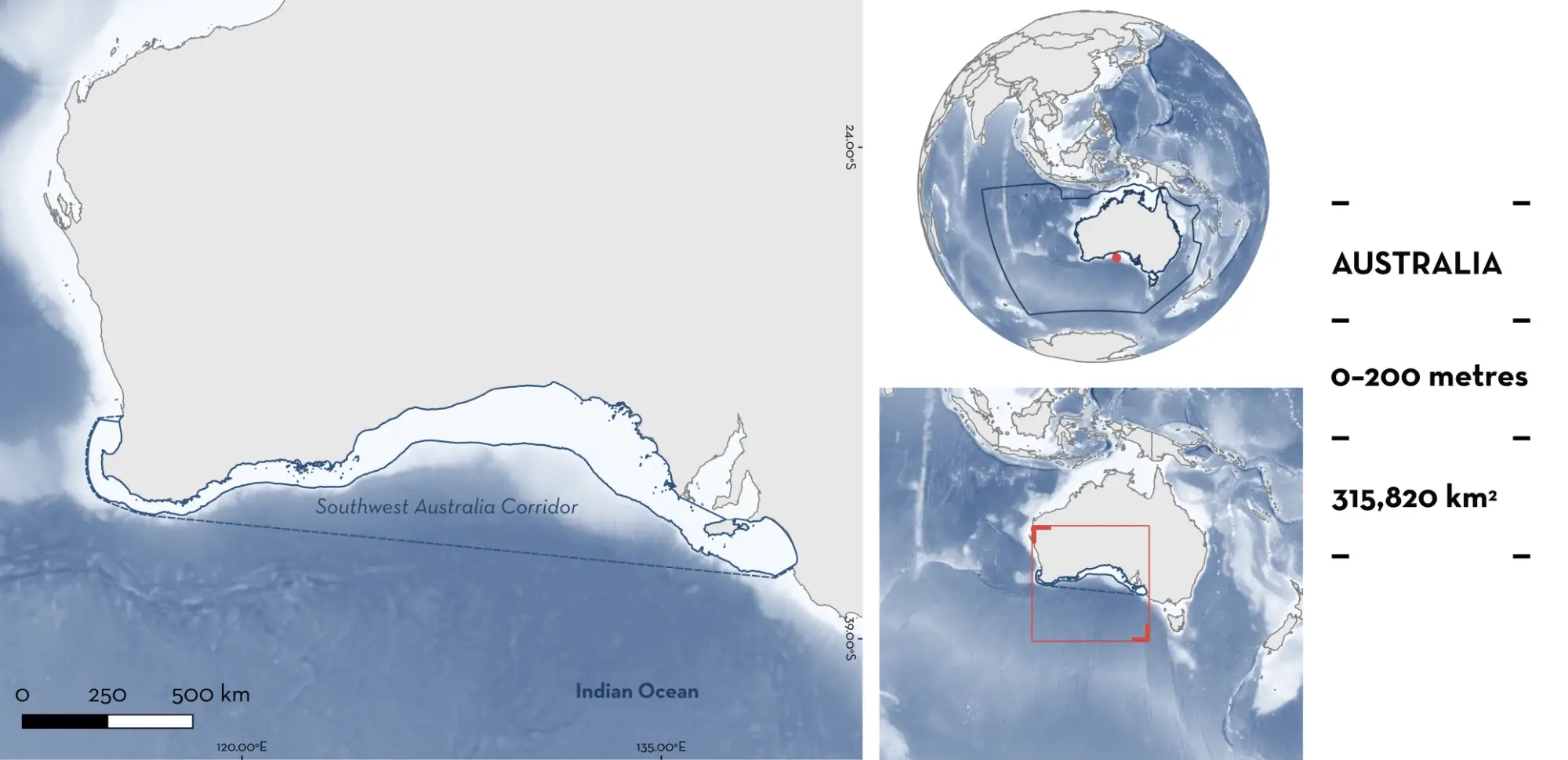
Southwest Australia Corridor
Summary
Southwest Australia Corridor stretches across the Great Australian Bight in southern Australia. It extends from Perth in Western Australia to The Pages Islands in South Australia. The area is characterised by temperate pelagic waters over seagrass patches, sandflats, shallow intertidal reef flats, and deep adjacent reefs. The area is influenced by the Leeuwin and Flinders currents and upwelling during the austral winter months. Within this area there are: threatened species and areas important for movement (White Shark Carcharodon carcharias).
Download factsheet
Southwest Australia Corridor
DESCRIPTION OF HABITAT
Southwest Australia Corridor is located off southern Australia and extends from Perth in Western Australia to The Pages Islands (Long Bay) in South Australia. The area stretches across the Great Australian Bight and encompasses pelagic waters over a diversity of temperate habitats. These include seagrass patches, sandflats, shallow intertidal reef flats, and deep adjacent reefs.
The oceanography and ecology of the region are both influenced by the Leeuwin and Flinders currents, which flow through the Great Australian Bight. The warm Leeuwin Current flows from the west during the austral winter, while the Flinders Current brings cooler water from the southeast and enhances upwelling during the winter (Richardson et al. 2019). Furthermore, seasonal upwellings of cold nutrient-rich water occur along the western side of Kangaroo Island and the Eyre Peninsula (Richardson et al. 2020). The mixing of currents and upwelling provides nutrient-rich waters that support communities of temperate species such as abundant plankton, teleosts, marine mammals, and seabirds.
This Important Shark and Ray Area is pelagic and is delineated from inshore and surface waters (0 m) to 200 m based on the depth range of Qualifying Species in the area.
CRITERION A
VULNERABILITY
One Qualifying Species considered threatened with extinction according to the IUCN Red List of Threatened Species regularly occurs in the area. This is the Vulnerable White Shark (Rigby et al. 2022).
CRITERION C
SUB-CRITERION C4 – MOVEMENT
Southwest Australia Corridor is an important movement area for one shark species.
Satellite and acoustic telemetry have shown regular movements of White Sharks between two southern Australian states by connecting aggregations sites in South Australia (i.e., Neptune Islands, The Pages Islands, Liguanea Island) and Western Australia (off Perth; Bruce & Bradford 2015; Robbins et al. 2015; McAuley et al. 2016; Schilds et al. 2019; Bradford et al. 2020).
Satellite tagging of 43 White Sharks (33 PSAT; 10 SLRT) ranging in size between 190–570 cm total length (TL) provided 3,663 days of tracking data covering a total distance of 109,900 km between 2003–2017 (Bradford et al. 2020). White Sharks tagged at the Neptune Islands (South Australia) showed long-distance dispersal with most tracks (n = 29, 67.4%) exceeding ~1,000 km and displaying westward movements to the southwest corner of Australia around Cape Leeuwin. Movements were restricted to the continental shelf, except for two mature females that moved around the continental slope. While a few White Sharks moved east to Wilsons Promontory (Victoria), most sharks did not go east of The Pages Islands (South Australia; Bradford et al. 2020). Acoustic telemetry also showed the same movement patterns. Of 171 White Sharks acoustically tagged at the Neptune Islands since 2015, 65 (38.0%) were detected off Perth, Western Australia (C Huveneers et al. unpubl. data 2025). In addition, 10 White Sharks (5.8%) were detected off Ningaloo Reef (~1,000 km north of Perth) but these movements do not occur regularly. Of a subsample of 90 White Sharks tagged in South Australia, 51 (54.2%) made back and forth movements to Western Australia and another three sharks tagged there moved to South Australia (C Huveneers et al. unpubl. data 2025). In terms of eastward movement from the Neptune Islands, 17 out of the 112 (15.2%) White Sharks tagged were detected off Portland (Victoria) since 2020 though it is unclear whether these movements are regular and part of the movement corridor.
Download factsheet
SUBMIT A REQUEST
ISRA SPATIAL LAYER REQUEST
To make a request to download the ISRA Layer in either a GIS compatible Shapefile (.shp) or Google Earth compatible Keyhole Markup Language Zipped file (.kmz) please complete the following form. We will review your request and send the download details to you. We will endeavor to send you the requested files as soon as we can. However, please note that this is not an automated process, and before requests are responded to, they undergo internal review and authorization. As such, requests normally take 5–10 working days to process.
Should you have questions about the data or process, please do not hesitate to contact us.

