ISRA FACTSHEETS
ISRA FACTSHEETS
AUSTRALIA AND SOUTHEAST INDIAN OCEAN
Two Peoples Bay
Summary
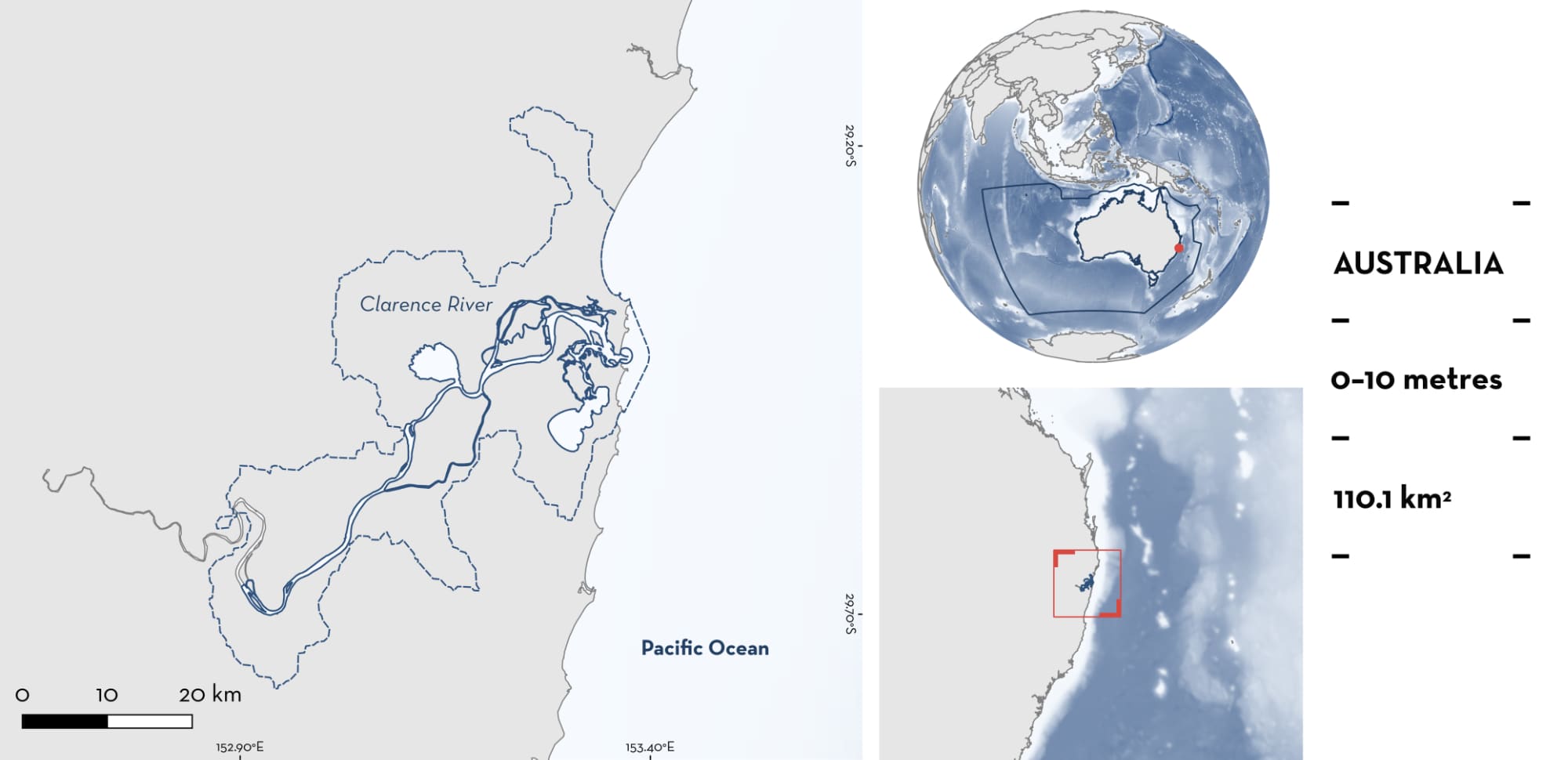
Two Peoples Bay is located on the southern coast of Western Australia, Australia. The area is characterised by perennial seagrass meadows, sand substrates, and kelp patches. The area is seasonally influenced by the southern flowing Leeuwin Current and the Flinders Current. Within the area there are: range-restricted species (Western Shovelnose Stingaree Trygonoptera mucosa).
Download factsheet
Two Peoples Bay
DESCRIPTION OF HABITAT
Two Peoples Bay is located on the southern coast of Western Australia, Australia. The area is situated in the surroundings of the Albany region and is characterised by perennial seagrass meadows, sand substrates, and kelp patches (Meeuwig & Radford 2008). This area is a mix of exposed and sheltered coastal habitats including a permanent open estuary (Oyster Harbour). In the sheltered area, phytoplankton blooms are common in late austral spring and early summer (November) as the nutrient-rich water slowly warms, and again in the early autumn (March) as the first rains bring nutrients into the system (Carruthers et al. 2007). The exposed part is characterised by the presence of strong and consistent ocean swells of 3–8 m, usually from a constant direction (south or southwest). The very high movement of water ensures that mass flow supplies CO₂ and nutrients to the seagrass, preventing carbon limitation (Carruthers et al. 2007).
The southern flowing Leeuwin Current transports warm tropical water along the south coast, strongly influencing regional circulation (Cresswell & Peterson 1993; Ridgway & Condie 2004). It intensifies during autumn and winter, suppressing upwelling, while in summer, weaker flow and prevailing southerly winds allow periodic upwelling driven by the Flinders Current (Middleton & Cirano 2002; Middleton & Platov 2003).
This Important Shark and Ray Area is benthic and is delineated from inshore and surface waters (0 m) to 80 m based on the bathymetry of the area.
CRITERION B
RANGE RESTRICTED
Two Peoples Bay holds the regular presence of Western Shovelnose Stingaree as a resident range-restricted species. Between 2006–2024, sharks and rays were recorded using benthic stereo Baited Remote Underwater Video Stations (BRUVS) between Abrolhos Bank and the Recherche Archipelago in southwest Western Australia. Kernel Density Analysis per species was extracted from the database of deployments where at least one shark or ray was recorded (Marine Futures Lab unpubl. data 2006–2024). As absence data were not available, results reflect areas of higher occurrence of records. Of 3,618 deployments in 11 locations across southwest Australia (with an average 362 deployments per location; range 154–749), 175 deployments were within this area in 2007. Benthic surveys after 2010 were only conducted outside this area, in the Recherche Archipelago (2019, 2021, 2022, 2023, 2024) and Cockburn Sound (2020, 2021). The analysis showed that this area had the highest occurrence of Western Shovelnose Stingaree across years and areas surveyed (Marine Futures Lab unpubl. data 2006–2024).
Between 2007–2022, a total of 45 BRUVS deployments recorded Western Shovelnose Stingaree in six of the 11 locations (one of which is outside the previously documented distributional range of the species), from Rottnest Island to the Recherche Archipelago (2007 = 41; 2008 = 3; 2022 = 1; Marine Futures Lab unpubl. data 2006–2024). Of these, 25 (55.6%) were from this area (all in 2007) and 13 from Ngari Capes (also in 2007), with the remaining seven from four different areas, highlighting this as the largest cluster (Marine Futures Lab unpubl. data 2006–2024). Of the 45 deployments that recorded the species, only two had two individual Western Shovelnose Stingarees in the same frame (MaxN = 2), both from this area, while the remaining were all MaxN = 1. Western Shovelnose Stingaree were recorded in 14.3% (25 of 175) of all deployments in this area, while in the remaining regions it was recorded in 0.10–1.75% of deployments.
Contemporary records from iNaturalist from 2025 (n = 7) confirm the species’ ongoing occurrence in the area (iNaturalist 2025). iNaturalist records suggest that three different individuals were observed in January 2022 and March 2022, while one individual was observed in September 2021, and one in October 2024. Additionally, in 2020, fish fauna in the nearshore and offshore waters of eight microtidal estuaries with varying extents of connectivity to the ocean in the Albany region were sampled (Krispyn 2021). Samples were collected from 12 sites (lower, middle, and upper) in each of the eight estuaries in four seasons (total n = 384) with seine and gillnet sets throughout each estuary in the same four seasons. The estuary connected to this area was the only one that recorded Western Shovelnose Stingarees (n = 2; Krispyn 2021). Western Shovelnose Stingarees are restricted to the South West Australia Shelf Large Marine Ecosystem (LME) and the West Central Australian Shelf LME.
Download factsheet
SUBMIT A REQUEST
ISRA SPATIAL LAYER REQUEST
To make a request to download the ISRA Layer in either a GIS compatible Shapefile (.shp) or Google Earth compatible Keyhole Markup Language Zipped file (.kmz) please complete the following form. We will review your request and send the download details to you. We will endeavor to send you the requested files as soon as we can. However, please note that this is not an automated process, and before requests are responded to, they undergo internal review and authorization. As such, requests normally take 5–10 working days to process.
Should you have questions about the data or process, please do not hesitate to contact us.