ISRA FACTSHEETS
ISRA FACTSHEETS
AUSTRALIA AND SOUTHEAST INDIAN OCEAN
Carnarvon Basin
Summary
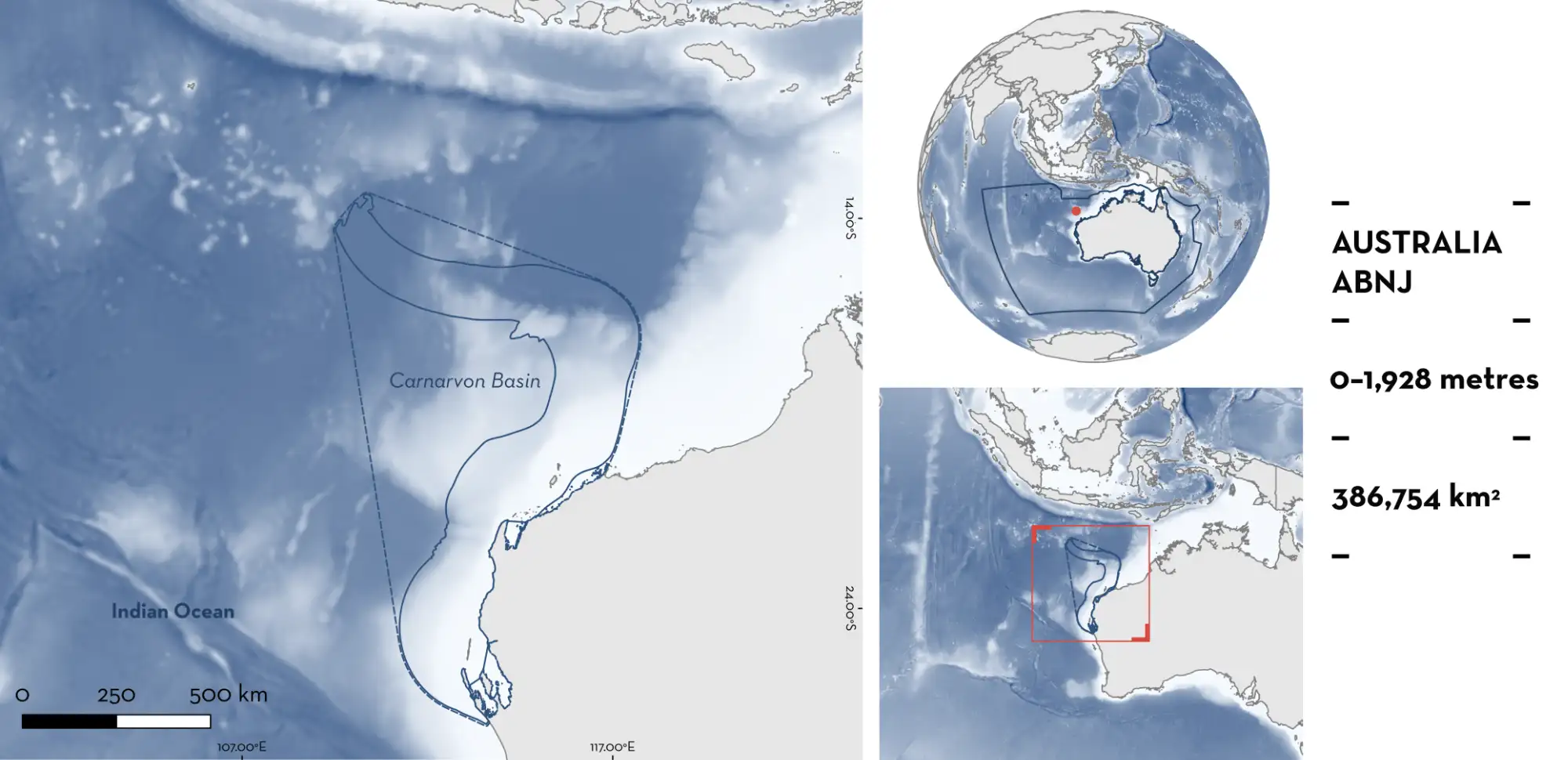
Carnarvon Basin is located off Western Australia, Australia and spans into areas beyond national jurisdiction (ABNJ). This area encompasses a transition from shallow, flat, and predominantly sandy coastal habitats to a narrow continental shelf and slope dominated by harder substrates, interspersed with numerous islands and seamounts. Offshore, the seascape grades into a steeply sloping environment punctuated by the Exmouth Plateau. It is characterised by strong tidal forcing and the generation of internal waves along the shelf break, which promote recurrent upwelling of deep waters and enhanced primary productivity. Within this area there are: threatened species and areas important for movement (Whale Shark Rhincodon typus).
Download factsheet
Carnarvon Basin
DESCRIPTION OF HABITAT
Carnarvon Basin is located off Western Australia, Australia and spans into areas beyond national jurisdiction (ABNJ). This area encompasses a transition from shallow, flat, and predominantly sandy coastal habitats to a narrow continental shelf and slope dominated by harder substrates, interspersed with numerous islands, pinnacles, and seamounts (Brewer et al. 2007). Offshore, the seascape grades into a steeply sloping environment punctuated by the Exmouth Plateau, a distinctive deepwater feature with a canyon in the northern section that rises to approximately 1,000 m depth (Brewer et al. 2007).
It is characterised by strong tidal forcing and the generation of internal waves along the shelf break, which promote recurrent upwelling of deep waters and enhanced primary productivity (Brewer et al. 2007). These mixed waters extend offshore and overlie the Exmouth Plateau, supporting the development of a persistent deep chlorophyll maximum (Brewer et al. 2007). Deep current systems associated with the initial formation of the Leeuwin Current flow off the shelf, further influencing regional circulation and productivity patterns (Holloway & Nye 1985).
Geomorphological features such as seamounts, canyons, and pinnacles are known to shape movement patterns and promote aggregations (Morato et al. 2008; Bouchet et al. 2015). This area connects Ningaloo Reef and Shark Bay in Western Australia to a concentration of intraplate seamounts in the Eastern Indian Ocean, including the Argo, Wharton, Vening-Meinesz, and Cocos-Keeling (Fallon et al. 2022). The Western Australia portion has seasonally high productivity in the austral autumn (March–May) and winter (June–August) months due to upwelling occurring at the reef front, which is close to the continental shelf (Hanson et al. 2005; Sleeman et al. 2010; Vanderklift et al. 2020).
This Important Shark and Ray Area is pelagic and is delineated from inshore and surface waters (0 m) to 1,928 m based on the global depth range of the Qualifying Species.
CRITERION A
VULNERABILITY
One Qualifying Species considered threatened with extinction according to the IUCN Red List of Threatened Species regularly occurs in the area. This is the Endangered Whale Shark (Pierce et al. 2025).
CRITERION C
SUB-CRITERION C4 – MOVEMENT
Carnarvon Basin is an important movement area for one shark species.
Satellite telemetry was used to describe the movement patterns of Whale Sharks from coastal aggregation sites used between April and September into oceanic seascapes of the Eastern Indian Ocean (Wilson et al. 2006; Sleman et al. 2010; Norman et al. 2016; Reynolds et al. 2017, 2022). Between 2005–2019, 78 Whale Sharks were instrumented with satellite linked tags during their seasonal aggregations in coastal waters at Ningaloo Reef and at Shark Bay, Western Australia during the autumn and winter (data from 66 individuals were used to delineate this area; Wilson et al. 2006; Norman et al. 2016; Reynolds et al. 2017, 2022; D’Antonio et al. 2024). Once sharks left their coastal aggregation sites (Ningaloo Reef and Shark Bay), they moved mostly along the continental shelf break of Western Australia but also into deep offshore areas and ABNJ off the southern coast of Indonesia (D’Antonio et al. 2024). Network analyses indicated that these large-scale movements were strongly structured by geomorphological features, particularly pinnacles, canyons, and seamounts, which functioned as key connectivity nodes across regional spatial scales exceeding thousands of kilometres in the Eastern Indian Ocean. Seamounts exhibited significantly higher node betweenness than other feature types, indicating a disproportionate role in facilitating connectivity across the movement network (D’Antonio et al. 2024).
The most frequent movement pathway connected Ningaloo Reef with pinnacles approximately 180 km to the north (including 64 of 66 individuals; 97.0%) and with Shark Bay approximately 324 km to the south (including 46 out of 66 individuals; 69.7%) (D’Antonio et al. 2024). The portion in this area between the pinnacles and the canyons area was used by 28 out of 66 individuals (42.4%).
Movements in the ABNJ portion (used by 10 out of 57 individuals; 17.5%) at northern end of this area, overlapped with oligotrophic spawning grounds of Southern Bluefin Tuna Thunnus maccoyii and other pelagic species in the southeastern Indian Ocean, where Whale Sharks tagged in Saleh Bay, Sumbawa, Indonesia, have also been recorded (Nieblas et al. 2014; IUCN SSC SSG 2024). These offshore areas may represent feeding opportunities associated with year-round spawning activity after sharks leave Ningaloo Reef and Shark Bay, although this has not been directly confirmed due to the remoteness of the region.
Research on Whale Shark within Ningaloo Reef spans decades with diverse methods used to examine seasonal aggregations, demographics, and foraging ecology. Overall, this area encompasses a location identified among the 25 largest aggregation sites for Whale Sharks globally (Araujo et al. 2022).
Download factsheet
SUBMIT A REQUEST
ISRA SPATIAL LAYER REQUEST
To make a request to download the ISRA Layer in either a GIS compatible Shapefile (.shp) or Google Earth compatible Keyhole Markup Language Zipped file (.kmz) please complete the following form. We will review your request and send the download details to you. We will endeavor to send you the requested files as soon as we can. However, please note that this is not an automated process, and before requests are responded to, they undergo internal review and authorization. As such, requests normally take 5–10 working days to process.
Should you have questions about the data or process, please do not hesitate to contact us.