ISRA FACTSHEETS
ISRA FACTSHEETS
NORTH AMERICAN PACIFIC
San Francisco Bay
Summary
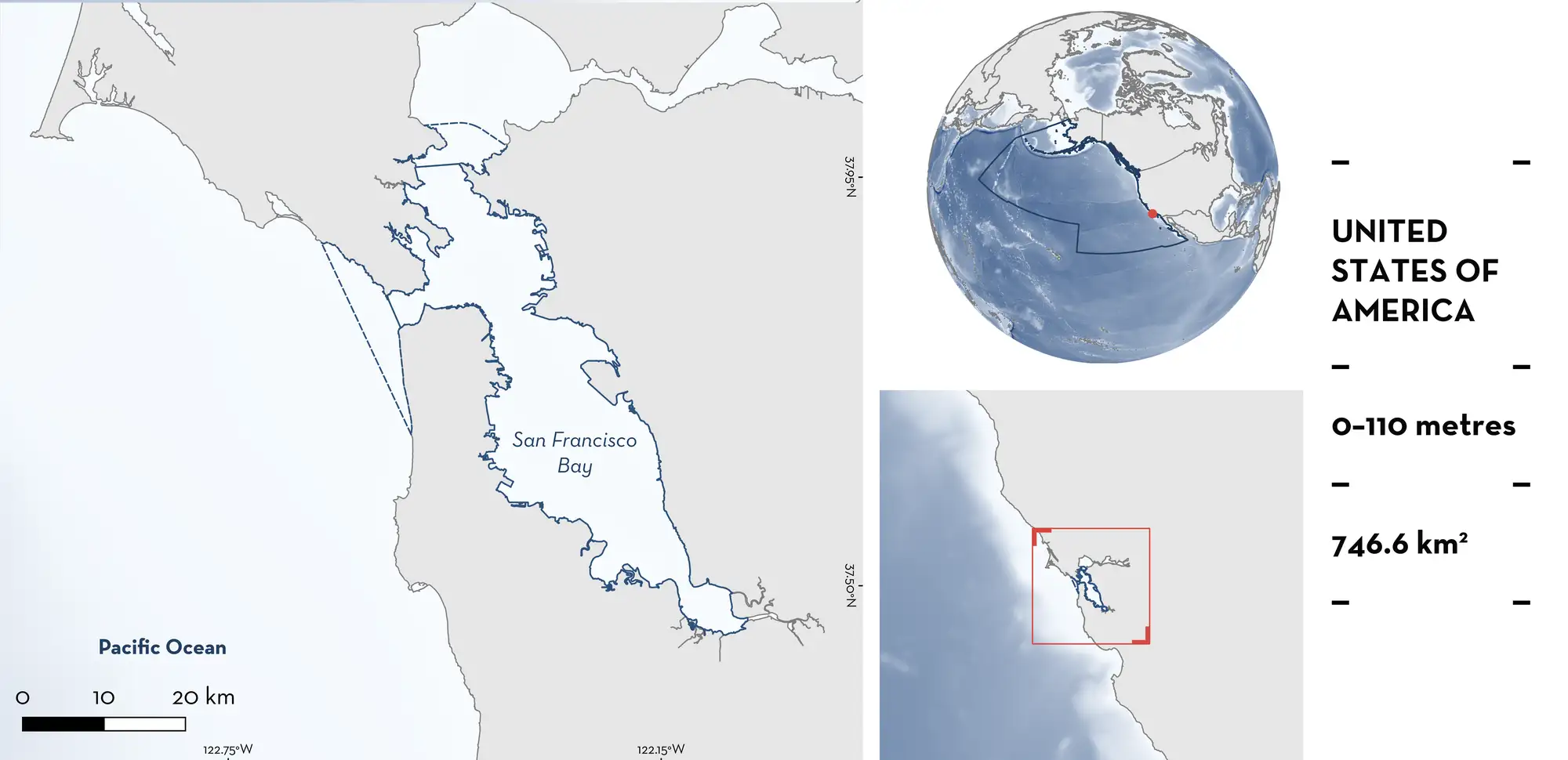
San Francisco Bay is located in California, United States of America. This area encompasses the Central Bay and the South Bay of the San Francisco Estuary and is characterised by shallow and deep waters strongly influenced by tidal flow. Within this area there are: threatened species (Broadnose Sevengill Shark Notorynchus cepedianus); and reproductive areas (e.g., Brown Smoothhound Mustelus henlei).
Download factsheet
San Francisco Bay
DESCRIPTION OF HABITAT
San Francisco Bay is located in California, United States of America. This area encompasses the Central Bay and the South Bay of the San Francisco Estuary and is characterised by shallow and deep waters strongly influenced by tidal flow. The bay includes extensive shallow habitats, eelgrass beds, and remnant tidal marshes intersected by numerous tidal sloughs (Raimonet & Cloern 2016).
The Central Bay lies between the South Bay and the northern part of the estuary, where California’s two largest rivers, the Sacramento and San Joaquin, discharge (Raimonet & Cloern 2016). It forms a relatively deep basin that is strongly influenced by water exchange with the coastal Pacific Ocean and through tidal stirring and non-tidal transport processes, maintains relatively high salinity, nutrient availability, and turbidity, particularly during the dry summer and autumn months (Cloern & Jassby 2012).
In contrast, the South Bay functions as a semi-enclosed marine lagoon where freshwater inputs are dominated by urban runoff and effluent from municipal wastewater treatment plants (Cloern & Jassby 2012). As a result, salinity commonly ranges between ~25–30, and water residence time can extend from several weeks to more than three months depending on seasonal conditions, reaching around 100 days during the dry season (Raimonet & Cloern 2016; Cloern et al. 2020).
This Important Shark and Ray Area is benthic and pelagic and is delineated from inshore and surface waters (0 m) to 110 m based on the bathymetry of the area.
CRITERION A
VULNERABILITY
One Qualifying Species considered threatened with extinction according to the IUCN Red List of Threatened Species regularly occurs in the area. This is the Vulnerable Broadnose Sevengill Shark (Finucci et al. 2020).
CRITERION C
SUB-CRITERION C1 – REPRODUCTIVE AREAS
San Francisco Bay is an important reproductive area for three shark and one ray species.
Between June 2019 and October 2023, 47 research sampling trips were conducted in the area (Holst 2024). Broadnose Sevengill Sharks were captured using hook-and-line on the incoming tide, then sexed, measured, and tagged. A total of 214 individuals were recorded, of which 143 (66.8%) were neonates and young-of-the-year (YOY; <91 cm total length; TL) and 78 were juveniles ranging from 91–150 cm TL. Size-at-birth for the species is 34–45 cm TL and YOY can be up to 100 cm TL (Ebert et al. 2021; Jaureguizar et al. 2022). Neonates and YOY were only captured in the boreal summer and autumn in the southern part of the bay, while juveniles were found year-round (M Holst unpubl. data 2026). Stable isotope analysis from pectoral fin white muscle showed inshore signals in juveniles, as δ13C and δ13N signatures matched local food-web baselines (Holst 2024), indicating extended residency during early life-stages. Given that isotopic turnover in shark white muscle is slow and integrates diet over one year (~422 days to ~95% turnover), these values reflect long-term habitat use rather than recent movements. This highlights that early life-history stages of this species are consistently using this area.
Between 1970 and 2001, scientific fishing trips within this area were conducted monthly, weather and equipment permitting (Russo 2019). Longlines, rod-and-reel, and otter trawls were used from 1970 to 1996, after which rod-and-reel was used until 2001. Sampling included 146 longline surveys, 36 rod and reel surveys, and 42 otter trawl surveys (7–15 min tows). Rod-and-reel and trawl sampling captured neonates and YOY that were not caught by longlines due to hook and mesh selectivity. Across the study, 4,121 sharks and rays were captured, including neonates and YOY Leopard Sharks and Brown Smoothhounds (Russo 2019). Between 2010–2024, 3,236 benthic otter trawl samples were conducted within the area for monthly surveys in Alviso Marsh (Lower South San Francisco Bay) and off Bair Island and Eden Landing (Middle South San Francisco Bay). A four-seam otter trawl (mouth opening: 1.5 x 4.3 m, ~6.45 m2; total length: 5.3 m), with a mesh size of 3.5 cm in the body and 0.6 cm in the codend, was deployed and towed against the prevailing tide at 3.5 km h⁻1 for 5 min (2011–2014) or 10 min (2015–2021) (Otolith Geochemistry & Fish Ecology Laboratory [OGFL] unpubl. data 2026). Between 2012–2024, 52 open-water stations in the broader San Francisco Estuary, of which 20 are in this area, were sampled monthly from a research vessel with two types of trawl gear: a midwater trawl and an otter trawl as part of the Interagency Ecological Program: San Francisco Bay Study Survey for Fish and Mobile Crustaceans started in 1980 (Hieb et al. 2025).
Between 1970–2001, 2,478 Leopard Sharks were reported from this area, including 696 neonates and YOY (28.1%). Neonate Leopard Sharks were defined as individuals within about one month of birth, with unhealed umbilical scars and measuring 16–25 cm TL, while YOY measured >25–50 cm TL and juveniles >50–80 cm TL (Russo 2019). Size-at-birth for the species is 19–30 cm TL (Ebert et al. 2021). Leopard Shark neonates and YOY primarily used marsh sloughs and channels, and to a lesser extent eelgrass meadows (Russo 2019). Between 2010–2024, 320 Leopard Sharks were captured, with most (n = 232) captured between April–October. Neonates and YOY ranging 14–50 cm TL accounted for 82.8% (n = 265) of the total catch (OGFL unpubl. data 2026). Between 2012–2024, 217 Leopard Sharks were captured in the broader San Francisco Estuary (n = 119 <50 cm TL), of which 180 were from this area (n = 110 <50 cm TL) (Hieb et al. 2025).
Between 1970–2001, 842 Brown Smoothhounds were reported from this area, including 234 neonates and YOY (27.8%). Neonate Brown Smoothhounds were defined as individuals with unhealed umbilical scars measuring 17 to <30.4 cm TL, while YOY were generally <40 cm TL (Russo 2019). Size-at-birth for the species is 17–20 cm TL (Ebert et al. 2021). Brown Smoothhound neonates and YOY were strongly associated with eelgrass habitats (Russo 2019). Between 2010–2024, 50 Brown Smoothhound were captured, with most (n = 48) captured between April–October. Neonates and YOY ranging 10–40 cm TL accounted for 98% (n = 49) of the total catch (OGFL unpubl. data 2026). Between 2012–2024, 458 Brown Smoothhounds were captured in the broader San Francisco Estuary (n = 292 <41.4 cm TL), of which 330 were from this area (n = 213 <41.4 cm TL) (Hieb et al. 2025). In 2025, at least seven Brown Smoothhounds recorded and shared on iNaturalist were visually estimated at <40 cm TL, but there are several records of neonates dating back to 2013 (iNaturalist 2026).
Between 2012–2024, 814 Bat Rays were captured in the broader San Francisco Estuary (n = 264: <40.3 cm DW), of which 693 were from this area (n = 238: <40.3 cm DW) (Hieb et al. 2025). Records by the OGFL monitoring programs also indicate the regular presence of neonate and YOY Bat Rays across multiple years. A total of 1,165 Bat Rays were captured, with most (n = 1,064) captured from April to October. Of the total number of Bat Rays captured, 779 individuals were measured for rostral length and 469 (60.2%) were neonates and YOY (17–36 cm disc width; DW). Size-at-birth for the species is 20–31 cm DW (Last et al. 2016). Additionally, feeding pits were identified in the area suggesting that this area might also be important for Bay Ray feeding (OGFL 2026). However, further information is required to understand the regularity and the importance of the area for Bat Ray feeding.
Between 2010–2024, 14 Shovelnose Guitarfish were captured, with most (n = 10) captured between April–October. Of 12 individuals that were measured, 10 (83.3%) were neonates and YOY ranging 23–47 cm TL (OGFL unpubl. data 2026). Size-at-birth for the species is 20–24 cm TL (Last et al. 2016) and neonates are typically born from June to October (Márquez-Farías 2007). Between 2012–2024, a total of 63 Shovelnose Guitarfish were captured in the broader San Francisco Estuary, with most (n = 61) captured in this area. Neonates and YOY were the majority of catches in the area (n = 40; 65.6%) ranging 16.5–44 cm (Hieb et al. 2025). All individuals within the size at-birth (n = 12 <24 cm TL) were captured in August and September (Hieb et al. 2025). Additional records of individuals in this size range are also available on iNaturalist (iNaturalist 2026). Of 58 individuals recorded in the area, 10 are visually estimated as <50 cm TL (8 are <40 cm TL) recorded in March (n = 2), April (n = 3) July (n = 4), October (n = 2), from 2016 (n =3), 2019 (n = 2), 2020 (n = 1), 2022 (n = 3), 2023 (n = 1).
Download factsheet
SUBMIT A REQUEST
ISRA SPATIAL LAYER REQUEST
To make a request to download the ISRA Layer in either a GIS compatible Shapefile (.shp) or Google Earth compatible Keyhole Markup Language Zipped file (.kmz) please complete the following form. We will review your request and send the download details to you. We will endeavor to send you the requested files as soon as we can. However, please note that this is not an automated process, and before requests are responded to, they undergo internal review and authorization. As such, requests normally take 5–10 working days to process.
Should you have questions about the data or process, please do not hesitate to contact us.