ISRA FACTSHEETS
ISRA FACTSHEETS
NORTH AMERICAN PACIFIC
Santa Barbara–San Luis Borderland
Summary
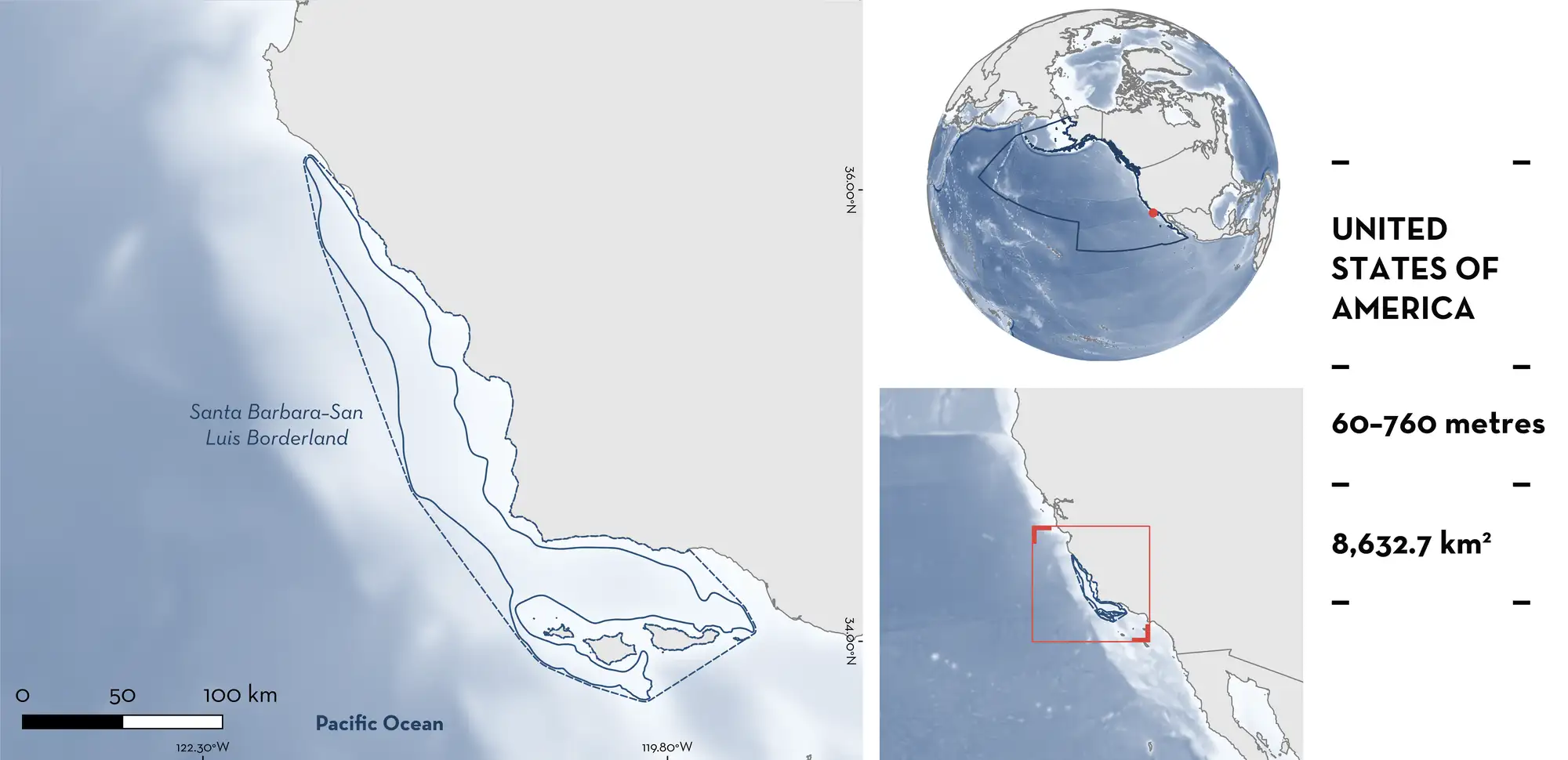
Santa Barbara–San Luis Borderland is located in California, United States of America. The area encompasses the Santa Barbara Channel, Arguello Terrace, and the continental slope between Santa Lucia Bank and San Luis Obispo County. The area is characterised by mixed sediments, rocky outcrops, and is influenced by submarine canyons, and the offshore Santa Lucia Bank. This area overlaps with ten protected areas. Within this area there are: range-restricted species (e.g., Filetail Catshark Parmaturus xaniurus); and undefined aggregations (e.g., Longnose Skate Caliraja rhina).
Download factsheet
Santa Barbara–San Luis Borderland
DESCRIPTION OF HABITAT
Santa Barbara–San Luis Borderland is located in California, United States of America (USA). The area encompasses the Santa Barbara Channel, Arguello Terrace, and the continental slope between Santa Lucia Bank and San Luis Obispo County. It is characterised by mixed sediments, rocky outcrops, and is influenced by submarine canyons, and the offshore Santa Lucia Bank. This structural complexity supports diverse benthic and pelagic communities and provides habitat for multiple life-history stages of marine species (NOAA 2024).
Oceanographic conditions are driven by wind-induced coastal upwelling, bringing cold, nutrient-rich waters to the surface and sustaining high primary productivity (Hickey 1998; Checkley & Barth 2009). Regional circulation is influenced by the equatorward California Current and subsurface poleward flows, as well as localised retention within the Santa Barbara Channel (Lynn & Simpson 1987; Hickey 1998). The area also lies within a biogeographic transition zone, where temperate and subtropical water masses interact (Checkley & Barth 2009; NOAA 2024).
This area overlaps with the Anacapa Island Federal Marine Reserve, Big Creek State Marine Reserve, Harris Point (San Miguel Island) Federal Marine Reserve, Judith Rock (San Miguel Island) State Marine Reserve, Point Conception State Marine Reserve, Richardson Rock (San Miguel Island) Federal Marine Reserve, Scorpion (Santa Cruz Island) Federal Marine Reserve, Scorpion (Santa Cruz Island) State Marine Reserve, South Point (Santa Rosa Island) Federal Marine Reserve, and South Point (Santa Rosa Island) State Marine Reserve (UNEP-WCMC & IUCN 2026).
This Important Shark and Ray Area is benthic and subsurface and is delineated from 60–760 m based on the depth range of Qualifying Species in the area.
CRITERION B
RANGE RESTRICTED
This area holds the regular presence of Filetail Catshark and Pacific Starry Skate as range-restricted species.
The West Coast Groundfish Bottom Trawl Survey (WCGBTS) is conducted annually between May –July and August–October along the USA West Coast between the USA-Canada border and the USA-Mexico border, at depths ranging from 55–1,280 m (Keller et al. 2017). The survey area is subdivided into ~12,000 equal-area grid cells, from which 188 cells are randomly selected each year within depth and latitudinal strata to ensure representative spatial sampling. All sharks and rays captured are sorted to species level (or the lowest possible taxonomic resolution) and weighed, and subsamples of selected species are measured. The trawl net used in the survey has a headrope measuring 25.9 m and a footrope measuring 31.7 m. Trawling is conducted during daylight hours at a target speed of 2.2 ± 0.5 knots, with a standard tow duration of 15 minutes (~0.55 km) (Keller et al. 2017). Between 2011–2025, 8,386 tows were conducted in the entire survey area, of which 928 were within this area (11.1%) (NOAA NWFSC FRAM 2026).
Filetail Catsharks were captured in 1,505 tows in the entire survey area (17.9% of total tows) at depths between 69–1,094 m. This species was captured in 535 tows within this area (57.7% of tows in this area) at depths between 143–748 m. The average catch-per-unit-effort (CPUE; number of individuals per square kilometre; ind/km2) for tows with Filetail Catshark outside this area was 743.3 ind/km2, while in this area it was 3,867.0 ind/km2. The average maximum number of individuals in a single tow with Filetail Catshark in this area was 67.8 (maximum = 1,324) and outside this area it was 13.7 (maximum = 208) for the same average area (0.02 km2) (NOAA NWFSC FRAM 2026).
Pacific Starry Skates were captured in 292 tows in the entire survey area (3.5% of total tows) at depths between 57–533 m. This species was captured in 108 tows within this area (11.6% of tows in this area) at depths between 64–533 m. The average CPUE for tows with Pacific Starry Skate outside this area was 92.8 ind/km2, while in this area it was 152.7 ind/km2. The average number of individuals in a single tow with Pacific Starry Skate in this area was 2.4 (maximum = 40) and outside this area it was 1.4 (maximum = 5) for the same average area (0.02 km2) (NOAA NWFSC FRAM 2026).
Filetail Catshark only occurs in the California Current Large Marine Ecosystem (LME) and Gulf of California LME, and Pacific Starry Skate only occurs in the California Current LME and Gulf of Alaska LME.
CRITERION C
SUB-CRITERION C5 – UNDEFINED AGGREGATIONS
Santa Barbara–San Luis Borderland is an important area for undefined aggregations of one shark, one ray, and one chimaera species.
The West Coast Groundfish Bottom Trawl Survey (WCGBTS) is conducted annually between May –July and August–October along the USA west coast between the USA-Canada border and the USA-Mexico border, at depths ranging from 55 to 1,280 m (Keller et al. 2017). The survey area is subdivided into ~12,000 equal-area grid cells, from which 188 cells are randomly selected each year within depth and latitudinal strata to ensure representative spatial sampling. All sharks and rays captured are sorted to species level (or the lowest possible taxonomic resolution) and weighed, and subsamples of selected species are measured. The trawl net used in the survey has a headrope measuring 25.9 m and a footrope measuring 31.7 m. Trawling is conducted during daylight hours at a target speed of 2.2 ± 0.5 knots, with a standard tow duration of 15 minutes (approximately 0.55 km) (Keller et al. 2017). Between 2011–2025, 8,338 tows were conducted in the entire survey area, of which 928 were within this area (11.1%) (NOAA NWFSC FRAM 2026).
Brown Catsharks were captured in 2,875 tows in the entire survey area (34.3% of total tows) at depths between 61–1,271 m. Within this area, this species was captured in 353 tows (38% of tows in this area) at depths between 102–757 m. The average CPUE for Brown Catshark outside this area was 749.6 ind/km2, while in this area it was 1,090.6 ind/km2. The average number of individuals in a single tow that had Brown Catshark captures outside this area was 14.5, while in this area it was 20.2 while for the same average area (0.02 km2) (NOAA NWFSC FRAM 2026). Of the 353 tows with Brown Catshark in this area, 138 (39.1%) were considered to capture aggregations as 112 tows captured 10–50 individuals, 15 captured 51–99 individuals, and 11 captured 100–739 individuals. Additionally, egg cases were recorded from five tows within this area (n = 752 egg cases) in 2012, 2014, 2015, and 2016, and 32 outside this area (n = 119 egg cases). Deepwater sharks, skates, and chimaeras are known to aggregate with temporal changes related to sex and life-stage segregations (Finucci et al. 2018). Based on specimens collected during survey cruises conducted between June 2001 and October 2004 from northern Washington to San Diego, California, depth segregation was documented in Brown Catsharks (NOAA NWFSC FRAM 2026). Additional fishery-independent bottom trawl and longline surveys targeting commercial groundfish species were conducted monthly between June 2002 and March 2004 from Davenport to Monterey, California by the Federal Ecology Division of the NOAA Fisheries Service Southwest Fisheries Science Center (SWFSC). Subadult Brown Catsharks were found significantly deeper (691 ± 8 m) than adults (580 ± 17 m), which in turn were deeper than pregnant females (440 ± 24 m; P < 0.001) (Flammang et al. 2011). Of the 352 tows with Brown Catshark in this area, 55.2% (n = 195) were between 450–600 m depth and 31.7% (n = 112) between 300–450 m depth, suggesting a higher proportion of mature individuals based on the depth layers.
Longnose Skates were captured in 5,138 tows in the entire survey area (61.6% of total tows) at depths between 2–1,184 m. This species was captured in 681 tows within this area (73.4% of tows in this area) at depths between 64–748 m. The average CPUE of Longnose Skate outside this area was 571.1 ind/km2, while in this area it was 893.5 ind/km2. The average number of individuals in a single tow that had Longnose Skate captures in this area was 15.2 (maximum = 172), while outside this area it was 9.7 (maximum = 130) for the same average area (0.02 km2) (NOAA NWFSC FRAM 2026). Of the 681 tows with Longnose Skate in this area, 270 captured 10–50 individuals, 32 captured 51–97 individuals, and 7 captured 108–172 individuals. Skates are often spatially aggregated and may be segregated by size and sex, with their distribution influenced by bottom habitat and depth, and occurring either in association with or independently of other skate species (Bizzarro et al. 2014).
Whitespotted Chimaeras were captured in 4,429 tows in the entire survey area (53.1% of total tows) between 2–959 m depth, with 477 in this area (51.4% of tows in this area) between 64.3–594.4 m depth. Based on Kernel Utilization Distribution (KUD) weighted by CPUE (number of individuals per square kilometre; ind/km2), this area is one of the only five areas with KUD >75% along the USA West Coast. Of the 100 highest CPUE along the coast (ranging 9,808.8–252,718.3 ind/km2), 25 are within this area (ranging 9,953.6–76,242.9 ind/km2). The average CPUE for the remaining 476 tows with Whitespotted Chimaera in this area was 1,254.3 ind/km2. Outside this area, the average CPUE of the remaining 3,877 tows with Whitespotted Chimaera captures (also not considering the 75 highest values) is 843.7/km2. The average maximum number of individuals in a single tow that had Whitespotted Chimaera captures in this area was 38.4, while outside this area it was 24.1 for the same average area (0.02 km2) (NOAA NWFSC FRAM 2026).
Data comprised the number of individuals and total kilograms per species in each tow, and the Precaudal Length (PCL) of Whitespotted Chimaeras was calculated based on the length-weight relationship (King & McPhie 2013). The average size of individuals in tows outside this area ranged 6–106 cm PCL, while in this area it ranged 910–54 cm PCL. Size-at-maturity for the species is 30 cm PCL for males and 39 cm PCL for females (King & McPhie 2013). Of the 477 tows with Whitespotted Chimaera in this area, 334 had the average size of individuals >30.2 cm PCL (70%) and 418 had the average size of individuals <39.3 cm PCL (87.6%) suggesting that aggregations were mainly composed of juveniles and subadults. Whitespotted Chimaeras are known to form large aggregations that can be size-specific (Barnett et al. 2009). Sharks, rays, and chimaeras can aggregate in high density areas resulting in large catches in specific areas within the broader seascape (e.g., Bizzarro et al. 2014). Elevated CPUE relative to surrounding areas can be used as an indicator of aggregations of deepwater species (Orlov & Volvenko 2022). Specifically for chimaeras, high densities of individuals have been shown to be indicative of aggregations (Finucci et al. 2018).
Further information is required to understand the nature and function of these aggregations.
Download factsheet
SUBMIT A REQUEST
ISRA SPATIAL LAYER REQUEST
To make a request to download the ISRA Layer in either a GIS compatible Shapefile (.shp) or Google Earth compatible Keyhole Markup Language Zipped file (.kmz) please complete the following form. We will review your request and send the download details to you. We will endeavor to send you the requested files as soon as we can. However, please note that this is not an automated process, and before requests are responded to, they undergo internal review and authorization. As such, requests normally take 5–10 working days to process.
Should you have questions about the data or process, please do not hesitate to contact us.