ISRA FACTSHEETS
ISRA FACTSHEETS
NORTH AMERICAN PACIFIC
Tomales Point & Point Reyes
Summary
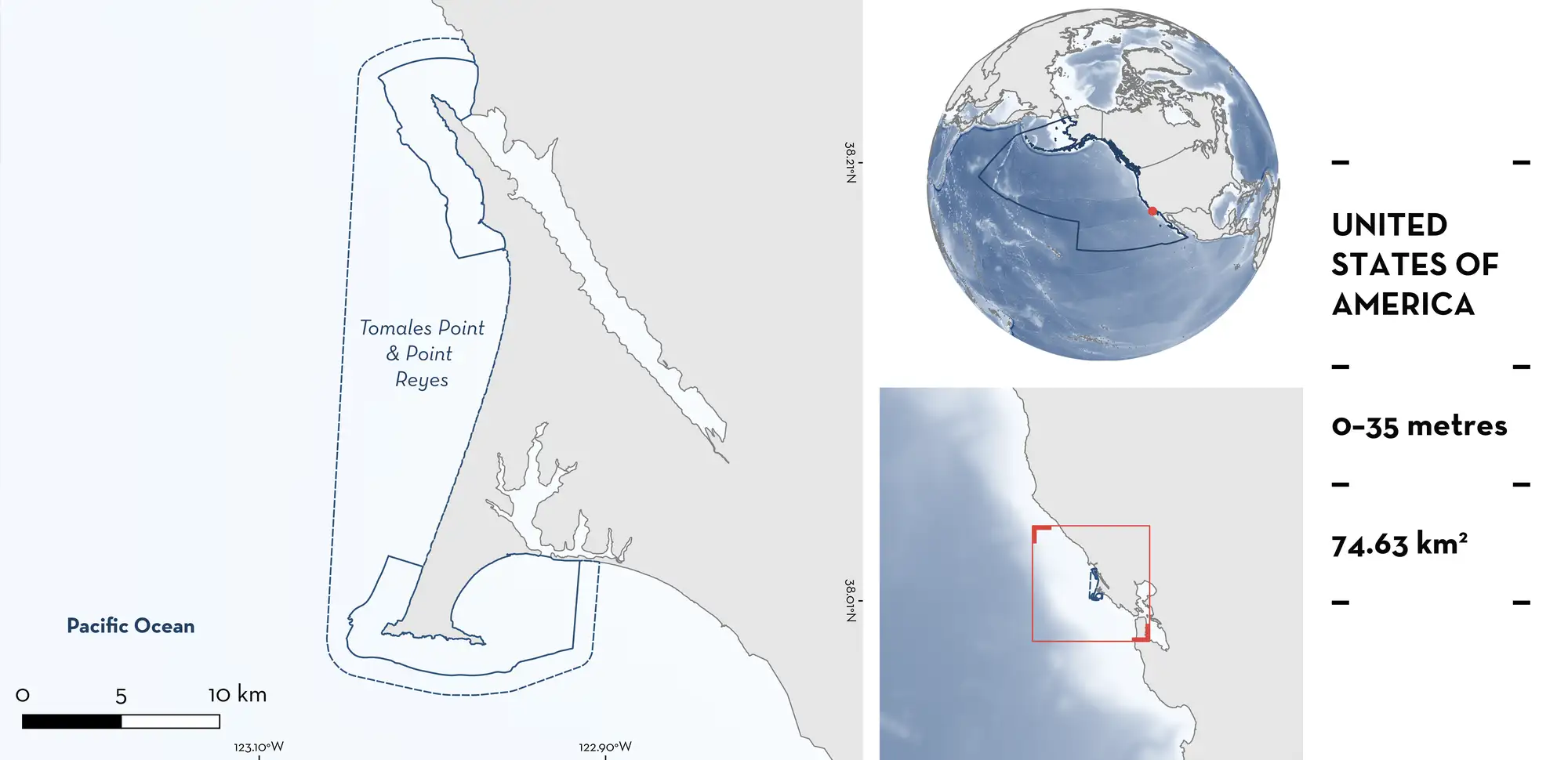
Tomales Point & Point Reyes is located in California, United States of America. This split area comprises a northern section around Tomales Point and a southern section around Point Reyes. The habitat is characterised by rocky headlands, sandy beaches, soft and hard substrates, and kelp. It is influenced by seasonal wind-driven upwelling, and by the southward-flowing California Current and the poleward-flowing Davidson Current. It overlaps with three marine protected areas. Within this area there are: threatened species and feeding areas (White Shark Carcharodon carcharias).
Download factsheet
Tomales Point & Point Reyes
DESCRIPTION OF HABITAT
Tomales Point & Point Reyes is located in California, United States of America (USA). This split area comprises a northern part around Tomales Point, which is separated from the mainland by a narrow, long estuary, and a southern part around Point Reyes, a rocky headland. The area is situated along a submerged portion of the San Andreas Fault. The coastline is characterised by steep, barren granitic cliffs and long sandy beaches. The habitat is characterised by soft sediment, rocky substrates, kelp, and rocky outcrops forming distinctive rib-like features created by differential erosion of sedimentary rock (Johnson et al. 2015).
This coastal region is influenced by wind-driven upwelling, which is strongest during the boreal spring and summer (April–July) and almost absent during winter (Harcourt-Baldwin & Diedericks 2006). Circulation is dominated by the southward-flowing California Current, with associated upwelling bringing cool, nutrient-rich water to the surface. The region experiences seasonal current reversals, with the poleward-flowing Davidson Current becoming active during autumn and winter months (Johnson et al. 2015).
This area overlaps with Point Reyes State Marine Reserve, Point Reyes State Marine Conservation Area, and Point Reyes Headlands Special Closure (California Department of Fish and Wildlife 2026).
This Important Shark and Ray Area is pelagic and is delineated from inshore and surface waters (0 m) to 35 m based on the bathymetry of the area.
CRITERION A
VULNERABILITY
One Qualifying Species considered threatened with extinction according to the IUCN Red List of Threatened Species regularly occurs in the area. This is the Vulnerable White Shark (Rigby et al. 2022).
CRITERION C
SUB-CRITERION C2 – FEEDING AREAS
Tomales Point & Point Reyes is an important feeding area for one shark species.
Sub-adult and adult White Sharks regularly and predictably feed on their pinniped prey in this area (Anderson et al. 2008; Jorgensen et al. 2010; Sherrill & Codde 2025; Andrzejaczek et al. 2025). This feeding area is located next to important California Sea Lion Zalophus californianus haul-out sites and Pacific Harbor Seal Phoca vitulina richardii and Northern Elephant Seal Mirounga angustirostris rookeries (Sherrill & Codde 2025). For example, surveys report an annual total of ~4,000–5,500 Pacific Harbour Seals during the breeding season in recent years (Sherrill & Codde 2025). Predation events are regularly observed here by pinniped monitoring groups and have been documented (Anderson et al. 2008). For example, 30 predation events and seven scavenging records were incidentally observed between 1982–2004 (Anderson et al. 2008).
Since the early 2000s to 2026, annual dedicated surveys were conducted to photo-identify individual White Sharks, estimate their size, and deploy acoustic and satellite tags to track their migrations (Jorgensen et al. 2010; Andrzejaczek et al. 2025). From 2006–2022, for instance, 355 sub-adult and adult White Sharks were tracked with acoustic tags (134 of which were tagged at Tomales Point) amounting to over 760,000 detections on a coastal array of receivers (Andrzejaczek et al. 2025). Of these, 53% of individuals and 19.1% of detections were recorded in this area, highlighting its regional importance. Tagged White Sharks predictably and regularly use this area between mid-August to mid-February, before moving into offshore waters as part of their annual migration (Jorgensen et al. 2010; Andrzejaczek et al. 2025).
From the 2000s to 2025, regular pinniped surveys were conducted across the Point Reyes National Seashore, which included counts of shark bites on hauled out Pacific Harbor Seals (Adams et al. 2009; Sherrill & Codde 2025). There were ~1,300 shark bites recorded, with up to 59 bites observed in a single month, June 2013 (Anderson et al. 2008; Sherrill & Codde 2025). Surveys are biased to the months of March–July to coincide with breeding and moulting seasons of pinnipeds, while peak White Shark activity in the area, based on acoustic telemetry monitoring, is from mid-August to mid-February (Andrzejaczek et al. 2025). The mismatch means that White Shark predation is likely underestimated in these pinniped surveys. Northern Elephant Seals are also periodically seen with fresh shark bites, but these data are not tracked (S Codde pers. comm. 2026) and, in contrast to other sites in California, this large species is not the primary prey target for White Sharks here (Anderson et al. 2008). Tomales Point & Point Reyes has the smallest average length of White Sharks (~365 cm total length; TL) across central California aggregation sites for mature individuals (Año Nuevo, ~410 cm TL; Farallon Islands, ~440 cm TL; PE Kanive unpubl. data 2026). This feeding area is primarily used by sub-adult White Sharks and juvenile White Sharks newly recruiting to pinniped hunting grounds. The size-at-maturity is defined as >450 cm TL for females and >380 cm TL for males, and subadults are >300 cm TL (Francis 1996; Pratt 1996; Tanaka et al. 2021). California Sea Lions and Pacific Harbor Seals are abundant in the area, and these smaller prey species, compared to Northern Elephant Seals, are likely better targets for smaller (210–300 cm TL) White Sharks to learn how to effectively hunt.
Download factsheet
SUBMIT A REQUEST
ISRA SPATIAL LAYER REQUEST
To make a request to download the ISRA Layer in either a GIS compatible Shapefile (.shp) or Google Earth compatible Keyhole Markup Language Zipped file (.kmz) please complete the following form. We will review your request and send the download details to you. We will endeavor to send you the requested files as soon as we can. However, please note that this is not an automated process, and before requests are responded to, they undergo internal review and authorization. As such, requests normally take 5–10 working days to process.
Should you have questions about the data or process, please do not hesitate to contact us.