ISRA FACTSHEETS
ISRA FACTSHEETS
NORTH AMERICAN PACIFIC
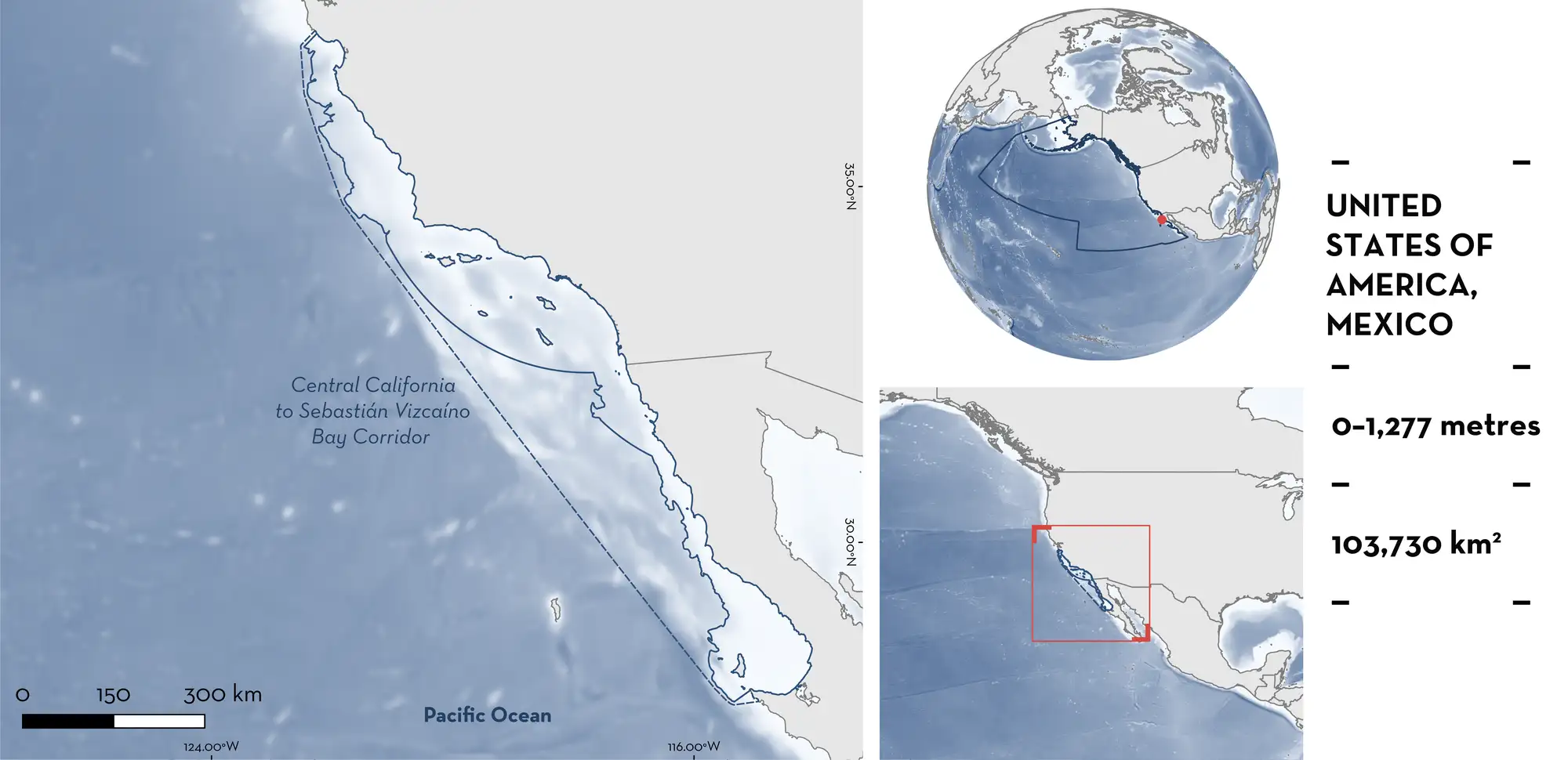
Central California to Sebastián Vizcaíno Bay Corridor
Summary
Central California to Sebastián Vizcaíno Bay Corridor is located on the Pacific Ocean coast of North America. It is a transboundary area that extends from Monterey Bay in central California, United States of America, to Sebastián Vizcaíno Bay in northwest Baja California, Mexico. The area extends from coastal waters to continental shelf, slope, and abyssal waters, encompassing a range of habitats including kelp forests, rocky reefs, sandy substrates, submarine canyons, and open ocean pelagic environments. It is influenced by the California Current system characterised by coastal upwelling. Within this area there are: threatened species and areas important for movement (White Shark Carcharodon carcharias).
Download factsheet
Central California to Sebastián Vizcaíno Bay Corridor
DESCRIPTION OF HABITAT
Central California to Sebastián Vizcaíno Bay Corridor is located along the Pacific Ocean coast of North America. This area extends from Monterey Bay in central California southward to Sebastián Vizcaíno Bay in Baja California. It is a transboundary area situated within the exclusive economic zones of the United States of America (USA) and Mexico. The area extends from coastal waters to continental shelf, slope, and abyssal waters, encompassing a range of habitats including kelp forests, rocky reefs, sandy substrates, submarine canyons, and open ocean pelagic environments.
The area is influenced by the California Current system, one of the major eastern boundary upwelling systems in the world (Carr & Kearns 2003). North-westerly winds drive coastal upwelling along the corridor, bringing cool, nutrient-rich deepwater to the surface and resulting in high primary productivity (Hickey 1979; Checkley & Barth 2009). Sea surface temperatures along the corridor typically range from approximately 10–22°C, with cooler conditions in the north and during periods of active upwelling. The southern extent of the corridor around Sebastián Vizcaíno Bay represents a temperate–subtropical transition zone. Oceanographic conditions across the corridor are subject to interannual and decadal variability driven by El Niño–Southern Oscillation and Pacific Decadal Oscillation events, which can alter water temperatures, productivity, and species distributions (Checkley & Barth 2009). In recent years, the area has been subject to prominent marine heatwaves, with prolonged periods of anomalously high sea surface temperatures in the north of the area (Tanaka et al. 2021).
This Important Shark and Ray Area is pelagic and is delineated from inshore and surface waters (0 m) to 1,277 m based on the global depth range of the Qualifying Species.
CRITERION A
VULNERABILITY
One Qualifying Species considered threatened with extinction according to the IUCN Red List of Threatened Species regularly occurs in the area. This is the Vulnerable White Shark (Rigby et al. 2019).
CRITERION C
SUB-CRITERION C4 – MOVEMENT
Central California to Sebastián Vizcaíno Bay Corridor is an important movement area for White Sharks.
The area is a regular movement corridor for juvenile and sub-adult northeast Pacific Ocean White Sharks (Weng et al. 2007; White et al. 2019; Spurgeon et al. 2022; Freedman et al. 2023; Logan et al. 2024; Anderson et al. 2026; AE DiGiacomo et al. unpubl. data 2026; BA Block unpubl. data 2026; CG Lowe unpubl. data 2026). Research groups at Stanford University, California State University Monterey Bay (CSUMB), and California State University Long Beach (CSULB Shark Lab) tagged White Sharks at aggregation sites within the area (Monterey Bay, n = 14; Southern California Bight, n = 79) with acoustic transmitters from 2022–2025 and tracked 93 individuals ranging in size from 137–427 cm total length (TL; mean = 225.5 ± 48.7 cm TL) for over one year. An acoustic receiver array (82 receivers) across central and southern California, with receivers located within 300 m of the shoreline, indicated that much of the intra-regional movements follow the coastline. By contrast, adult White Sharks seasonally migrate between coastal waters of California and Baja California and offshore waters >2,000 km from the coast (Jorgensen et al. 2010). Tracked juvenile White Sharks exhibited considerable inter- and intra-regional movements among nursery hotspot areas in Monterey, Santa Barbara, Santa Monica Bay, Huntington Beach, Del Mar, and Sebastián Vizcaíno Bay, Mexico. Within a year, 35–50% of acoustically tagged individuals were detected in both central and southern Californian regions of the movement corridor. In total, 34 of 93 individuals (37%) of acoustically tracked individuals moved between central and southern Californian sites. In addition, of 10 neonate/young-of-the-year/juvenile White Sharks tagged at Sebastián Vizcaíno Bay with acoustic transmitters, seven were detected on receivers deployed in California and came back to Mexican waters the following year (García-Rodríguez 2020).
In a second study, 38 juvenile White Sharks (134–290 cm TL) were tracked with satellite tags (SPOT and PAT) between 2003 and 2020, yielding 10,442 quality-filtered positions (O’Sullivan et al. 2022). Track duration was shorter than for acoustic tags, with a mean of 173 days. Of these 38 individuals, 17 sharks (45%) connected Mexican and Californian waters over the track duration, demonstrating regular use of the movement corridor between central California and the Baja California peninsula. Three sharks used the full extent of the corridor, travelling between Monterey Bay in central California and Sebastián Vizcaíno Bay in Mexico, a straight-line distance of >1,000 km. A further nine sharks connected the Southern California Bight with Sebastián Vizcaíno Bay, while two additional sharks moved between central and southern California. Site-level analysis revealed that the Southern California Bight was the most heavily used area (32 of 39 sharks), followed by the Santa Barbara/Ventura region (20 sharks), and Sebastián Vizcaíno Bay (17 sharks). Movements into Mexican waters occurred predominantly between November and April, with sharks returning north to California during boreal summer months, indicating that temperature may be a driver of these movements. Kernel Utilisation Distribution analysis identified two large core-use hotspots (50% KUD): one in the Southern California Bight and a second encompassing Sebastián Vizcaíno Bay and the waters around Cedros Island. Their movements were concentrated in shelf and slope waters, but also included deeper areas, particularly in the Southern California Bight (O’Sullivan et al. 2022).
Young-of-the-year and juvenile White Sharks of the northeast Pacific Ocean are most commonly observed in shallow, nearshore beach environments of southern California and Baja California, generally remaining south of Point Conception, within this area (Klimley 1985; Weng et al. 2007; Oñate-González et al. 2017; White et al. 2019). However, increasing numbers of juvenile White Sharks have been sighted in Monterey Bay coastal habitats, at the northern boundary of this area, following the 2014–2016 heatwave (Tanaka et al. 2021) and have been observed there in regional annual surveys and detected on acoustic receivers since. As individuals grow, they spend more time in northern sites and eventually recruit to adult aggregation sites (Año Nuevo, Farallon Islands, Tomales Point, and Point Reyes; Logan et al. 2024) located outside of this area. This movement corridor is important for juvenile White Sharks, connecting coastal nursery sites and encompassing seasonal movements along the coast.
Download factsheet
SUBMIT A REQUEST
ISRA SPATIAL LAYER REQUEST
To make a request to download the ISRA Layer in either a GIS compatible Shapefile (.shp) or Google Earth compatible Keyhole Markup Language Zipped file (.kmz) please complete the following form. We will review your request and send the download details to you. We will endeavor to send you the requested files as soon as we can. However, please note that this is not an automated process, and before requests are responded to, they undergo internal review and authorization. As such, requests normally take 5–10 working days to process.
Should you have questions about the data or process, please do not hesitate to contact us.