ISRA FACTSHEETS
ISRA FACTSHEETS
NORTH AMERICAN PACIFIC
San Quintín Bay
Summary
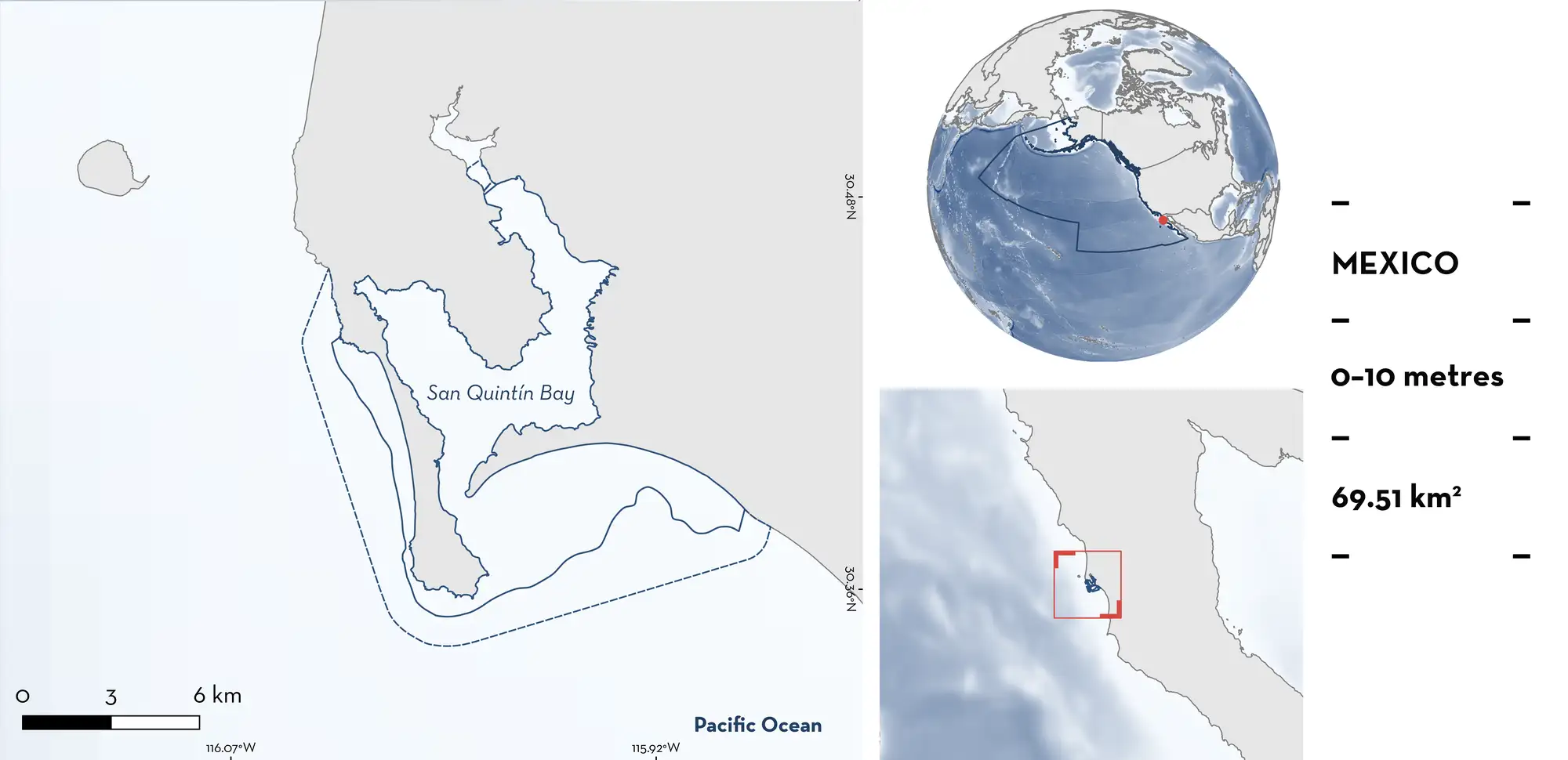
San Quintín Bay is located in northwest Baja California, Mexico. It is a shallow coastal lagoon characterised by sandflats, muddy, slime, and sandy substrates, and a high coverage of seagrass meadows. The area is influenced by tide dynamics and by upwellings during the boreal spring. Within this area there are: range-restricted species (e.g., Thornback Ray Platyrhinoidis triseriata).
Download factsheet
San Quintín Bay
DESCRIPTION OF HABITAT
San Quintín Bay is located in northwest Baja California, Mexico. The area is a shallow coastal lagoon with deep channels reaching 10 m and two arms: False Bay (west arm) and San Quintín (east arm). The bay opens to the sea trough with a 1 km wide mouth. The area is characterised by sandflats, muddy and slime substrates in the inner part, and sandy substrates near the mouth. Seagrass meadows of Common Eelgrass Zostera marina dominate in the inner part of the area around subtidal flats (Camacho-Ibar et al. 2003; Ward et al. 2003).
The area is influenced by tide dynamics with a tidal amplitude of ~2 m during spring tides (Camacho-Ibar et al. 2003). Dynamics in the area are like those of an inverse estuarine system, with lower temperatures and salinities near the mouth. Water from upwellings flow into the area during boreal spring and summer (Ribas-Ribas et al. 2011).
This Important Shark and Ray Area is benthic and pelagic and is delineated from inshore and surface waters (0 m) to 10 m based on the bathymetry of the area.
CRITERION B
RANGE RESTRICTED
This area holds the regular presence of Shovelnose Guitarfish and Thornback Ray as resident range-restricted species. Both species were recorded inside the bay and near the mouth during surveys conducted in the area between 1993–1996 using beam trawl, otter trawl, beach seine, gillnet, and hook-and-line fishing gear (Rosales-Casián 1996, 2004). Since then, no surveys have been conducted in the area, but the presence of these species has been confirmed in Baited Remote Underwater Video Station (BRUVS) surveys (E García-Rodríguez et al. unpubl. data 2026). Sixty BRUVS were deployed seasonally (June, October, January, April) between 2022–2023 (E García-Rodríguez et al. unpubl. data 2026). BRUVS were deployed inside the area (n = 20), in the outer part of the bay (n = 20), and around San Martín Island (n = 20; ~1o km north). During these surveys, both species were only recorded inside this area and were associated with sandy and muddy substrates with seagrass patches. Shovelnose Guitarfish were recorded in five (25%) of the BRUVS deployed inside the area in summer and autumn, with the maximum number of individuals observed in a single frame (MaxN) of 1–3 individuals (three instances with MaxN = 2–3 individuals). Thornback Rays were recorded in nine (45%) of the BRUVS deployed in the area in summer and autumn, with MaxN of 1–3 individuals (five instances with MaxN = 2–3 individuals). Both species are known to aggregate in shallow bays and lagoons (Farrugia et al. 2011; Last et al. 2016; Medina-Trujillo 2021), and San Quintín Bay is the only bay/lagoon area in the region with the closest being Punta Banda (~150 km north) and Bahía Sebastián Vizcaíno (~300 km south). These species occur in the California Current Large Marine Ecosystem (LME) and in the Gulf of California LME.
Download factsheet
SUBMIT A REQUEST
ISRA SPATIAL LAYER REQUEST
To make a request to download the ISRA Layer in either a GIS compatible Shapefile (.shp) or Google Earth compatible Keyhole Markup Language Zipped file (.kmz) please complete the following form. We will review your request and send the download details to you. We will endeavor to send you the requested files as soon as we can. However, please note that this is not an automated process, and before requests are responded to, they undergo internal review and authorization. As such, requests normally take 5–10 working days to process.
Should you have questions about the data or process, please do not hesitate to contact us.