ISRA FACTSHEETS
ISRA FACTSHEETS
NORTH AMERICAN PACIFIC
Shelikof Strait
Summary
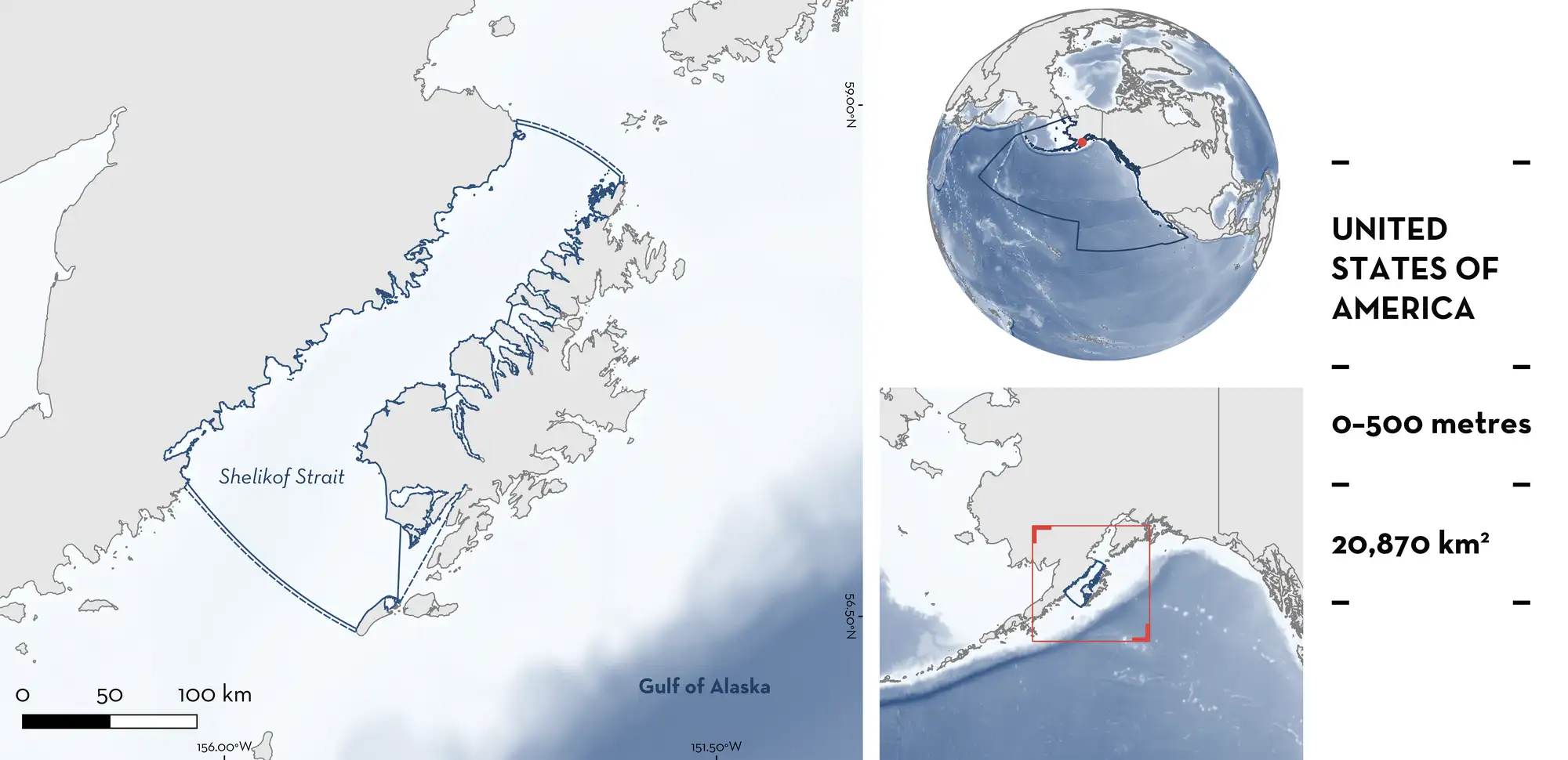
Shelikof Strait is located in Alaskan waters of the United States of America. It is situated in southwest Alaska, between the Alaska Peninsula and Kodiak Island. The area is characterised by high-productivity waters and escarpments, and strong eddy and upwelling activity that promotes primary productivity. Within this area there are: undefined aggregations (Pacific Sleeper Shark Somniosus pacificus).
Download factsheet
Shelikof Strait
DESCRIPTION OF HABITAT
Shelikof Strait is located in Alaskan waters of the United States of America. It is situated in southwest Alaska, between the mainland of the Alaska Peninsula to the west and Kodiak Island to the east. Its northern end is Cook Inlet, and the southern end is the Shelikof Sea Valley. The area is characterised by high-productivity waters and the presence of escarpments (Zimmerman et al. 2019; Mordy et al. 2023).
The area is influenced by the Alaska Coastal Current, a nutrient-rich current that flows down the strait and into the Shelikof Sea Valley producing upwelling events and an estuarine-like circulation. Bathymetric conditions in the strait creates eddies that also enhance productivity (Schumacher et al. 1993; Mordy et al. 2023). Current speeds increase during the boreal autumn when freshwater discharges flow into the Alaska Coastal Current. The area experiences extreme tidal flow due to its close proximity to Cook Inlet, which can have maximum tidal variances of up to 12 m (Stabeno et al. 2004; Mordy et al. 2023).
This Important Shark and Ray Area is benthic and pelagic and is delineated from inshore and surface waters (0 m) to 500 m based on the bathymetry of the area.
CRITERION C
SUB-CRITERION C5 – UNDEFINED AGGREGATIONS
Shelikof Strait is an important area for undefined aggregations of one shark species.
Between 1998–2025, the International Pacific Halibut Commission conducted annual longline surveys during summer across nearshore and offshore waters from Southern California to Alaska waters (Gulf of Alaska, Aleutian Islands, and Bering Sea; IPHC 2026a). Surveys were conducted at ~1,200 stations each year at depths of 15–500 m. Longlines consisted of 4–8 skates (longline units) with 96–104 hooks per skate with soak times between 5–24 hours (IPHC 2026b). Non-halibut species were counted either as subsample counts (20% of observations, where the majority for sharks are considered) and whole-set counts (100% observations). Nominal catch-per-unit-effort (CPUE) was estimated as the number of individuals caught per 100 hooks per hour.
Between 1998–2025, aggregations of Pacific Sleeper Sharks were regularly recorded in this area. During this period, Pacific Sleeper Sharks were recorded in 3,455 sets during longline surveys across the whole region, 987 (28.6%) of which were recorded inside this area during the months of June–August across all surveyed years and at depths of 22–168 m (IPHC 2026a). Individuals were counted in subsamples (20% of the observations) in 3,292 sets (95.3% of total) suggesting that abundances reported reflects an underestimate of the total catches for this species in this fishery. The second highest mean CPUE of Pacific Sleeper Sharks in the region was reported from this area (mean = 0.08 individuals/100 hooks/hour; 0.006–0.615) compared to adjacent areas in the region (mean CPUE outside the area = 0.04 individuals/100 hooks/hour; 0.006–0.450) after Prince William Sound. Multiple individuals (>10) were recorded in 144 sets (14.6% of the sets with the species captured inside this area) with 25 individuals being the maximum number recorded in a single set (mean 4.8 individuals/set). In addition, this area has been highlighted as important to Pacific Sleper Sharks due to the large catches (biomass) according to commercial fisheries data collated from non-pelagic trawl gears (Tribuzio et al. 2022). High abundances for Pacific Sleeper Sharks have been associated with aggregations of the species (Matta et al. 2024). Additional information is required to understand the nature and function of these aggregations.
Download factsheet
SUBMIT A REQUEST
ISRA SPATIAL LAYER REQUEST
To make a request to download the ISRA Layer in either a GIS compatible Shapefile (.shp) or Google Earth compatible Keyhole Markup Language Zipped file (.kmz) please complete the following form. We will review your request and send the download details to you. We will endeavor to send you the requested files as soon as we can. However, please note that this is not an automated process, and before requests are responded to, they undergo internal review and authorization. As such, requests normally take 5–10 working days to process.
Should you have questions about the data or process, please do not hesitate to contact us.