ISRA FACTSHEETS
ISRA FACTSHEETS
CENTRAL AND SOUTH AMERICAN PACIFIC REGION
Rapa Nui
Summary
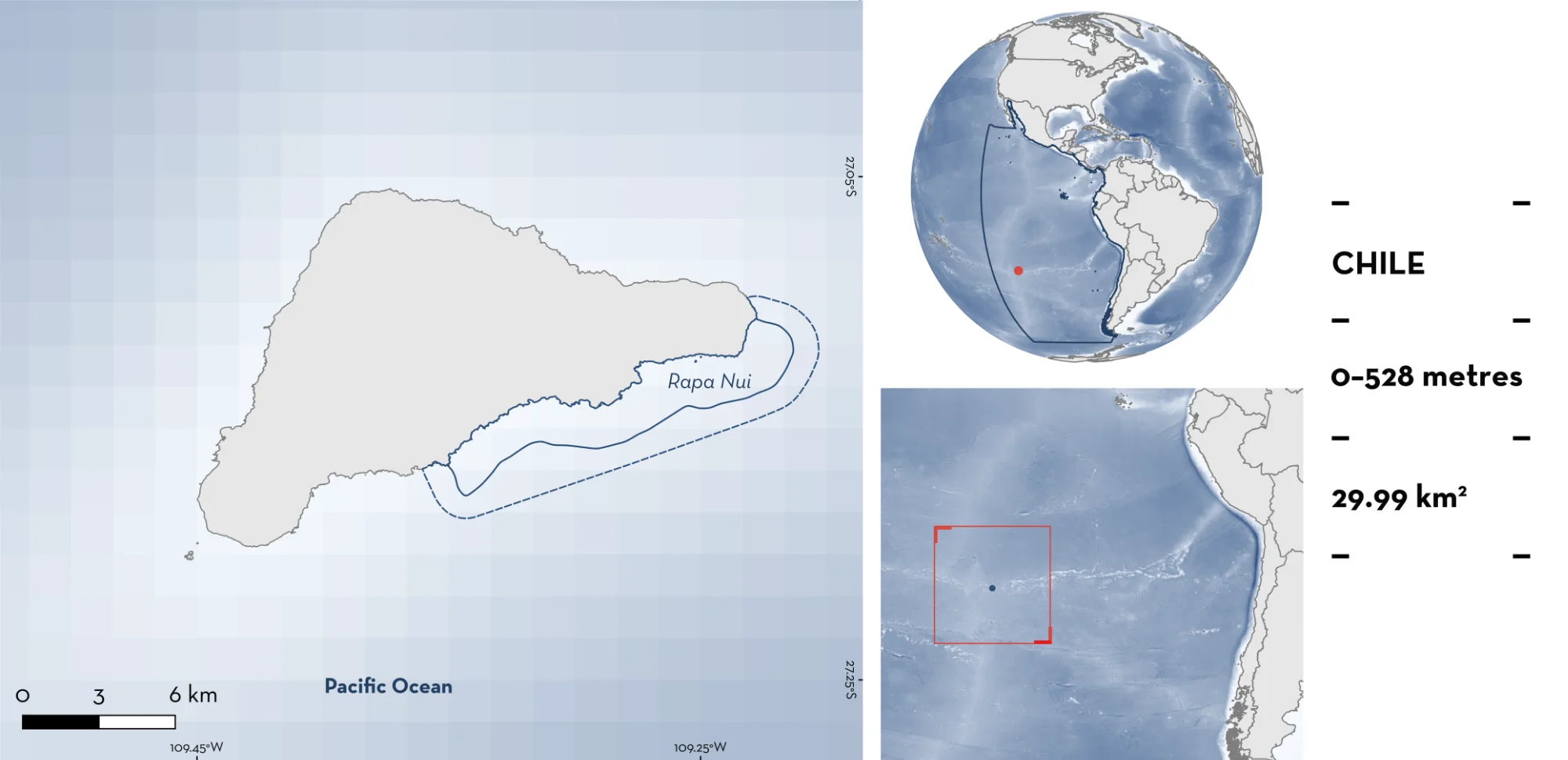
Rapa Nui is located around southeastern Rapa Nui Island (Easter Island), Chile, in the Southeast Pacific Ocean. This remote island lies on the Salas y Gómez Ridge, along with Salas y Gómez Island and several dozen seamounts. This area is characterised by rocky shores, sandy substrates, and coral reefs. The area overlaps with the Multiple Uses Coastal Marine Protected Area of Rapa Nui and the Salas y Gómez and Nazca Ridges Ecologically or Biologically Significant Marine Area. Within this area there: reproductive areas (Galapagos Shark Carcharhinus galapagenis).
Download factsheet
Rapa Nui
DESCRIPTION OF HABITAT
Rapa Nui (also known as Easter Island) is located in the Valparaíso province, Easter Island ecoregion of Chile, in the Southeast Pacific Ocean. This remote isolated island is located 2,250 km east of Pitcairn Island and 3,760 km southwest of mainland Chile. The nearest island is Isla Salas y Gómez (~400 km east), an uninhabited volcanic outcrop. Together, both islands are the only two exposed landmasses of the numerous submerged volcanic seamounts that make up the 2,232 km-long Salas y Gómez Ridge (Ray et al. 2012; Friedlander et al. 2013). Rapa Nui is the southeasternmost coral reef ecosystem in the Pacific Ocean and harbors a unique fish assemblage with a high level of endemism (Randall & Cea 2010; Wagner et al. 2021). The marine habitats around the island include rocky shores, sandy substrates, and coral reefs.
The coastline of the area is influenced by wave and wind energy exposure. The Easter Island Ecoregion experiences oligotrophic conditions, yet coastal upwelling around this oceanic island creates a distinctive habitat that can sustain marine predators (Andrade et al. 2014).
The area overlaps with the Multiple Uses Coastal Marine Protected Area of Rapa Nui and the Salas y Gómez and Nazca Ridges Ecologically or Biologically Significant Marine Area (EBSA; CBD 2026).
This Important Shark and Ray Area is benthic and pelagic and is delineated from inshore and surface waters (0 m) to 528 m based on the global depth range of Qualifying Species.
CRITERION C
SUB-CRITERION C1 – REPRODUCTIVE AREAS
Rapa Nui is an important reproductive area for one shark species.
The occurrence of early life-stage Galapagos Sharks has been regularly and predictably documented during 2015–2024 through independent monitoring efforts, demonstrating temporal persistence in the use of this area. A total of 192 Baited Remote Underwater Video Stations (BRUVS) were deployed at 30 m depth around the island during 2016–2017 (72 BRUVS within the area). Deployments were conducted across four seasons: August–September (austral winter) 2016, November–December (spring) 2016, March (summer) 2017, and May–June (autumn) 2017 (Morales et al. 2019). Total lengths of sharks on BRUVS were estimated using the software EventMeasure (SeaGIS).
Galapagos Sharks were the third most abundant pelagic fish recorded during these deployments, and the only recorded shark species (Morales et al. 2019). Across the Eastern Tropical Pacific, four other oceanic islands (Salas y Gómez, Galápagos, Revillagigedo, Cocos) have estimated MaxN (the maximum number of individuals visible at one time) for Galapagos Sharks (Morales et al. 2019; Morales-Serrano & Gonzalez-Pestana 2024). Rapa Nui showed the highest MaxN values (MaxN = 21) compared to those areas (Salas y Gómez, MaxN = 8; Galápagos, MaxN = 8; Revillagigedo, MaxN = 6; Cocos, MaxN = 8; Morales-Serrano & Gonzalez-Pestana 2024). Although Galapagos Sharks were observed around the entire island, most records (91%; 103/112) occurred within this area. The size-at-birth of this species is 57–81 cm total length (TL; Ebert et al. 2021) and it is likely that young-of-the-year (YOY) measure upward to ~110 cm TL (Morales-Serrano & Gonzalez-Pestana 2024). Higher abundances of early life-stage sharks were consistently recorded year-round along the southeast coast (Morales et al. 2019), where 77% of measured individuals (n = 51) were < 110 cm TL (Morales 2017).
Landing observations in Rapa Nui have also documented over 40 YOY Galapagos Sharks year-round from 2015–2024 (N Morales-Serrano unpubl. data 2025). Additionally, neonates (n = 14; ~80 cm TL) exhibiting visible umbilical scars were recorded in February (n = 9) and July 2025 (n = 5) (N Morales-Serrano et al. unpubl. data 2025). This pattern is further supported by a 2025 study based on Local and Traditional Ecological Knowledge, in which 25 fishers and divers were interviewed. All respondents reported having observed sharks around the island, including early life-stages throughout the year, particularly in shallow waters (< 5 m depth) within this area. Participants also reported the presence of large females in nearshore areas during the summer (N Morales-Serrano et al. unpubl. data 2025) while pregnant females have been captured in offshore waters outside of the area (Vega & Cortes 2005).
Rapa Nui and Salas y Gómez are the only shallow nearshore habitats available for early life-stage Galapagos Sharks within the Easter Island Ecoregion, offering more suitable conditions (e.g., greater prey availability) for small Galapagos Sharks than the surrounding deep, less-productive offshore waters (Morales-Serrano & Gonzalez-Pestana 2024). This species is strongly associated with oceanic islands, with individuals exhibiting long-term site fidelity of up to nine years to a single island or a group of nearby islands (Pazmiño et al. 2018). In the Eastern Tropical Pacific, 90% of recorded movements occur within less than 50 km, further indicating high residency near tagging sites (Lara-Lizardi et al. 2020). Early life-stages are known to have limited dispersal capacity and smaller home ranges than adults (Speed et al. 2010), likely because neonates are not well adapted for long-distance movements and may benefit from residency to prioritise growth (McMillan et al. 2021). Given the isolation of Rapa Nui, with Salas y Gómez located ~400 km away and the Pitcairn Islands 2,250 km distant, it is unlikely that neonates and YOY disperse to other islands (Morales-Serrano & Gonzalez-Pestana 2024). Consequently, these early life-stages are most likely to remain in this area, highlighting its importance as a reproductive area within a vast seascape.
Download factsheet
SUBMIT A REQUEST
ISRA SPATIAL LAYER REQUEST
To make a request to download the ISRA Layer in either a GIS compatible Shapefile (.shp) or Google Earth compatible Keyhole Markup Language Zipped file (.kmz) please complete the following form. We will review your request and send the download details to you. We will endeavor to send you the requested files as soon as we can. However, please note that this is not an automated process, and before requests are responded to, they undergo internal review and authorization. As such, requests normally take 5–10 working days to process.
Should you have questions about the data or process, please do not hesitate to contact us.