
ISRA FACTSHEETS
ISRA FACTSHEETS
CENTRAL AND SOUTH AMERICAN PACIFIC REGION
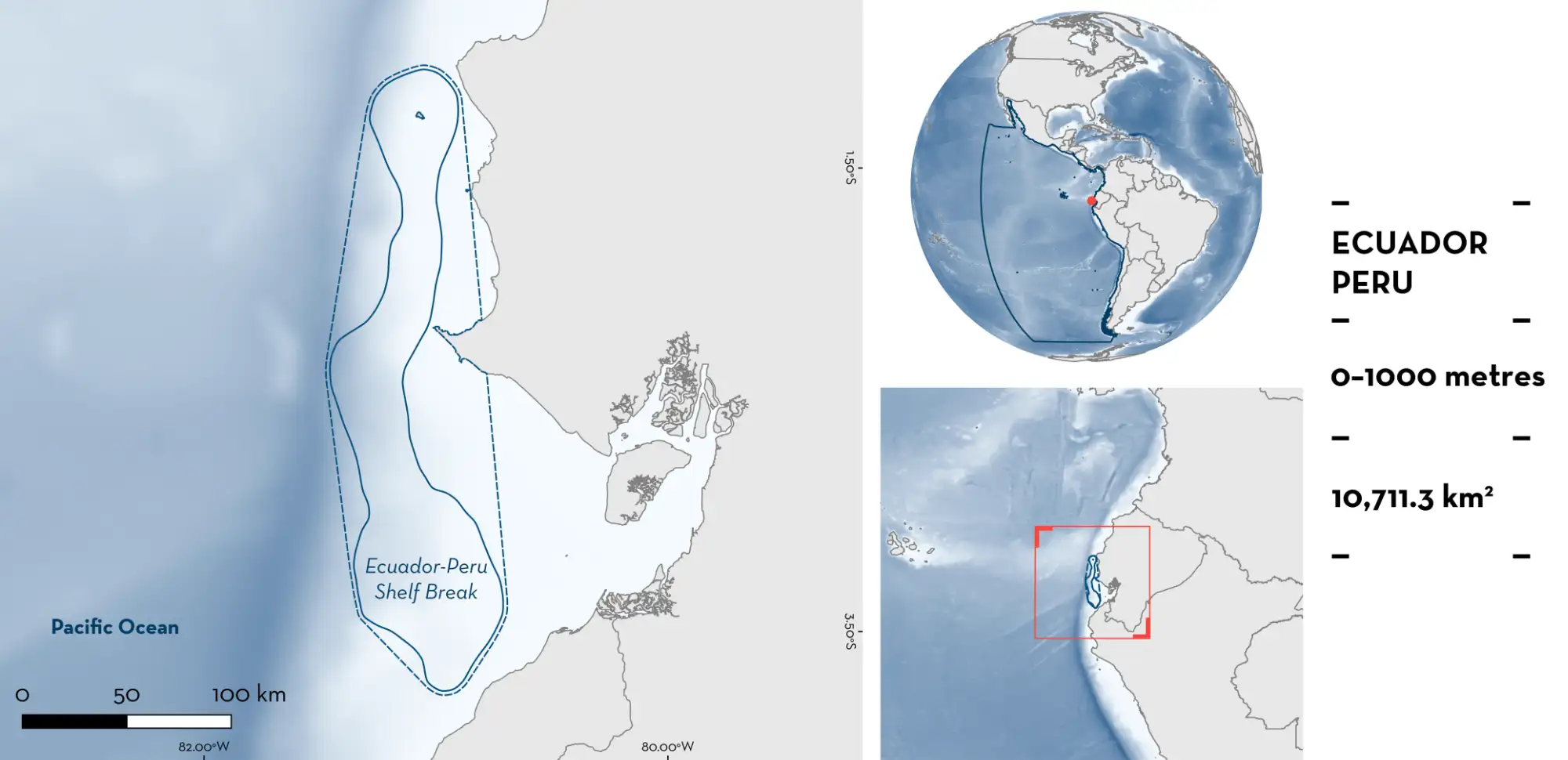
Ecuador-Peru Shelf Break
Summary
Ecuador-Peru Shelf Break stretches from Península de Santa Elena in southern Ecuador to south of Tumbes in northern Peru. The area contains unique oceanographic and bathymetric conditions resulting in high biodiversity and exceptionally high marine productivity. It overlaps with two Ecologically or Biologically Significant Marine Areas, six marine protected areas, and one Key Biodiversity Area. Within this area there are: threatened species and areas important for movement (Oceanic Manta Ray Mobula birostris).
Download factsheet
Ecuador-Peru Shelf Break
DESCRIPTION OF HABITAT
Ecuador-Peru Shelf Break stretches from Península de Santa Elena in southern Ecuador to northern Tumbes in northern Peru. The area is characterised by many important habitats. The underwater Carnegie Ridge, an aseismic ridge of volcanic origin, is located between the coasts of Ecuador and the Galápagos Islands at depths <2,500 m and includes at least five seamounts. The Equatorial Front is a transitional zone between two marine currents with high biological productivity. Isla de la Plata is a small island, ~25 km from mainland Ecuador, and is part of Machalilla National Park, located in the Equatorial Front. This island sits ~5 km from the east of the continental shelf, where the shelf depth drops sharply (~200 m).
The Gulf of Guayaquil is the largest estuary on the southeast Pacific coast with the largest area of mangroves in Ecuador (1,210 km2) (Stevenson 1981). It contains high biological productivity due to the oceanographic conditions associated with the development of the Equatorial Front, coastal outcrops, and interaction of various types of water masses (i.e., oceanic and fresh water transporting organic materials from the estuary’s interior). In the gulf, 23 hydrographic basins are discharged in which the Guayas River Basin constitutes the most important fluvial system of the entire western slope of the Andes. The dry season is from June to November and the rainy season from January to April, coinciding with greatest river discharge.
This area overlaps with two Ecologically or Biologically Significant Marine Areas (EBSA): the Carnegie Range-Equatorial Front EBSA and Gulf of Guayaquil EBSA (CBD 2026). Six marine protected areas have been designated in the area including Machalilla National Park, Cantagallo – Machalilla and Bajo Cope in Ecuador, and Mar Tropical de Grau in Peru (UNEP-WCMC & IUCN 2026). This area also sits within a Key Biodiversity Area, Coastal Ecuador Marine Corridor (KBA 2026).
This Important Shark and Ray Area is delineated from the surface (0 m) to 1,000 m based on the global depth range of the Qualifying Species.
CRITERION A
VULNERABILITY
One Qualifying Species considered threatened with extinction according to the IUCN Red List of Threatened Species regularly occurs in the area. The Oceanic Manta Ray is assessed as Endangered (Marshall et al. 2022).
CRITERION C
SUB-CRITERION C4 – MOVEMENT
Ecuador-Peru Shelf Break is an important movement area for one ray species.
There is evidence of connectivity between Isla de La Plata, Bajo Copé and northern Peruvian waters for Oceanic Manta Rays. Between 2010–2015, 11 Oceanic Manta Rays were tagged with satellite tags at Isla de la Plata with results indicating that these animals undertake considerable journeys (hundreds or thousands of kilometres) in relatively short periods of time (Hearn et al. 2014; Guerrero & Hearn 2017). Most tagged animals travelled between coastal Ecuador and northern Peru, and none of them travelled in a northerly direction. Between 2017–2019, 46 Oceanic Manta Rays were tagged (16 individuals using satellite tags and 30 individuals using acoustic tags) in Isla de la Plata and Bajo Copé (Palomino et al. 2020). The trajectories show a constant displacement between the mainland coast of Ecuador and Peru, especially on the edge and within the continental shelf. In Ecuador, movement analysis showed that this species has a greater residency in Isla de La Plata (68.5%), the Cantagallo-Machalilla (15.1%), and the Bajo Copé (13.0%) (Palomino et al. 2020). Kernel density descriptive analysis showed that hotspots for this species are mainly around Isla de la Plata and Tumbes region (Palomino et al. 2020). Three tagged Oceanic Manta Rays also moved between coastal Ecuador and northern Peru (Peñaherrera-Palma et al. 2018). Furthermore, an additional satellite telemetry study in 2018 showed that two individuals tagged in northern Peru moved in the area between northern Peru and Ecuador (Andrzejaczek et al. 2021). These results are supported by genetic diversity and population structure studies that show a low gene flow between mainland Ecuador and Galápagos Islands (Rojas Lopez et al. 2022) suggesting that Oceanic Manta Rays moved mainly along the mainland coast.
Download factsheet
SUBMIT A REQUEST
ISRA SPATIAL LAYER REQUEST
To make a request to download the ISRA Layer in either a GIS compatible Shapefile (.shp) or Google Earth compatible Keyhole Markup Language Zipped file (.kmz) please complete the following form. We will review your request and send the download details to you. We will endeavor to send you the requested files as soon as we can. However, please note that this is not an automated process, and before requests are responded to, they undergo internal review and authorization. As such, requests normally take 5–10 working days to process.
Should you have questions about the data or process, please do not hesitate to contact us.

