
ISRA FACTSHEETS
ISRA FACTSHEETS
NEW ZEALAND & PACIFIC ISLANDS REGION
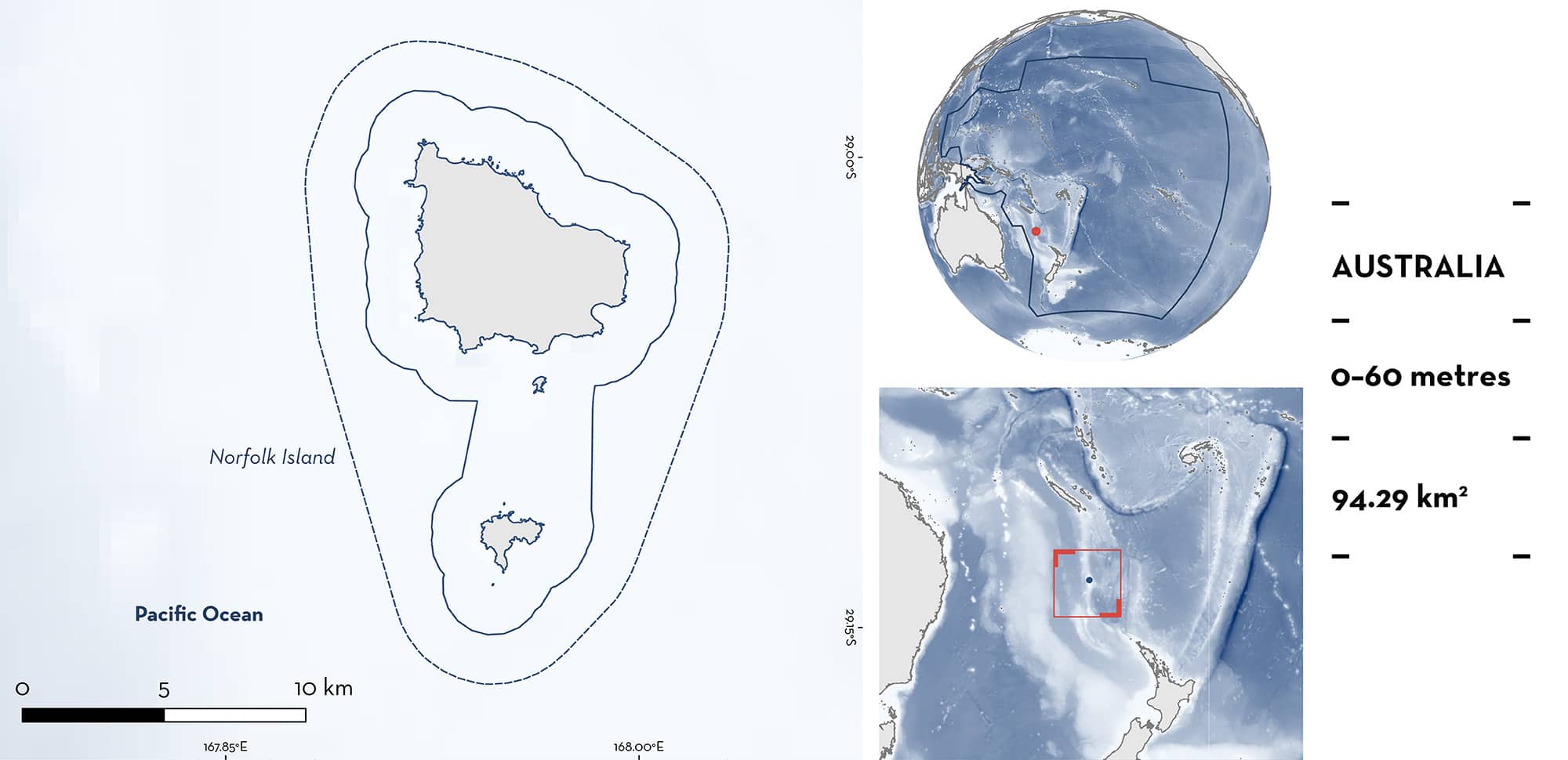
Norfolk Island
Summary
Norfolk Island is located in the western South Pacific Ocean, ~750 km from the closest land mass but in the Australian exclusive economic zone. The area surrounds Norfolk, Phillip, and Nepean Islands which are the remnants of a shield volcano. The area is exposed to a combination of oceanic currents that have led to marine communities encompassing a range of tropical, temperate, and endemic species. The habitat is characterised by reefs, corals, and sand. The area overlaps with the Seamounts of West Norfolk Ridge Ecologically or Biologically Significant Marine Area and the Norfolk Island/Phillip Island Key Biodiversity Area. Within this area there are: threatened species (Dusky Shark Carcharhinus obscurus); feeding areas (Tiger Shark Galeocerdo cuvier); and undefined aggregations (e.g., Galapagos Shark Carcharhinus galapagensis).
Download factsheet
Norfolk Island
DESCRIPTION OF HABITAT
Norfolk Island is an Australian territory located in the western South Pacific Ocean, ~750 km north of New Zealand and ~750 km south of New Caledonia. The oceanography and ecology of the region are both strongly influenced by the East Australian Current, which flows southwards from the Coral Sea to east of Tasmania, and the South Equatorial Current, which carries tropical Pacific waters towards the Coral and Tasman Seas. Norfolk Island is located at the southern limit of the Tropical Convergence, which can seasonally influence the currents (Francis 1993). When the Tropical Convergence lies south of Norfolk Island in some summers, warm water flows southward, while at other times the flow is eastward or northward past the island (Francis 1993). Sea surface temperature varies seasonally from 19–26 °C (Millar 1999).
The area includes coastal waters around Norfolk, Phillip, and Nepean Islands. The corals around these islands are one of the southern-most coral assemblages in the world and one of the few known examples of a transitional algae and coral assemblage, leading to an unusual mix of tropical and temperate marine fauna and flora due to the alternating influence of warm and cool currents at the islands (Francis 1993). Reef communities are further structured by gradients in wave exposure around the coastline of Norfolk Island and nearby islands and emergent rocks. Large prevailing swells, winds from multiple directions, and few enclosed bays allow moderate to strongly wave exposed reef habitats to predominate, with only a small lagoon in the south supporting a sheltered shallow coral reef habitat.
Norfolk Island overlaps with the Seamounts of West Norfolk Ridge Ecologically or Biologically Significant Marine Area (EBSA; CBD 2024) and the Norfolk Island/Phillip Island Key Biodiversity Area (KBA 2024).
This Important Shark and Ray Area is benthopelagic and is delineated from inshore and surface waters (0 m) to 60 m based on the bathymetry of the area.
CRITERION A
VULNERABILITY
One Qualifying Species considered threatened with extinction according to the IUCN Red List of Threatened Species regularly occurs in the area. This is the Endangered Dusky Shark (Rigby et al. 2019).
CRITERION C
SUB-CRITERION C2 – FEEDING AREAS
Norfolk Island is an important feeding area for one shark species.
Tiger Sharks seasonally feed in this area. A four-year movement study (2020–2024) of 47 Tiger Sharks with acoustic tags and 16–19 receivers around the island, as well as 35 individuals with SPOT satellite tags has shown high site fidelity and strong seasonal use of the area between December–April (C Huveneers et al. unpubl. data 2024). Stable isotope and fatty acid analyses of Tiger Shark tissue (n = 100) and potential prey samples (n = ~60) collected in the area showed that their diet was dominated by birds (73%), with Wedge-tailed Shearwaters Ardenna pacifica a likely key prey item (L Meyer et al. unpubl. data 2024). Wedge-tailed Shearwaters nest in the area between October–May, with several hundred thousand on Norfolk Island and 1,000–10,000 breeding pairs on Phillip Island (Priddle et al. 2010; M Christian et al. unpubl. data 2024). Their rafting behaviour at dusk may make them easy prey for Tiger Sharks, as is also supported by Local Ecological Knowledge (L Meyer & Norfolk residents pers. obs. 2024). Shearwaters have been documented in the stomachs (often regurgitated) of Tiger Sharks caught at Norfolk Island, including one historical report of ~40 individual birds in the stomach of one Tiger Shark (Tofts 1993). The results from the diet study and the overlap of the seabird breeding season with the Tiger Shark presence at Norfolk Island suggest that the feeding opportunity is an important driver of their seasonal presence. During five research fishing surveys in 2020–2024 using two floating drumlines, 106 individuals were caught in 25 days (mean catch rate: 4.24 Tiger Sharks caught per day). Most Tiger Sharks were adult females, with a sex ratio of 9:1 female:male and a mean size of ~400 cm total length (TL). Size-at-maturity for females ranges 250–350 cm TL (Ebert et al 2021). Although feeding is an important driver of their seasonal presence, it is also possible that these mature females aggregate at Norfolk Island to aid embryonic development.
CRITERION C
SUB-CRITERION C5 – UNDEFINED AGGREGATIONS
Norfolk Island is an important area for undefined aggregations of two shark species.
Acoustic telemetry of 32 Galapagos Sharks monitored over three years (2021–2024) has shown that many individuals (~30%) are detected year-round in the area (C Huveneers et al. unpubl. data 2024). Aggregations of Galapagos Sharks have been detected at the same receiver at the same time in several sites around Norfolk Island (C Huveneers et al. unpubl. data 2024). Additionally, aggregations are often sighted by local divers (M Graham pers. obs. 2024) and recreational fishers (L Fitzpatrick pers. obs. 2024) around the island. Norfolk Island is ~750 km from the nearest landmass and the species is largely restricted to continental shelves and oceanic islands (Kyne et al. 2019). Acoustic data show their regular and continuous use of the area (C Huveneers et al. unpubl. data 2024) highlighting the regional importance of Norfolk Island for this species, however, more information is required to determine the nature and function of these aggregations.
Dusky Sharks have been regularly recorded aggregating at Norfolk Island. Acoustic tagging of 35 Dusky Sharks monitored by 16–19 receivers between 2021–2024 shows that most individuals (~50%) are detected year-round in this area (C Huveneers et al. unpubl. data 2024). Aggregations of Dusky Sharks have been detected at the same receiver at the same time in several sites around the island (C Huveneers et al. unpubl. data 2024) and are often sighted by recreational fishers (L Fitzpatrick pers. obs. 2024). Similar to the Galapagos Shark, this species is also largely restricted to shelf and island waters (Rigby et al. 2019). Acoustic data show their regular and continuous use of the area (C Huveneers et al. unpubl. data 2024) highlighting the regional importance of this area for the species. However, more information is required to determine the nature and function of these aggregations.
Download factsheet
SUBMIT A REQUEST
ISRA SPATIAL LAYER REQUEST
To make a request to download the ISRA Layer in either a GIS compatible Shapefile (.shp) or Google Earth compatible Keyhole Markup Language Zipped file (.kmz) please complete the following form. We will review your request and send the download details to you. We will endeavor to send you the requested files as soon as we can. However, please note that this is not an automated process, and before requests are responded to, they undergo internal review and authorization. As such, requests normally take 5–10 working days to process.
Should you have questions about the data or process, please do not hesitate to contact us.

