ISRA FACTSHEETS
ISRA FACTSHEETS
EUROPEAN ATLANTIC
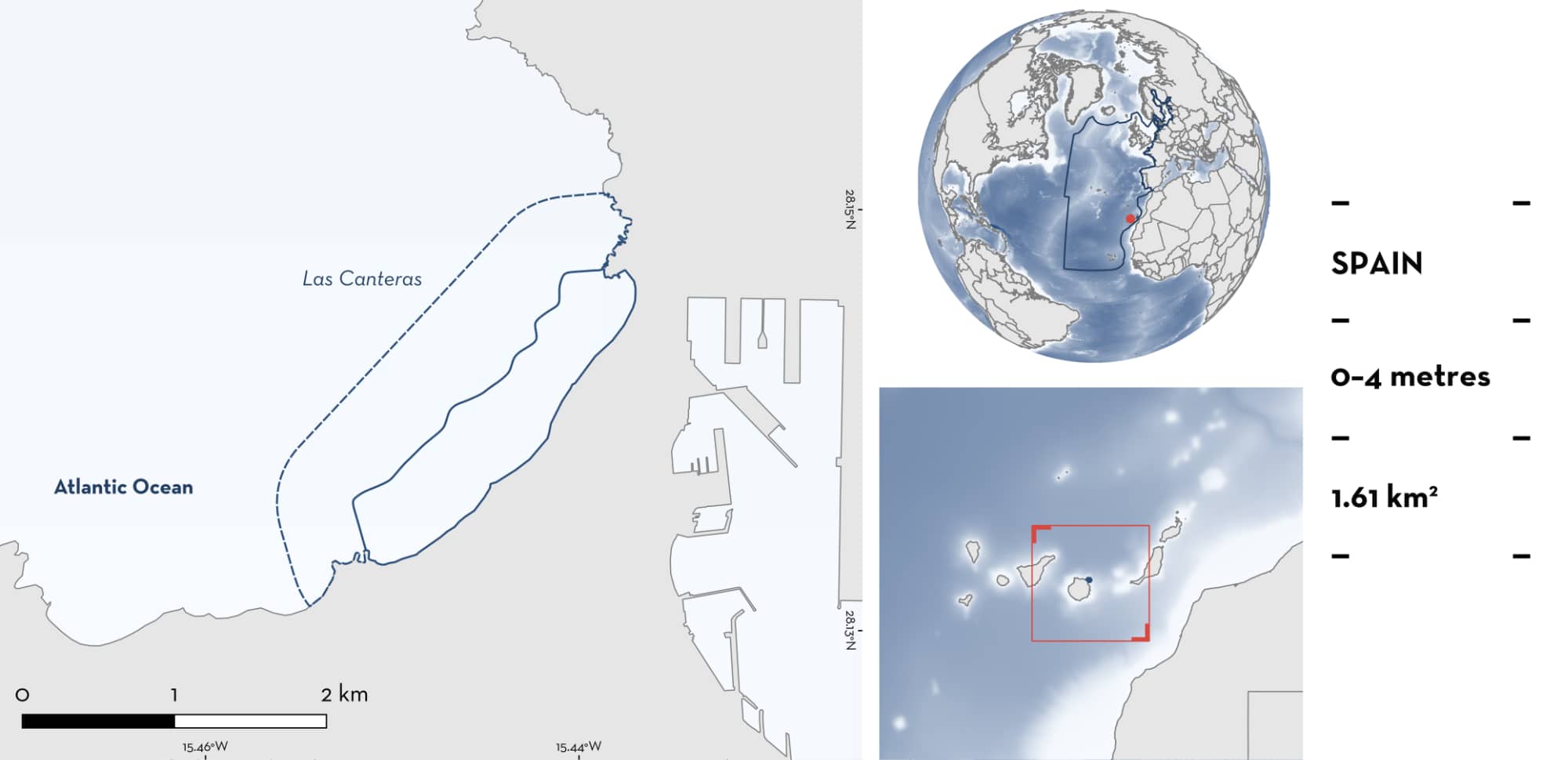
Las Canteras
Summary
Las Canteras is located on the northeastern coast of Gran Canaria Island, Canary Islands, Spain. It encompasses Las Canteras Beach and a semi-enclosed coastal lagoon. The area is characterised by a natural offshore sedimentary bar, and sandy and rocky substrates with submerged caves and crevices. The area is influenced by seasonal macroalgal blooms, local temperature regimes, and tidal dynamics. This area overlaps with the Oceanic Islands and Seamounts of the Canary Region Ecologically or Biologically Significant Marine Area. Within this area there are: threatened species (Spiny Butterfly Ray Gymnura altavela); reproductive areas (Round Fantail Stingray Taeniurops grabatus); and undefined aggregations (e.g., Spiny Butterfly Ray).
Download factsheet
Las Canteras
DESCRIPTION OF HABITAT
Las Canteras is located on the northeastern coast of Gran Canaria Island, Canary Islands, Spain. It encompasses Las Canteras Beach in the city of Las Palmas de Gran Canaria, limited to the north by the promontory of La Isleta and to the south by a groin, as well as a semi-enclosed coastal lagoon. The area is characterised by a natural offshore sedimentary bar, locally known as ‘La Barra’, which runs 2 km parallel to the coast and includes both sandy and rocky substrates with submerged caves and crevices (Tuya et al. 2020). Sandy habitats dominate the inner lagoon, while rocky outcrops and reef structures are present along the periphery and near ‘La Barra’.
The area is influenced by seasonal blooms of green and brown macroalgae, local temperature regimes, and tidal dynamics, with moderate seasonal variation in sea surface temperatures ranging from 18°C in the boreal winter to 24.5°C in summer (Tuya et al. 2020). Water exchange with the open ocean is limited during low tide, when the sedimentary bar ‘La Barra’ emerges above the surface, providing protection against swells (Tuya et al. 2020). Additionally, during low tide, the beach reaches its maximum width, ranging from 30–110 m depending on the location (Di Paola et al. 2018). At high tide, the system opens to offshore waters, promoting nutrient input and larval dispersal (Tuya et al. 2020).
This area overlaps with the Oceanic Islands and Seamounts of the Canary Region Ecologically or Biologically Significant Marine Area (EBSA; CBD 2025).
This Important Shark and Ray Area is benthic and is delineated from inshore and surface waters (0 m) to 4 m based on the bathymetry of the area.
CRITERION A
VULNERABILITY
One Qualifying Species considered threatened with extinction according to the IUCN Red List of Threatened Species regularly occurs in the area. This is the Endangered Spiny Butterfly Ray (Dulvy et al. 2021).
CRITERION C
SUB-CRITERION C1 – REPRODUCTIVE AREAS
Las Canteras is an important reproductive area for one ray species.
Between 2015–2025, scientific surveys were conducted in the area alongside snorkelling tours. Each week, 2–4 surveys lasting 80–90 minutes each were carried out along a standard transect during low tide, both during the day and at night, and throughout all months of the year (Tuya et al. 2020; Latitud Azul unpubl. data 2025). Between 2020–2025, additional data were collected from diver reports. Observations included the number of individuals, species identification, sex, and size, either estimated visually or through underwater photographs with a marked scale for size reference (Tuya et al. 2020; Latitud Azul unpubl. data 2025).
During this period, 220 Round Fantail Stingrays were recorded in the area, with sightings spanning all months of the year (Latitud Azul unpubl. data 2025). A total of 44 individuals (20.5% of total observations) ranging between 20–40 cm disc width (DW) were observed in the area in 2017 (n = 8), 2018 (n = 4), 2019 (n = 22), and 2020 (n = 10). Size-at-birth for this species is not known, but the Blotched Fantail Ray Taeniurops meyeni from the same genus, but with a larger maximum disc width (180 cm DW compared to 112 cm DW), has a size-at-birth of 30–35 cm DW (Last et al. 2016), supporting the likelihood that these individuals comprise neonates and young-of-the-year. Observations of this small age-class were made during most months of the year but with a seasonal peak in December–April (n = 28; 64% of small age-classes) (Latitud Azul unpubl. data 2025). Adults co-occur in the area year-round but higher abundances are observed between August–December (n = 102; 63% of adult observations) (Latitud Azul unpubl. data 2025). Pregnant females (n = 8), inferred visually from distended abdomens, were observed in the area in 2019, 2021, 2024, and 2025 during the months of November–December and May–July (Latitud Azul unpubl. data 2025).
CRITERION C
SUB-CRITERION C5 – UNDEFINED AGGREGATIONS
Las Canteras is an important area for undefined aggregations of two ray species.
Between 2015–2025, as described in detail above, scientific monitoring and observations were conducted through snorkelling and diving activities, recording data on the number of individuals, species identification, sex, and size along standardized transects at various times of day and throughout the year (Tuya et al. 2020; Latitud Azul unpubl. data 2025).
Between 2017–2020, 10 aggregations of Spiny Butterfly Ray (ranging between 3–5 individuals; mean = 3.7) were recorded in the area during scientific surveys on snorkelling tours (n = 173 animals) (RedPromar Gobierno de Canarias 2025; Latitud Azul unpubl. data 2025). Aggregations were observed during 2017 (n = 1 aggregation), 2018 (n = 4), 2019 (n = 4), and 2020 (n = 1) (RedPromar Gobierno de Canarias 2025; Latitud Azul unpubl. data 2025). Individuals of both sexes and across a wide range of size classes from 20–200 m DW are consistently reported throughout the summer and autumn months (June–October), indicating seasonality in aggregation patterns (RedPromar Gobierno de Canarias 2025; Latitud Azul unpubl. data 2025). Aggregations in shallow waters around Gran Canaria Island have been reported during the summer and autumn months, primarily involving adult females (Espino et al. 2022). However, in the area, a peak in sightings between June–October in 2015–2018 included both adults and juveniles, suggesting that parturition may occur during these months, with juveniles remaining in the area for some time (Tuya et al. 2020). Additionally, 10 neonates ranging in size between 20–40 cm DW were observed in the area during September–November in 2018–2019 (Latitud Azul unpubl. data 2025). Size-at-birth is estimated at 38–44 cm DW (Last et al. 2016). Further information is required to understand the nature and function of these aggregations.
Between 2015–2025, 18 aggregations of Round Fantail Stingray were observed within the area ranging in size between 3–7 individuals (mean = 4.1) (Tuya et al. 2020; Latitud Azul unpubl. data 2025). Of a total of 220 individuals observed, 75 (35%) were sighted within aggregations (Tuya et al. 2020; Latitud Azul unpubl. data 2025). Aggregations were observed in 2017 (n = 3 aggregations), 2019 (n = 11), 2020 (n = 3), and 2024 (n = 1) (Latitud Azul unpubl. data 2025). Aggregations were observed between November–June, with most records between November–February (n = 11; 61%). Further information is required to understand the nature and function of these aggregations.
Download factsheet
SUBMIT A REQUEST
ISRA SPATIAL LAYER REQUEST
To make a request to download the ISRA Layer in either a GIS compatible Shapefile (.shp) or Google Earth compatible Keyhole Markup Language Zipped file (.kmz) please complete the following form. We will review your request and send the download details to you. We will endeavor to send you the requested files as soon as we can. However, please note that this is not an automated process, and before requests are responded to, they undergo internal review and authorization. As such, requests normally take 5–10 working days to process.
Should you have questions about the data or process, please do not hesitate to contact us.