ISRA FACTSHEETS
ISRA FACTSHEETS
EUROPEAN ATLANTIC
Abades-El Porís
Summary
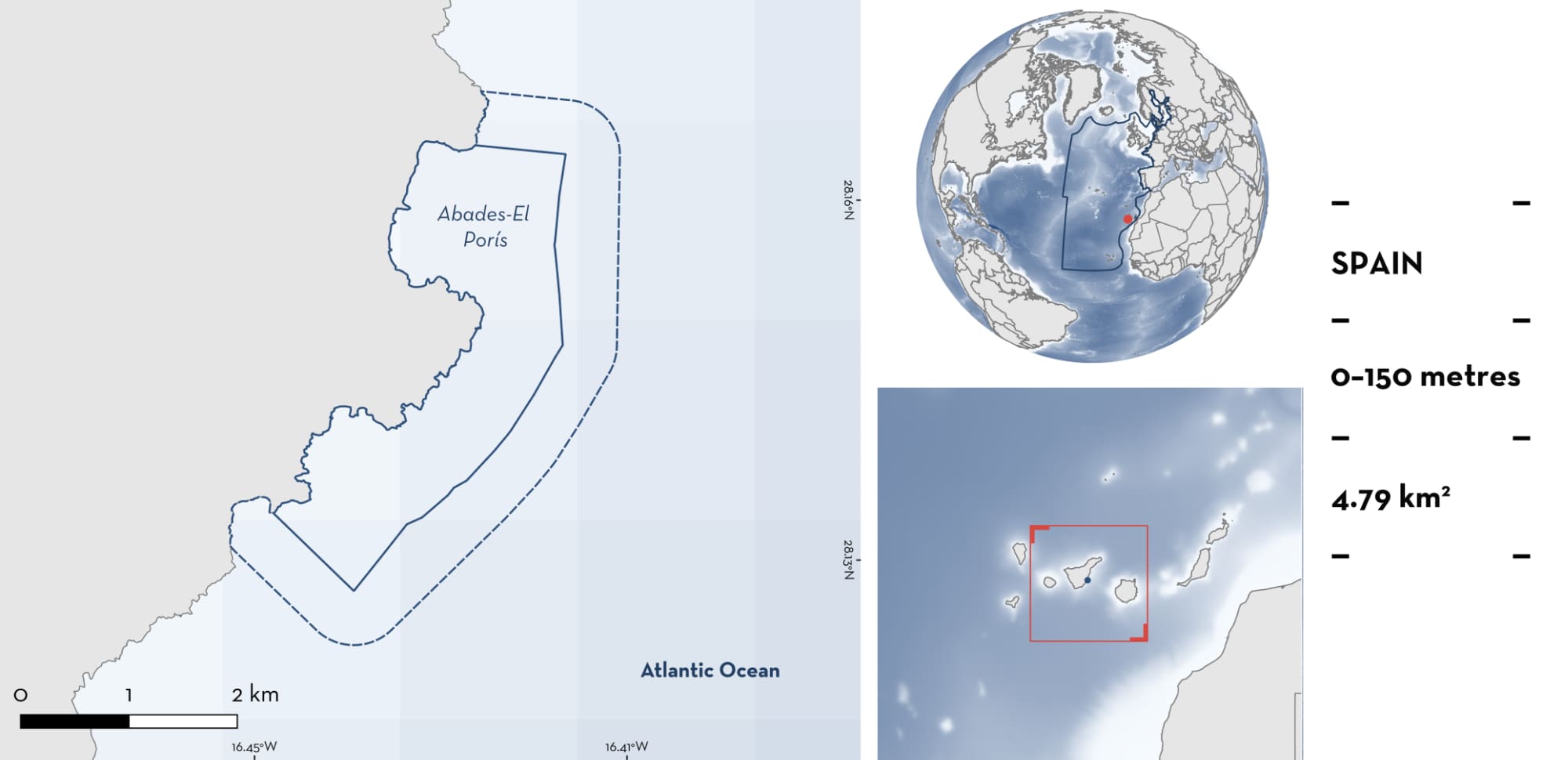
Abades-El Porís is located on the southeast coast of Tenerife, in the Canary Islands, Spain. The area is characterised by extensive sandy substrates, rocky outcrops, volcanic reef structures, and patches of seagrass beds. The area overlaps with the Oceanic Islands and Seamounts of the Canary Region Ecologically or Biologically Significant Marine Area. Within this area there are: threatened species (e.g., Angelshark Squatina squatina); and reproductive areas (e.g., Common Smoothhound Mustelus mustelus).
Download factsheet
Abades-El Porís
DESCRIPTION OF HABITAT
Abades-El Porís is located on the southeast coast of Tenerife, in the Canary Islands. The Canary Islands are a Spanish archipelago in the northeast Atlantic, consisting of eight main islands and five islets, situated ~100 km from the northwest African coastline. The area is characterised by a mosaic of static, spatially bound habitats. These include extensive sandy substrates, rocky outcrops, volcanic reef structures, and patches of Slender Seagrass Cymodocea nodosa (Martín Solà et al. 2024).
The coastline is exposed to seasonal changes in wave energy and wind-driven circulation, which influence sediment transport and local hydrodynamics. Although the site is not directly influenced by major upwelling centres, seasonal variation in oceanographic conditions may enhance localised productivity, especially during the boreal spring and summer months. Water temperature typically ranges between 18°C and 24°C across the year, with good overall visibility and low turbidity levels (Hernández et al. 2010; Vázquez et al. 2024).
The area overlaps with the Oceanic Islands and Seamounts of the Canary Region Ecologically or Biologically Significant Marine Area (EBSA; CBD 2025).
This Important Shark and Ray Area is benthic and pelagic and is delineated from inshore and surface waters (0 m) to 150 m based on the bathymetry of the area.
CRITERION A
VULNERABILITY
Two Qualifying species considered threatened with extinction according to the IUCN Red List of Threatened Species regularly occur in the area. These are the Critically Endangered Angelshark (Morey et al. 2019) and the Endangered Common Smoothhound (Jabado et al. 2021).
CRITERION C
SUB-CRITERION C1 – REPRODUCTIVE AREAS
Abades-El Porís is an important reproductive area for two shark species.
Neonate/young-of-the-year (YOY) Common Smoothhounds have been recorded opportunistically and during underwater visual census (UVC) surveys in the area between 2022–2024 (Condrik unpubl. data 2025). Common Smoothhounds were classified as neonate/YOY as they were visually estimated to measure ~40 cm total length (TL) which overlaps with the reported size-at-birth (34–42 cm TL; Ebert et al. 2021). Size was confirmed with laser photogrammetry during a snorkel survey (Condrik unpubl. data 2025). Aggregations of neonate/YOY consisted of ~20 individuals. This is the only location in Tenerife Island where these life stages have been recorded.
Neonate and YOY Angelsharks have been regularly recorded within the area. This location has also been recognised as a potential nursery area for Angelsharks (Jiménez-Alvarado et al. 2020). Since 2016, the Angel Shark Project has conducted a combination of UVC surveys, tagging, and citizen science data collection in the area. Visual transects and tagging surveys were conducted across the Canary Islands in high suitability areas (Meyers et al. 2017), potential nursery areas (Jiménez-Alvarado et al. 2020), and locations where Angelsharks are commonly observed. Within this area, nine campaigns were conducted between 2016–2023 with each campaign consisting of 1–3 days of surveys per campaign. All individuals recorded (n = 18) measured <40 cm TL (Angel Shark Project unpubl. data 2025). These individuals were classified as neonate/YOY as their size overlaps with the reported size-at-birth (26–30 cm TL; Ebert et al. 2021). Neonate Angelsharks (n = 11; 55% of sightings) were also recorded by local dive centres between 2020–2024 (Angel Shark Project unpubl. data 2025). Sharks were observed in shallow waters (<10 m), primarily on sandy and mixed substrates. Abades-El Porís is the area with the largest number of neonate/YOY recorded in Tenerife Island (Jiménez-Alvarado et al. 2020).
Download factsheet
SUBMIT A REQUEST
ISRA SPATIAL LAYER REQUEST
To make a request to download the ISRA Layer in either a GIS compatible Shapefile (.shp) or Google Earth compatible Keyhole Markup Language Zipped file (.kmz) please complete the following form. We will review your request and send the download details to you. We will endeavor to send you the requested files as soon as we can. However, please note that this is not an automated process, and before requests are responded to, they undergo internal review and authorization. As such, requests normally take 5–10 working days to process.
Should you have questions about the data or process, please do not hesitate to contact us.