ISRA FACTSHEETS
ISRA FACTSHEETS
EUROPEAN ATLANTIC
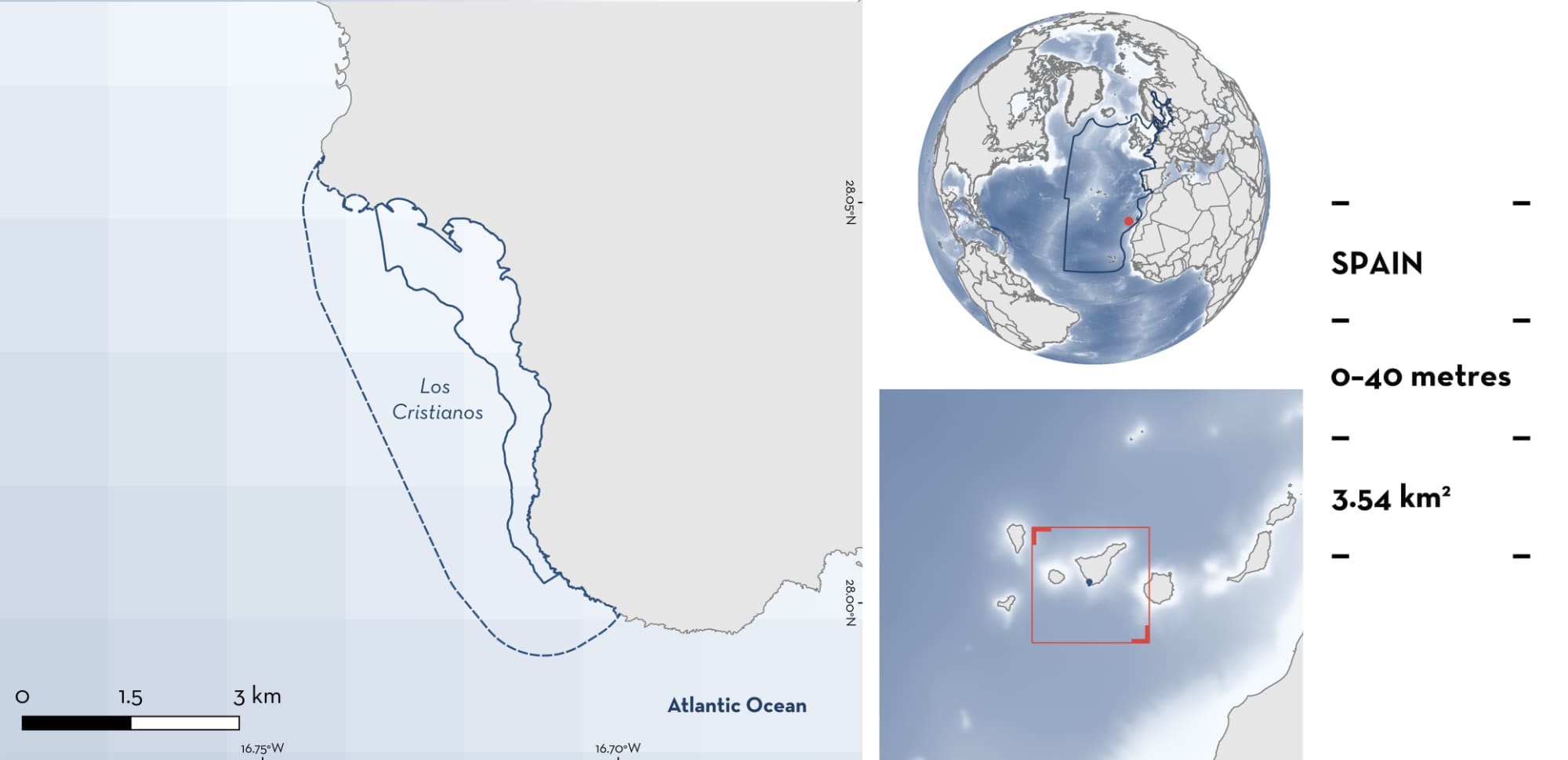
Los Cristianos
Summary
Los Cristianos is located on the southwestern coast of Tenerife Island, Canary Islands, Spain. It encompasses a sloping bay bounded by rocky outcrops. The area is characterised by sandy substrates with patches of basaltic rock and submerged caves. It is influenced by the Canary Current and the seasonal coastal upwelling system off northwest Africa, and occasional upwelling events with moderate wave action. The area overlaps with the Oceanic Islands and Seamounts of the Canary Region Ecologically or Biologically Significant Marine Area. Within this area there are: threatened species (e.g., Common Smoothhound Mustelus mustelus); reproductive areas (Spiny Butterfly Ray Gymnura altavela); and undefined aggregations (e.g., Duckbill Eagle Ray Aetomylaeus bovinus).
Download factsheet
Los Cristianos
DESCRIPTION OF HABITAT
Los Cristianos is located on the southwestern coast of Tenerife Island, Canary Islands, Spain. It encompasses a gently sloping bay bounded by rocky outcrops, with a gradual depth gradient from the intertidal zone to ~40 m depth. The area is characterised by fine to medium-grained sandy substrates with patches of basaltic rock and submerged caves (H Toledo-Padilla pers. obs. 2025).
This area is influenced by the Canary Current and the seasonal coastal upwelling system off northwest Africa, which brings cold, nutrient-rich waters, enhancing primary productivity especially from the boreal spring to autumn (Gómez-Letona et al. 2017). The area is also influenced by occasional upwelling events and moderate wave action, contributing to water mixing and the redistribution of organic material along the shore (H Toledo-Padilla pers. obs. 2025).
This area overlaps with the Oceanic Islands and Seamounts of the Canary Region Ecologically or Biologically Significant Marine Area (EBSA; CBD 2025).
This Important Shark and Ray Area is benthic and pelagic and is delineated from inshore and surface waters (0 m) to 40 m based on the bathymetry of the area.
CRITERION A
VULNERABILITY
Three Qualifying Species considered threatened with extinction according to the IUCN Red List of Threatened Species regularly occur in the area. These are the Critically Endangered Duckbill Eagle Ray (Jabado et al. 2021a) and the Endangered Common Smoothhound (Jabado et al. 2021b) and Spiny Butterfly Ray (Dulvy et al. 2021).
CRITERION C
SUB-CRITERION C1 – REPRODUCTIVE AREAS
Los Cristianos is an important reproductive area for one ray species.
Between 2021–2024, a research campaign was conducted every year during September (two days per campaign, maximum of 4 h per day) in this area. Surveys were conducted at 0–1 m depth while walking and capturing rays with hand nets. Individuals were measured (disc width; DW) and ultrasounds (2023–2024) performed to assess pregnancy (Rays of Paradise unpubl. data 2025).
Between 2021–2024, Spiny Butterfly Rays regularly formed reproductive aggregations of pregnant females in the area. A total of 67 Spiny Butterfly Rays ranging in size between 44–194 cm DW were captured of which more than half were pregnant females (Rays of Paradise unpubl. data 2025). All pregnant females were captured in September between 2021–2024 with pregnancy inferred from abdominal distension or ultrasound during 2023–2024. In addition, there are several observations of recent mating and parturition inferred from non-healed abrasions in the cloaca (Rays of Paradise unpubl. data 2025). These reproductive aggregations of adult and pregnant females comprised between 4–14 individuals during 2021–2023 (Rays of Paradise unpubl. data 2025). The surveys in this area were undertaken in September, and therefore additional temporal data are required to confirm the seasonality of reproductive behaviour (Rays of Paradise unpubl. data 2025). However, adult female Spiny Butterfly Rays show a preference for aggregating in shallow waters during summer and early autumn in the Canary Islands, when the sea surface temperature fluctuates between 19–24°C, which probably provides suitable conditions for breeding behaviour including mating (Espino-Ruano et al. 2023). Additionally, three neonate/young-of-the year (YOY) individuals measuring up to 49 cm DW were captured within the area in 2022 and 2024. Size-at-birth for the species is 38–44 cm DW (Last et al. 2016). Site fidelity in this area has been documented for this species between 2021–2024 through passive acoustic telemetry (n = 48 tagged individuals) (Rays of Paradise unpubl. data 2025).
CRITERION C
SUB-CRITERION C5 – UNDEFINED AGGREGATIONS
Los Cristianos is important for undefined aggregations of one shark and one ray species.
Between 2021–2024, year-round aggregations of Common Smoothhound were observed opportunistically in the port within the area (D Jiménez-Alvarado pers. obs. 2025). Aggregation sizes typically ranged from 30–40 individuals and have been observed on a monthly basis since 2021 (D Jiménez-Alvarado pers. obs. 2025). These aggregations primarily consisted of small individuals, ranging from YOY to juveniles (~52–70 cm total length; TL) inferred from visual estimations (D Jiménez-Alvarado pers. obs. 2025). Size-at-birth for the species is 34–42 cm TL (Ebert et al. 2021), indicating that individuals observed were YOY or juveniles. Additionally, in June 2021, an aggregation of ~200 juvenile Common Smoothhounds was reported at a depth of 2 m in Playa de Las Vistas, within the area (Espino et al. 2022). This observation was made during a regional effort to identify aggregation sites for the species across the Canary Islands, based on reports from marine scientists, fishers, and divers (Espino et al. 2022). Although such aggregations are regularly observed in the port, restricted access has prevented further sampling. Further information is required to confirm the nature and function of these aggregations.
Between 2018–2021, aggregations of Duckbill Eagle Rays (3–5 individuals) were documented in the area by professional photographers while scuba and free diving (F Ravina pers. obs. 2025). During this period, aggregations of >3 individuals were observed monthly, with three aggregations documented in January 2018 (>4 individuals), August 2018 (>5), and January 2021 (>3) (F Ravina pers. obs. 2025). Additionally, between 2018–2019, seven diving surveys on random transects in the area, photo-identified 10 individuals (Moreno et al. 2022). All individuals were females, with sizes ranging from 103–158 cm TL (Moreno et al. 2022). Two individuals, confirmed through photo-identification of their dorsal patterns, were resighted on one or nine separate occasions, totalling 10 re-sightings within a one-year period (summer 2018–summer 2019), indicating a degree of residency in the area (Moreno et al. 2022). Moreover, records from citizen science (n = 38 sightings) between 2018–2021 increased the number of photo-identified individuals to 18 Duckbill Eagle Rays in the area (Angel Shark Project unpubl. data 2025). This area hosts the highest number of recorded sightings for the species around Tenerife Island (Moreno et al. 2022) and is the only area in the Canary Islands with confirmed aggregations over multiple years. Further information is required to confirm the nature and function of these aggregations.
Download factsheet
SUBMIT A REQUEST
ISRA SPATIAL LAYER REQUEST
To make a request to download the ISRA Layer in either a GIS compatible Shapefile (.shp) or Google Earth compatible Keyhole Markup Language Zipped file (.kmz) please complete the following form. We will review your request and send the download details to you. We will endeavor to send you the requested files as soon as we can. However, please note that this is not an automated process, and before requests are responded to, they undergo internal review and authorization. As such, requests normally take 5–10 working days to process.
Should you have questions about the data or process, please do not hesitate to contact us.