ISRA FACTSHEETS
ISRA FACTSHEETS
EUROPEAN ATLANTIC
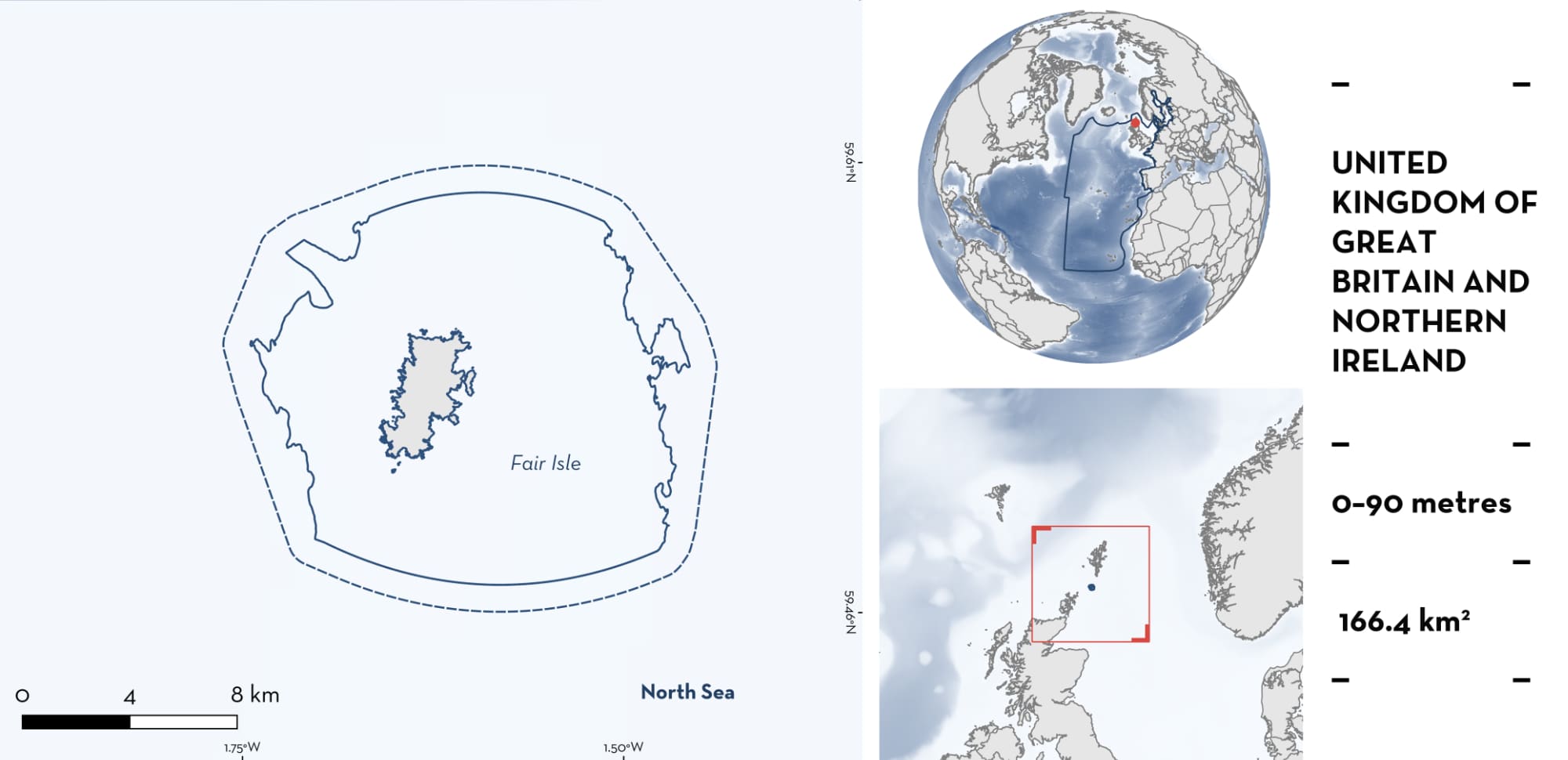
Fair Isle
Summary
Fair Isle is located in Scotland, United Kingdom of Great Britain and Northern Ireland. The area is the most southerly inhabited island in the Shetland Archipelago. The inshore waters of the area are in a transitionary zone strongly influenced by tidal currents, thermal fronts, and ocean swell. The substrate is composed of fine sand and exposed rock. The area falls within a Demonstration and Research Marine Protected Area, with nearshore areas (up to ~2 km from shore) further classified as a Special Protected Area. Within this area there are: threatened species and undefined aggregations (Flapper Skate Dipturus intermedius).
Download factsheet
Fair Isle
DESCRIPTION OF HABITAT
Fair Isle is located in Scotland, United Kingdom of Great Britain and Northern Ireland. The area is the most southerly inhabited island in the Shetland Archipelago. The area is characterised by a complex variety of substrates and habitat types, including circalittoral fine sand to exposed rock (Riley et al. 2024). The spatial distribution of habitats is linked both to the underlying geology and to the complex and powerful tidal currents in the area which form defined sand banks to the west and east of the island and rugged tide-swept areas closer to shore. The area’s inshore waters are in a transitionary zone strongly influenced by tidal currents, thermal fronts, and ocean swell.
The area sits within a Demonstration and Research Marine Protected Area (DR MPA) which extends 5 km seawards, with nearshore areas (up to ~2 km from shore) further classified as a Special Protected Area (SPA) (FFI 2021).
This Important Shark and Ray Area is benthic and pelagic and is delineated from inshore and surface waters (0 m) to 90 m based on the bathymetry of the area.
CRITERION A
VULNERABILITY
One Qualifying Species considered threatened with extinction according to the IUCN Red List of Threatened Species regularly occurs in the area. This is the Critically Endangered Flapper Skate (Ellis et al. 2024).
CRITERION C
SUB-CRITERION C5 – UNDEFINED AGGREGATIONS
Fair Isle is an important area for undefined aggregations of one ray species.
Between 2022–2024, two survey methods were used to investigate Flapper Skate occurrence in the area: Baited Remote Underwater Video Station (BRUVS) surveys (M McAllister & S Fraser unpubl. data 2025) and trawl surveys (Fair Isle Fish Survey [FIFS ]). In 2023 and 2024, BRUVS surveys were conducted seasonally (July and August). The average deployment duration was 73.7 minutes, and units were deployed across a depth range of 29.8–57.2 m (average = 36 m). Flapper Skates were present in 11 out of 12 deployments in the area (91.7%) and 35 individual skates were identified based on photo-identification of unique spot and scarring patterns (12 and 23 individuals in 2023 and 2024, respectively). The largest aggregation observed in a single BRUVS deployment was nine individuals, and 45% of deployments recorded aggregations of three or more Flapper Skates. The average time of arrival (TOA) was 25.8 mins, with the fastest TOA being 5.8 mins – corresponding to the deployment with the highest MaxIND (9 individuals). Five minutes is a relatively quick time in which to observe Flapper Skates, indicating they were likely already in the vicinity in high numbers. The mean sightings-per-unit-effort (SPUE; MaxIND/hr) was 2.2 and 2.47 in 2023 and 2024, respectively (M McAllister & S Fraser unpubl. data 2025). Comparatively, the SPUE for the rest of Shetland was close to 0 (MaxIND/hr = 0.18; M McAllister & S Fraser unpubl. data 2025). Between 2022–2024, pre-defined scientific trawl stations were surveyed seasonally (July and August). Flapper Skates were present in 13 out of 25 tows (52%). Tows with Flapper Skates present covered depths of 50–91 m. Average catch-per-unit-effort (CPUE; count/hr) ranged between 1.38–2.77 (Fraser et al. 2023, 2024, 2025), supporting the importance of the area for this species. This CPUE is higher in this area than other areas surveyed in the rest of the Shetland region.
Within this broader region, Fair Isle stands out as a potential hotspot for Flapper Skates, with evidence of higher Flapper Skate numbers than in the rest of Shetland (M McAllister & S Fraser unpubl. data 2025) and compared to similar studies from the west coast of Scotland (Benjamins et al. 2018; Taylor et al. 2025). Historically, the Shetland Islands of Scotland have been recognised as an important stronghold for Flapper Skate populations (Walker & Heessen 1996; Walker & Hilsop 1998), and the contemporary data presented here supports this. Landings of the ‘common skate’ complex by commercial fishing vessels has been banned in European Union waters since 2009. Flapper Skates have faced population declines in the past, with a suspected reduction in population size of >80% in the last 100 years (Ellis et al. 2024). Once widespread throughout the northeast Atlantic, they have undergone extensive range reductions and local extinctions (Brander 1981; Walker & Hilsop 1998; Dulvy & Reynolds 2002), further highlighting the importance of this area for this species.
The inshore area of Fair Isle is strongly affected by tides, where tidal flows accelerate closer to shore. Tidal current is known to be an important factor in understanding Flapper Skate distribution, and tide can influence shark and ray movements for a variety of reasons such as foraging tactics, energy conservation, and predator avoidance (Schlaff et al. 2014). In addition to BRUVs and trawl surveys, Flapper Skate egg cases regularly wash up on the shores of Fair Isle – the community keeps a record of skate egg cases as well as dead individuals that wash up (K Cubbon pers. obs. 2025). Aggregative behaviour has been observed in Flapper Skates off the west coast of Scotland (Régnier et al. 2024), supporting the aggregative ecology of this species. However, further information is required to understand the nature and function of these aggregations.
Download factsheet
SUBMIT A REQUEST
ISRA SPATIAL LAYER REQUEST
To make a request to download the ISRA Layer in either a GIS compatible Shapefile (.shp) or Google Earth compatible Keyhole Markup Language Zipped file (.kmz) please complete the following form. We will review your request and send the download details to you. We will endeavor to send you the requested files as soon as we can. However, please note that this is not an automated process, and before requests are responded to, they undergo internal review and authorization. As such, requests normally take 5–10 working days to process.
Should you have questions about the data or process, please do not hesitate to contact us.