ISRA FACTSHEETS
ISRA FACTSHEETS
EUROPEAN ATLANTIC
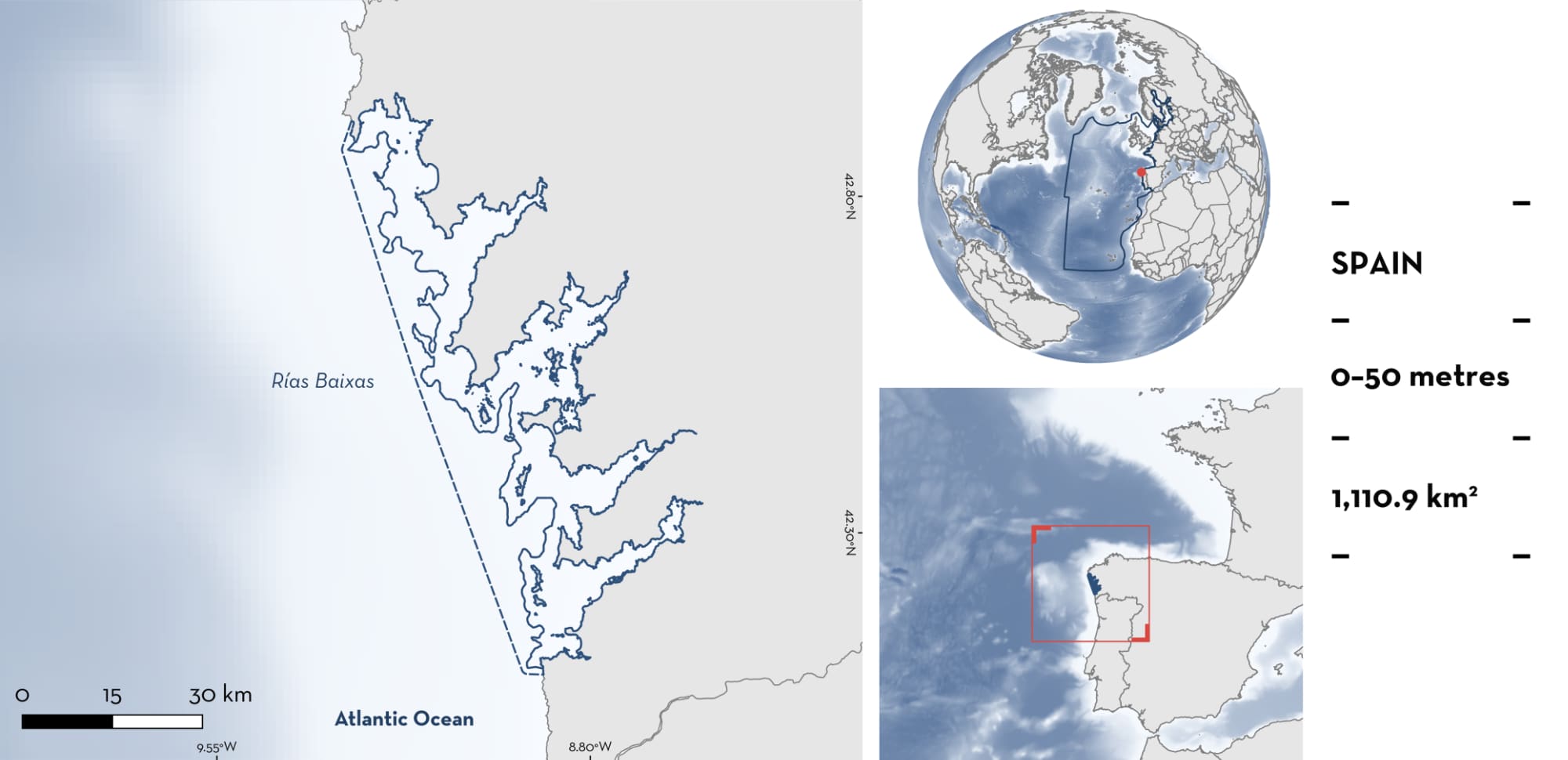
Rías Baixas
Summary
Rías Baixas is located along the coast of Pontevedra Province and west coast of A Coruña Province in Galicia, Spain. This area encompasses part of the gently sloping continental shelf and estuarine inlets of the Ría de Vigo, Ría de Pontevedra, Ría de Arousa, and Ría de Muros and Noya. Rías Baixas is characterised by sand, gravel, and mud substrates rich in organic matter. The area is influenced by seasonal upwelling of nutrient-rich Eastern North Atlantic Central Water, and downwelling cycles due to wind regimes. The area overlaps with the West Iberian Canyons and Banks Ecologically or Biologically Significant Marine Area, the Entorno marino de las Rías Baixas Key Biodiversity Area, and one protected area. Within this area there are: threatened species (Common Eagle Ray Myliobatis aquila); reproductive areas (Blue Shark Prionace glauca); and undefined aggregations (e.g., Undulate Skate Raja undulata).
Download factsheet
Rías Baixas
DESCRIPTION OF HABITAT
Rías Baixas is located along the coast of Pontevedra Province and west coast of A Coruña Province in Galicia, Spain. This area encompasses part of the gently and narrow sloping continental shelf with a maximum width of 35 km and estuarine inlets of the Ría de Vigo, Ría de Pontevedra, Ría de Arousa, and Ría de Muros and Noya. Rías Baixas is characterised by sandy and gravel substrates, mostly found near river mouths and near the outer parts of the estuaries, and muddy substrates rich in organic matter in the middle part of the estuaries (Vilas et al. 2005).
The area is influenced by strong seasonal variability, dominated by upwelling (April–September) with northerly winds promoting upwelling of nutrient-rich Eastern North Atlantic Central Water, while from October to the end of March, the area is characterised by downwelling cycles due to southerly winds (Varela et al. 2005). The area also features complex tidal dynamics and the influence of the Iberian Poleward Current, which transports warm, saline waters northward along the slope during the boreal autumn and winter (Varela et al. 2005).
The area overlaps with the West Iberian Canyons and Banks Ecologically or Biologically Significant Marine Area (EBSA; CBD 2025), the Entorno marino de las Rías Baixas Key Biodiversity Area (KBA; KBA 2025), and Islas Atlánticas de Galicia Marine Protected Area (UNEP-WCMC & IUCN 2025).
This Important Shark and Ray Area is benthic and pelagic and is delineated from inshore and surface waters (0 m) to 50 m based on the bathymetry of the area.
CRITERION A
VULNERABILITY
One Qualifying species considered threatened with extinction according to the IUCN Red List of Threatened Species regularly occurs in the area. This is the Critically Endangered Common Eagle Ray (Jabado et al. 2021).
CRITERION C
SUB-CRITERION C1 – REPRODUCTIVE AREAS
Rías Baixas is an important reproductive area for one shark species.
Between 2012–2025, Blue Shark catch records from recreational and professional fishers, regional newspapers, and citizen science data collected via an app were collected across the northwestern coast of the Iberian Peninsula (Mejuto et al. 2014; Bañón et al. 2016; Mucientes et al. 2018; K Papadopoulo unpubl. data 2025). Collected data included location, depth, number of individuals, sex, behaviour, size of individuals (total length [TL]; estimated based on photographs, videos, or descriptions from the observers), and the presence of umbilical scars. Most records were supported by photographs and videos. This resulted in 963 Blue Shark records from the coast of Galicia, including this area. Of these, more than half (n = 502; 52%) were neonates, young-of-the-year (YOY), or small juveniles. The rest were mainly subadults measuring <180 cm TL (Mejuto et al. 2014; Bañón et al. 2016; Mucientes et al. 2018; K Papadopoulo unpubl. data 2025).
Within Rías Baixas, 565 Blue Sharks were recorded between 2014–2025, with at least 353 neonates and YOY ranging in size from 40–80 cm TL (Mejuto et al. 2014; Bañón et al. 2016; Mucientes et al. 2018; Tiburones Pelágicos Galicia 2025; K Papadopoulo unpubl. data 2025). Size-at-birth for the species is 33–60 cm TL (Skomal & Natanson 2003; Ebert et al. 2021), and size of YOY are reported up to ~122 cm TL (Skomal & Natanson 2003), indicating that these individuals were neonates and YOY. Neonates and YOY were recorded during the months of June–November with a peak between July–September (96.5% of observations for these size classes) (Mejuto et al. 2014; Bañón et al. 2016; Mucientes et al. 2018; K Papadopoulo unpubl. data 2025). This aligns with the primary pupping season in spring and summer (between April–July; Nakano & Stevens 2008). The shallower inshore waters in the area may serve as a potential nursery ground for Blue Sharks in the northeast Atlantic Ocean, where neonates and YOYs can feed on cephalopods and small fishes close to shore due to the narrow Galician Shelf (Mejuto et al. 2014; Bañón et al. 2016; Mucientes et al. 2018; K Papadopoulo unpubl. data 2025). Monthly spatial predictions of habitat preference for small juveniles in the northeast Atlantic highlighted the waters around Galicia as important from June–September (Vandeperre et al. 2016).
CRITERION C
SUB-CRITERION C5 – UNDEFINED AGGREGATIONS
Rías Baixas is an important area for undefined aggregations of two ray species.
Between 2015–2024, Common Eagle Rays were observed in groups of >20 individuals throughout the Ría de Vigo within the area, from the island of San Simón in the inner estuary to Monteferro and Cabo Home at the mouth of the Ría (K Papadopoulo et al. unpubl. data 2025). Shell fishers have been reporting sightings and interactions with large aggregations of Common Eagle Rays in the area dating back to at least 2015 (Parquistas de Carril 2021). Between August 2024 and November 2024, 10 aggregations of 3–20 small juveniles, inferred from visual size estimations, were opportunistically observed in the area by researchers (K Papadopoulo pers. obs. 2025). Additional acoustic and traditional tagging efforts inside the area, within Ría de Vigo, captured a total of 79 individuals ranging from ~35 to 182 cm disc width (DW) (K Papadopoulo et al. unpubl. data 2025). Size-at-birth for the species is ~19 cm DW (Last et al. 2016), indicating that some of these individuals were YOY. To date, no recaptures of conventionally tagged individuals (n = 79) have been recorded. Early telemetry results suggest that larger, mature individuals tend to remain inside the Ría year-round, while juveniles may use the entire estuary (K Papadopoulo et al. unpubl. data 2025). Aggregations of this species, consisting of groups of 25–30 individuals during the summer months (August–September), have been documented in the broader region such as the Azores (Afonso & Vasco-Rodrigues 2015) and in Italy in the Mediterranean Sea (Grancagnolo & Arculeo 2021). These observations align with both the size and timing of aggregations reported in the area. The presence of YOY and small juveniles within these aggregations may indicate that the area serves as a potential pupping ground, however, further information is required to understand the nature and function of these aggregations.
Seasonal aggregations of Undulate Skate were recorded south of Viños Islet in Cíes Archipelago, within the area from May–October, peaking between July–August (Leeb et al. 2021; Daban et al. 2024), with groups of >15 individuals observed (Alonso Fernández & Mucientes Sandoval 2021). This aggregation area was first identified by recreational divers that reported high densities of the species in a small rocky reef area surrounded by sand (G Mucientes pers. obs. 2021). Between 2019–2024, acoustic tagging surveys were conducted during aggregations months (May–October) by daily trips to the aggregation site. Undulate Skates were captured with a hand net while SCUBA diving at depths of 11–12 m. The individuals were then brought to the surface, where their DW was measured (Alonso Fernández & Mucientes Sandoval 2021; Leeb et al. 2021; Daban et al. 2024). A total of 246 individuals were captured and tagged with acoustic transmitters between 2019–2024 measuring 24–50 cm DW (Leeb et al. 2021; Daban et al. 2024; A Alonso-Fernández unpubl. data 2025). In 2019, capture surveys spanned four days: two in May (n = 13 and 17 individuals captured each day at the same site); one in June (n = 2); and one in October (n = 12). In 2021, five day-survey trips were conducted at the aggregation site, capturing a total of 49 individuals, and recording the highest density with up to 15 Undulate Skates captured in less than 15 minutes of diving (Alonso Fernández & Mucientes Sandoval 2021). Up to 55 individuals have been detected in the same day in June–July 2022 on one acoustic receiver at the aggregations site, repeating the same pattern in consecutive summers (2023–2024), with >40 individuals detected in the area on the same day (A Alonso-Fernández unpubl. data 2025). Undulate Skate showed a low daytime activity associated with resting behaviour, during which rays buried themselves in the sand and sought refuge on rocky reefs, with residency to the area between 14–355 days (mean = 160 ± 78 days) with records of the same individuals across four consecutive years (Mucientes Sandoval et al. 2019; Leeb et al. 2021; Daban et al. 2024). Further information is required to understand the nature and function of these aggregations.
Download factsheet
SUBMIT A REQUEST
ISRA SPATIAL LAYER REQUEST
To make a request to download the ISRA Layer in either a GIS compatible Shapefile (.shp) or Google Earth compatible Keyhole Markup Language Zipped file (.kmz) please complete the following form. We will review your request and send the download details to you. We will endeavor to send you the requested files as soon as we can. However, please note that this is not an automated process, and before requests are responded to, they undergo internal review and authorization. As such, requests normally take 5–10 working days to process.
Should you have questions about the data or process, please do not hesitate to contact us.