NEWS


Critical habitats for sharks and rays in Asia remain largely unprotected
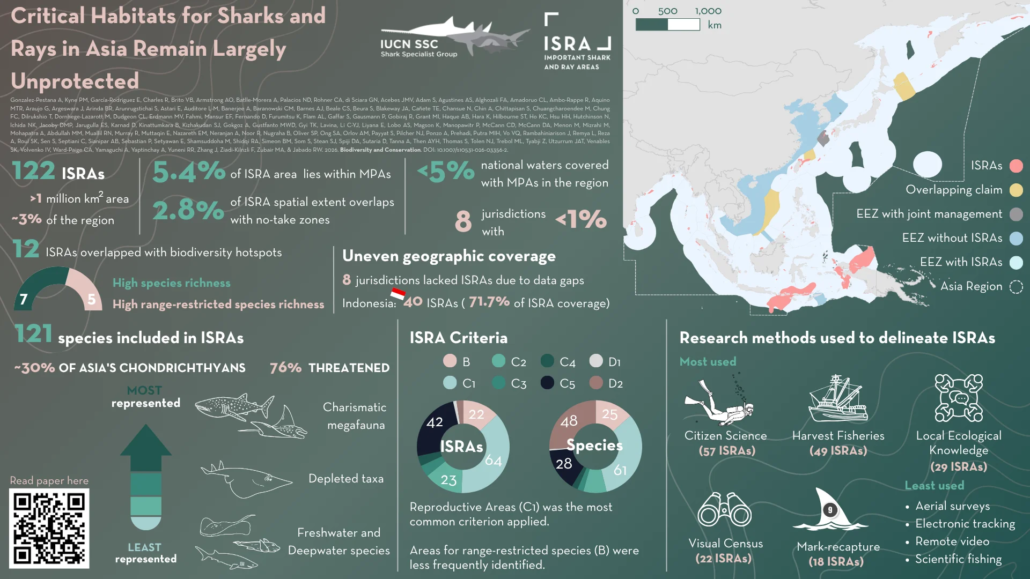
The Asia region harbors exceptional chondrichthyan (shark, ray, and chimaera) diversity but faces intense fishing pressure. The Important Shark and Ray Area (ISRA) process provides a collaborative, evidence-based framework to identify critical habitats and inform spatial management. We assessed ISRAs across the Bay of Bengal, Southeast Asia, and the Northwest Pacific to characterize their extent, ecological significance, and conservation relevance. We delineated 122 ISRAs spanning ~ 1 million km2 (~ 3% of the region) across 12 jurisdictions and international waters, encompassing habitats for 121 species (~ 30% of Asia’s chondrichthyans), 76% of which are threatened. Depleted taxa (e.g., giant guitarfishes, Glaucostegidae) were represented, but charismatic megafauna (e.g., Whale Shark Rhincodon typus) were overrepresented. In contrast, deepwater and freshwater species were underrepresented. Reproductive Areas were the most common ISRA sub-criterion applied (52% of ISRAs), largely in nearshore zones, while areas for range-restricted species were less frequently (18%) identified. Twelve ISRAs overlapped with biodiversity hotspots, including seven in areas of high overall chondrichthyan species richness and five in areas of high range-restricted species richness. Citizen science was the predominant research method used to delineate ISRAs, while fisheries data were underused despite the region’s major fisheries footprint. Geographic coverage was uneven: Indonesia held the most ISRAs (n = 40; 71.7% of ISRA coverage) while eight jurisdictions (e.g., Viet Nam, China, Republic of Korea) lacked ISRAs due to data gaps. Protection shortfalls are stark: MPAs cover < 5% of national waters in 16 jurisdictions (eight with < 1%); 5.4% of ISRA area lies within MPAs; and only 2.8% of ISRA spatial extent overlaps with no-take zones. These results provide a regional foundation to guide spatial planning, prioritize management, close data gaps, and support recovery of Asia’s diverse and imperiled chondrichthyan assemblages.
Read the full paper here