
ISRA FACTSHEETS
ISRA FACTSHEETS
EUROPEAN ATLANTIC
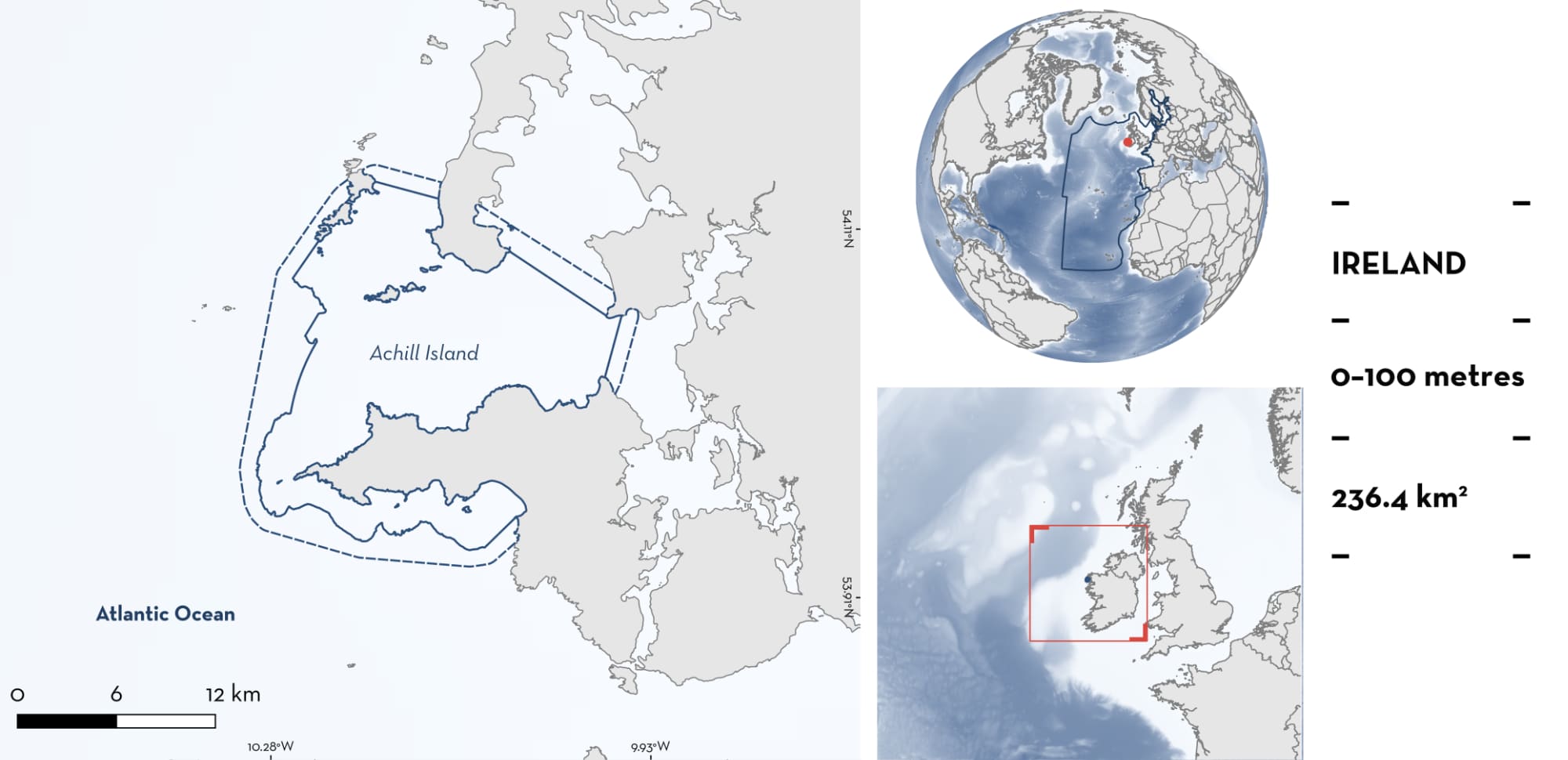
Achill Island
Summary
Achill Island is located in County Mayo, off the west coast of Ireland. The area is a coastal region on the continental shelf and encompasses a diversity of habitats, including headlands, cliffs, bays, and inlets, which likely serve to create small fronts and eddies that aggregate prey. This area overlaps with the Achill Head Special Area of Conservation. Within this area there are: threatened species and feeding areas (Basking Shark Cetorhinus maximus).
Download factsheet
Achill Island
DESCRIPTION OF HABITAT
Achill Island is located in County Mayo off the west coast of Ireland. It is the largest of the Irish Isles with an area of 148 km2. The island’s coastline is characterised by a combination of cliffs and headlands, bays and large shallow inlets, rocky and sandy beaches, rocky reefs, and flat coastal grasslands. The subtidal environment encompasses areas of mudflats, sandflats, flat sloping bedrock with small patches of cobbles and boulders, and diverse biotic communities of red algae, brown algae, and rare sponges (NPWS 2013). These structures, specifically the cliffs and headlands, likely serve to create small fronts and eddies that aggregate prey, creating suitable feeding areas within inlets and bays.
Irish coastal waters remain relatively well mixed in boreal winter, but in the warmer months thermal stratification occurs and influences phytoplankton growth from March to September. Offshore, in shelf waters, the transport of phytoplankton is associated with the Irish Coastal Current with bottom density fronts developing and transporting blooms. Diatom blooms occur in both the spring and autumn, with spring bloom abundances higher than autumn blooms. Dinoflagellates are typically at their highest abundance from June to August, with the growth season commencing in May and continuing through to August on an annual basis, seasonally creating a highly productive area (Marine Institute 2023).
This Important Shark and Ray Area is pelagic and delineated from inshore and surface waters (0 m) to a depth of 100 m based on the depth range of habitat in the area.
CRITERION A
VULNERABILITY
One Qualifying Species considered threatened with extinction according to the IUCN Red List of Threatened Species regularly occurs in the area. This is the Endangered Basking Shark (Rigby et al. 2021).
CRITERION C
SUB-CRITERION C2 – FEEDING AREAS
Achill Island is an important feeding area for one shark species.
Basking Sharks have aggregated to feed at Achill Island from the end of March–August since at least the 1950s. Every year, sharks can be observed swimming slowly at or near the surface with an open gape and the presence of plankton blooms in line with the animal’s path. During these months, up to 50 individuals are regularly sighted feeding within the coastal corridor in a single encounter. This behaviour is regularly observed by local maritime operators who have led public excursions, facilitated scientific research across this area, and worked for the Achill Basking Shark fishery for ~70 years (R Sweeney & G Hassett pers. comm. 2025). Feeding Basking Sharks have also been frequently observed by researchers from the Marine Institute of Ireland conducting tagging from April–May 2021–2025. Marine Institute researchers have observed >30 Basking Shark in a single day’s tagging in 2021, and >10 daily during three days of tagging in consecutive years from 2022–2025 (C Waters, A Drumm, & J Cooney pers. comm. 2025). A total of 43 of these Basking Shark have been tagged while feeding during this time, with results from tagging showing evidence of residency of 1–9 days (Thorburn et al. 2024; Marine Institute unpubl. data 2025). Basking Sharks display inter-annual site fidelity to this location, with individuals returning in consecutive years. For example, two sharks were detected 506 days post-tagging in the area (Thorburn et al. 2024). In May 2021 and April 2022, two aggregation events were documented on an acoustic array comprising 11 and 12 sharks, respectively (Thorburn et al. 2024). These sharks had been tagged near Achill Island in the same month as these aggregation occurrences. Further aggregations of Basking Shark have also been reported from Achill Island by citizen scientists on 37 occasions, six prior to 2010 (mean = 6.3; maximum = 13) and 31 between 2010–2024 (mean = 6.4; maximum 30 individuals; Irish Basking Shark Group [IBSG] & Irish Whale and Dolphin Group [IWDG] unpubl. data 2025). Though the citizen science reports do not always document behaviours, these aggregations are suspected to be for feeding purposes as feeding is the most commonly observed behaviour in this location, as described above. Furthermore, these aggregations occur seasonally regularly and predictably between March–June, which is typically the season that Basking Shark are observed feeding around the Irish coast (IBSG & IWDG unpubl. data 2025). Images posted on social media from Achill Island have also depicted the sharks feeding at the surface (The Wild Atlantic Traveller 2025). Moreover, this location has a historic significance due to the Achill Basking Shark fishery that was located in this region from the 1950s–1980s, established based on the consistency of aggregations. At its peak, the Achill fishery caught a total of 9,000 Basking Sharks between 1950–1964 (McNally 1976). This area is the world’s most well-documented Basking Shark fishery throughout the 20th century, with contemporary data supporting its current importance.
Download factsheet
SUBMIT A REQUEST
ISRA SPATIAL LAYER REQUEST
To make a request to download the ISRA Layer in either a GIS compatible Shapefile (.shp) or Google Earth compatible Keyhole Markup Language Zipped file (.kmz) please complete the following form. We will review your request and send the download details to you. We will endeavor to send you the requested files as soon as we can. However, please note that this is not an automated process, and before requests are responded to, they undergo internal review and authorization. As such, requests normally take 5–10 working days to process.
Should you have questions about the data or process, please do not hesitate to contact us.

