ISRA FACTSHEETS
ISRA FACTSHEETS
EUROPEAN ATLANTIC
An Mhuir Cheilteach
Summary
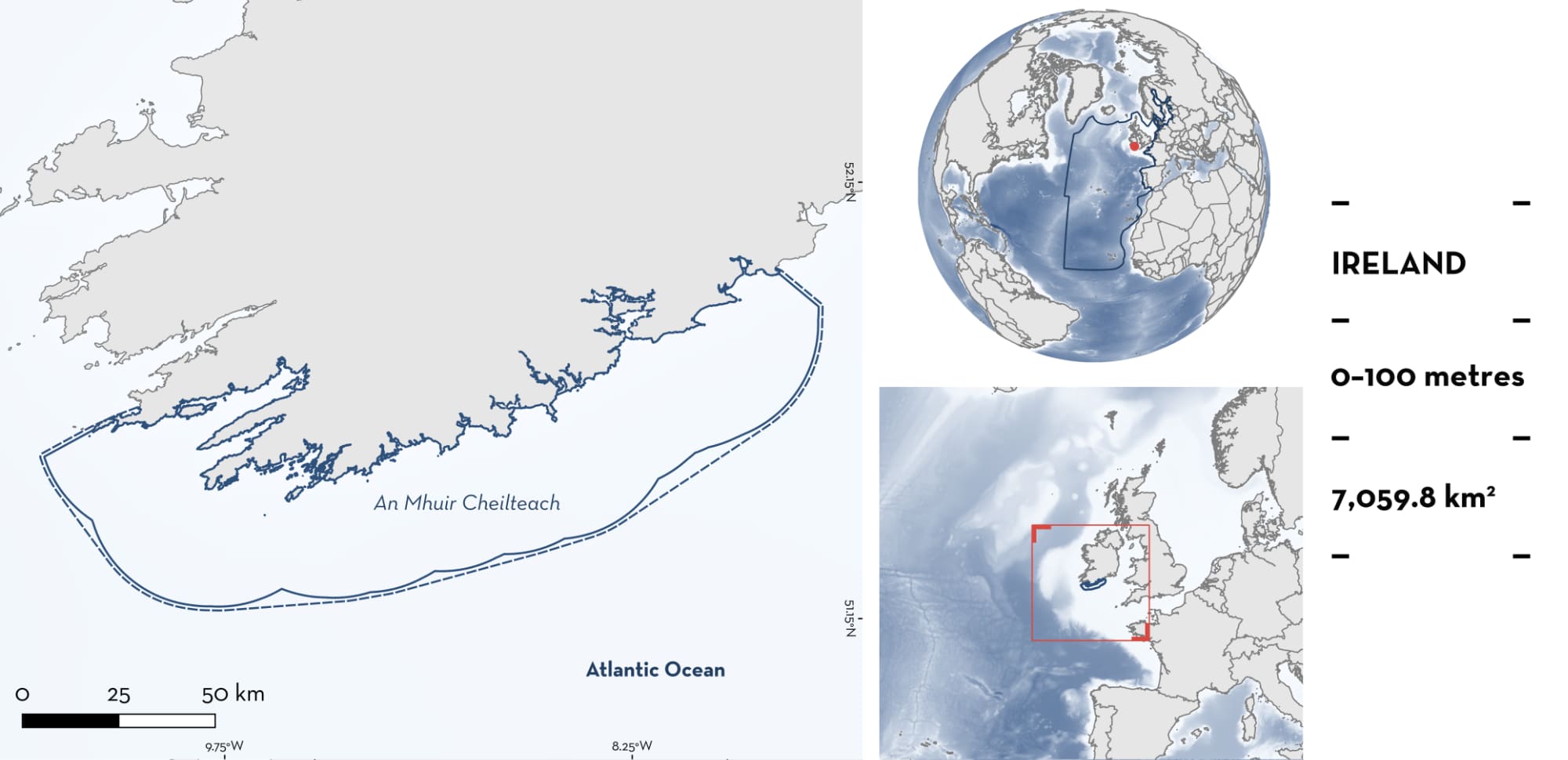
An Mhuir Cheilteach is located on the continental shelf off the southern seaboard of Ireland. The area includes a diversity of coastal habitats, including headlands and cliffs, which likely serve to create small fronts and eddies that aggregate prey. The area also includes a network of shallow coastal bays encompassing a range of habitats, including rocky reefs and muddy and sandy substrates. This area overlaps with two Ramsar Sites. Within this area there are: threatened species (Basking Shark Cetorhinus maximus); feeding areas (Basking Shark); and undefined aggregations (Blue Shark Prionace glauca).
Download factsheet
An Mhuir Cheilteach
DESCRIPTION OF HABITAT
An Mhuir Cheilteach is located on the continental shelf off the southern seaboard of Ireland. This coastal habitat consists of rocky reefs, cliffs and headlands, rocky inlets, and bays. The benthic habitat is predominantly offshore circalittoral sand, rock and biogenic reef, coarse sediment, rock and biogenic reef, and mud (EMODnet 2025). Cork Harbour, within the area, is a transitional waterway with a large freshwater influence that experiences intense tidal flows with a >4 m spring tidal range (Hartnett & Nash 2015).
This is a highly productive ecosystem with cliffs and headlands that likely serve to create small fronts and eddies that aggregate prey. Offshore, in shelf waters, the transport of phytoplankton is associated with the Irish Coastal Current with bottom density fronts developing and transporting blooms. Around the Irish coastline, diatom blooms occur in both the boreal spring and autumn, with higher abundances in spring, seasonally creating productive areas along the coast (Marine Institute 2023).
This area overlaps with Ballycotton Bay and Ballymacoda Ramsar Sites (Wetlands of International Importance; Ramsar 2025a, 2025b).
This Important Shark and Ray Area is benthic and pelagic and is delineated from inshore and surface waters (0 m) to 100 m based on the depth range of Qualifying Species in the area.
CRITERION A
VULNERABILITY
One Qualifying Species considered threatened with extinction according to the IUCN Red List of Threatened Species regularly occurs in the area. This is the Endangered Basking Shark (Rigby et al. 2021).
CRITERION C
SUB-CRITERION C2 – FEEDING AREAS
An Mhuir Cheilteach is an important feeding area for one shark species.
Basking Sharks have been observed to feed predictably in this area based on four different data sources. Firstly, feeding has been observed yearly from April to May by local maritime operators who have led public excursions and facilitated scientific research across this area for the last ~50 years (M Gannon & D Edwards pers. obs. 2025). Feeding behaviour is classified here as slow swimming at or near the surface, with animals showing an open gape and the presence of plankton blooms in line with the animal’s path. During these months, up to 100 individuals are regularly sighted feeding during a single encounter. Secondly, feeding behaviours were frequently observed by researchers during tagging and slime-sampling efforts conducted in 2022 and 2025 with between 4 – >10 individuals feeding per day over eight days in 2022 and 10+ individuals observed per day over two days in 2025 (A McInturf, N Payne, A Gallagher unpubl. data 2025). Thirdly, in 2022, research using animal-borne cameras and biologgers (n = 2) documented feeding bouts based on the extension of the gills seen on camera while in this location (D Cade pers. comm. 2025). Lastly, aggregations of Basking Sharks were regularly reported in this area from 1982–2024 via the Irish Basking Shark Group (IBSG) (IBSG unpubl. data 2025). Between 1982–2009, 62 of 247 total sightings (25%) included aggregations of three or more Basking Sharks (mean = 3.2; max = 100). From 2010–2024, 224 aggregations were reported, with a mean aggregation size of 12.4 individuals (max = 150 individuals). Aggregations are of notable size here, with 40 sightings of >20 individual sharks identified between 1982–2024. Although these reports do not always document animal behaviour, these aggregations are suspected to be for feeding purposes, as the vast majority (~95%) of aggregations fall between April and June, which is when Basking Sharks are known to use this area for feeding.
CRITERION C
SUB-CRITERION C5 – UNDEFINED AGGREGATIONS
An Mhuir Cheilteach is an important area for undefined aggregations of one shark species.
Data are available from sharks caught on rod-and-line by sports fishers, tagged with conventional tags, and released. The data were reported to Inland Fisheries Ireland’s (IFI) Marine Sportfish Tagging Programme (IFI 2023; IFI unpubl. data 2025). Fishing trips were either from shore or from a boat and ranged from 2–8 hours per day. Reports are limited to successful trips, where at least one shark was captured. Catch was reported as the number of individuals of a species per angling trip per day and aggregations are reported as trips in which >3 individuals were caught. The angling season spans April to October with peak aggregations of species between June–August annually.
Of all Blue Sharks tagged around Ireland between 2010–2017 and 2022–2024, 68% (n = 1,804) were recorded in the area. Blue Sharks were recorded on 346 trips in total. Aggregations were inferred on 179 occasions with a mean group size of 5.7 individuals (max = 53). Aggregations occurred between June and September 2010–2017 and 2022–2023, with 60% of these reported from July and August. On 29 days between 2010–2017, two or more taggers relatively large numbers of Blue Sharks per trip. Tagged Blue Shark in this area were predominantly female (1:0.1 F:M ratio). Inland Fisheries Ireland has reported that Blue Sharks typically occur in large numbers, inferring aggregations, which are often size and sex segregated (IFI unpubl. data 2025). As these captured individuals are almost all female, it is suspected that these are sex separated aggregations. Sex separated aggregating behaviours have been further observed in this species in the Atlantic and Indian oceans (Litvinov 2006; Coelho et al. 2018). Chumming is occasionally performed when angling for Blue Sharks in this area; however, given the high proportion of Blue Sharks caught in this area compared to other parts of Ireland and given how high the numbers are in this area (up to 53 individuals caught per trip), this area appears to be an important aggregation site for Blue Sharks.
This area is a known hotspot for Blue Sharks on the Irish coast, which is reflected in fishing blogs and social media posts. There are multiple reports of anglers catching Blue Sharks in double figures on a single trip in this area. For example, one post reported 12 Blue Sharks caught on one day, another 12 Blue Sharks caught two days later, and 13 Blue Sharks caught the following day (Kelly 2020). Another post stated that in one week, one group of anglers caught 10 Blue Sharks on a trip, another trip landed 16 Blue Sharks, and a third trip landed 10 Blue Sharks in the same area (IFI 2022). Reports such as these are commonly seen on angling forum websites. Further information is needed to understand the nature and function of these aggregations.
Download factsheet
SUBMIT A REQUEST
ISRA SPATIAL LAYER REQUEST
To make a request to download the ISRA Layer in either a GIS compatible Shapefile (.shp) or Google Earth compatible Keyhole Markup Language Zipped file (.kmz) please complete the following form. We will review your request and send the download details to you. We will endeavor to send you the requested files as soon as we can. However, please note that this is not an automated process, and before requests are responded to, they undergo internal review and authorization. As such, requests normally take 5–10 working days to process.
Should you have questions about the data or process, please do not hesitate to contact us.