ISRA FACTSHEETS
ISRA FACTSHEETS
SOUTH AMERICAN ATLANTIC REGION
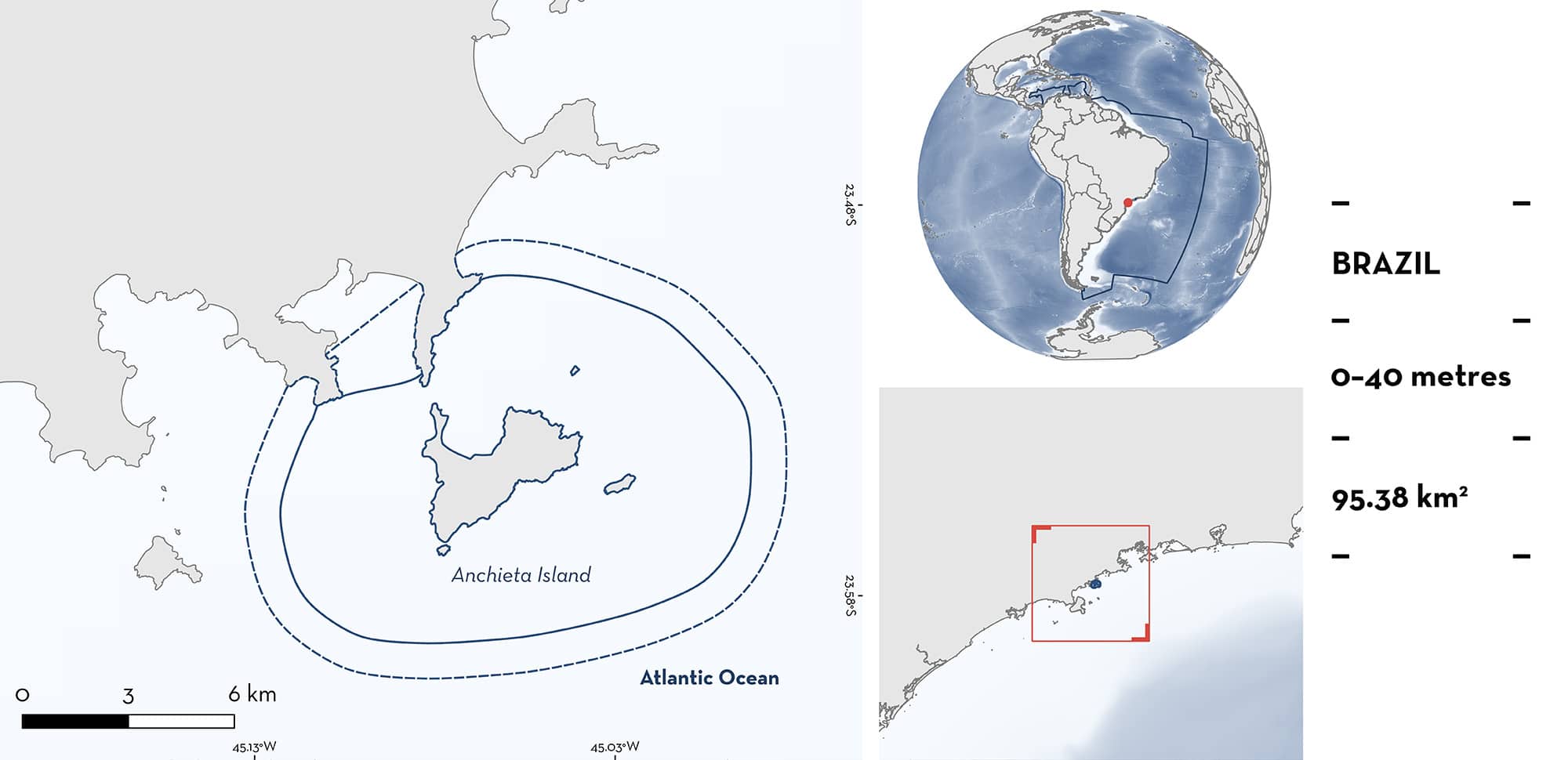
Anchieta Island
Summary
Anchieta Island is located in the northern part of the São Paulo state in southeastern Brazil. The area encompasses Anchieta Island and surrounding islands including Palmas and Cabras Islands. It is characterised by muddy substrate and patches of algae. The area is influenced by a cold, nutrient-rich water mass. It overlaps with the Tupinambás Ecological Station – Conflict Zone Marine Protected Area. Within this area there are: threatened species (e.g., Rio Skate Rioraja agassizi); range-restricted species (e.g., Brazilian Guitarfish Pseudobatos horkelii); and reproductive areas (e.g., Shortnose Guitarfish Zapteryx brevirostris).
Download factsheet
Anchieta Island
DESCRIPTION OF HABITAT
Anchieta Island is located in Ubatuba, in the northern part of the São Paulo state in southeastern Brazil. The area encompasses Anchieta Island and some surrounding islands, including Palmas and Cabras Islands. It is characterised by heterogeneous sediment with high deposition of sand and higher concentration of organic matter related to algae banks on the continental side of the area (Candido 2023). The area has relatively stable conditions and is less influenced than other surrounding areas by south and southeast waves (Barcellos & Furtado 1999). The direction and intensity of the winds influence the area through the seasonal (austral spring and summer months) influx of the South Atlantic Central Water (Pires-Vanin & Matsuura 1993; Muto et al. 2000; Sumida et al. 2005).
This area encompasses the Apa Marinha Do Litoral Norte marine protected area (MPATLAS 2025).
This Important Shark and Ray Area is benthic and pelagic and is delineated from inshore and surface waters (0 m) to 40 m based on the bathymetry of the area.
CRITERION A
VULNERABILITY
Three Qualifying Species considered threatened with extinction according to the IUCN Red List of Threatened Species regularly occur in the area. These are the Critically Endangered Brazilian Guitarfish (Pollom et al. 2020b), the Endangered Shortnose Guitarfish (Pollom et al. 2020a), and the Vulnerable Rio Skate (Pollom et al. 2020c).
Rio Skate is also considered Endangered according to the Red Book of Marine Fishes of Brazil (ICMBio 2018).
CRITERION B
RANGE RESTRICTED
Anchieta Island holds the regular presence of Brazilian Guitarfish and Rio Skate as resident range-restricted species. These species have been regularly reported from otter trawl surveys undertaken between 2022–2024 and citizen science reports (TC Karlovic & JF Dias unpubl. data 2024). Surveys were undertaken across the broader adjacent area of Ubatuba, however, these range-restricted species were only observed in this area.
For Brazilian Guitarfish, 71 individuals were reported from otter trawl surveys (TC Karlovic & JF Dias unpubl. data 2024). Aggregations of >100 individuals were also reported in the area in 2024 and 2025 via citizen science. Between 2022–2024, 64 otter trawl surveys reported 84 Rio Skate; many of which were considered neonate/young-of-the-year (YOY) based on their sizes (TC Karlovic & JF Dias unpubl. data 2024). There are also historical reports of these species in this area since 1985, which confirm the longstanding importance of the area for these range-restricted species (Ponz-Louro 1995; Rocha & Rossi-Wongtschowski 1998; Muto et al. 2000; Oddone & Amorim 2007; Oddone et al. 2007; Oddone et al 2008; Souza et al. 2018; Rodrigues et al. 2021). Brazilian Guitarfish occur in the South Brazilian Shelf Large Marine Ecosystem (LME) and the Patagonian Shelf LME. Rio Skate occur primarily in the South Brazilian Shelf LME and Patagonian Shelf LME, and only marginally in the East Brazil Shelf LME.
CRITERION C
SUB-CRITERION C1 – REPRODUCTIVE AREAS
Anchieta Island is an important reproductive area for two ray species.
Brazilian Guitarfish (n = 71) were recorded from 64 otter trawl surveys undertaken between 2022–2024 (TC Karlovic & JF Dias unpubl. data 2024). Surveys were undertaken in May 2022 (n = 16), November 2022 (n = 16), January 2023 (n = 16), and February 2024 (n = 16). Of the animals captured, 44 were neonates/YOY measuring 24–42 cm total length (TL) (TC Karlovic & JF Dias unpubl. data 2024). The size-at-birth of this species is 22–29 cm TL (Gomes et al. 2010), and the size at one year of age is 45 cm TL (Caltabellotta et al. 2019). Neonates/YOY were caught in 2022 (n = 18; 30–42 cm TL), 2023 (n = 10; 24–29 cm TL), and 2024 (n = 16; 23–28 cm TL). In addition, Brazilian Guitarfish aggregate in groups of >100 individuals in this area for reproductive purposes – specifically at Palmas Beach on Anchieta Island. Aggregations have been reported by Anchieta Island State Park’s staff, recreational divers, and scientific researchers (LC Candido pers. obs. 2025; TC Karlovic, JF Dias, LC Candido & PS Moreira unpubl. data 2024). Brazilian Guitarfish are known to migrate from deeper areas (>100 m) to coastal zones during the summer months to mate and give birth (Lessa et al. 1986; Anderson et al. 2021). Therefore, Brazilian Guitarfish appear to be aggregating in this area for reproductive purposes. This is consistent with the observations in this area where in 2024, aggregations increased in size from four individuals in October to >100 individuals in November (PS Moreira pers. obs. 2025). Divers from the Diving into Conservation Project also video-recorded aggregations in January 2025. In the same month, drone surveys at Palmas Beach also recorded aggregations of >100 individuals (adults measuring >74 cm TL) (TC Karlovic & LC Candido unpubl. data 2025c).
For Shortnose Guitarfish, at least 25 animals were recorded during otter trawl surveys undertaken between 2022–2024 (TC Karlovic & JF Dias unpubl. data 2024). Of these, 24 neonates/YOY were recorded in 2022 (n = 11, 13–55 cm TL), 2023 (n = 10, 16–46 cm TL), and 2024 (n = 3, 20–34 cm TL). The size-at-birth of this species is 13–14 cm TL (Carmo et al. 2018; Maganhe et al. 2023), and the size at one year of age is ~25 cm TL (Caltabellotta et al. 2019). Shortnose Guitarfish occur primarily in the South Brazilian Shelf LME and Patagonian Shelf LME, and only marginally in the East Brazil Shelf LME.
Historic trawl survey data collected between 1985–1986 (39 trawls undertaken up to the 30 m isobath) also reported the presence of neonate/YOY individuals of these two species in this area. The combination of these historic reports of neonate/YOY Brazilian Guitarfish (n = 19) and Shortnose Guitarfish (n = 22) in combination with the contemporary information confirm the longstanding importance of this area for early life stages of these range-restricted species (JF Dias unpubl. data 2024). This is one of the only known locations with regular and predictable observations of Shortnose Guitarfish at early life stages.
Download factsheet
SUBMIT A REQUEST
ISRA SPATIAL LAYER REQUEST
To make a request to download the ISRA Layer in either a GIS compatible Shapefile (.shp) or Google Earth compatible Keyhole Markup Language Zipped file (.kmz) please complete the following form. We will review your request and send the download details to you. We will endeavor to send you the requested files as soon as we can. However, please note that this is not an automated process, and before requests are responded to, they undergo internal review and authorization. As such, requests normally take 5–10 working days to process.
Should you have questions about the data or process, please do not hesitate to contact us.