ISRA FACTSHEETS
ISRA FACTSHEETS
EUROPEAN ATLANTIC
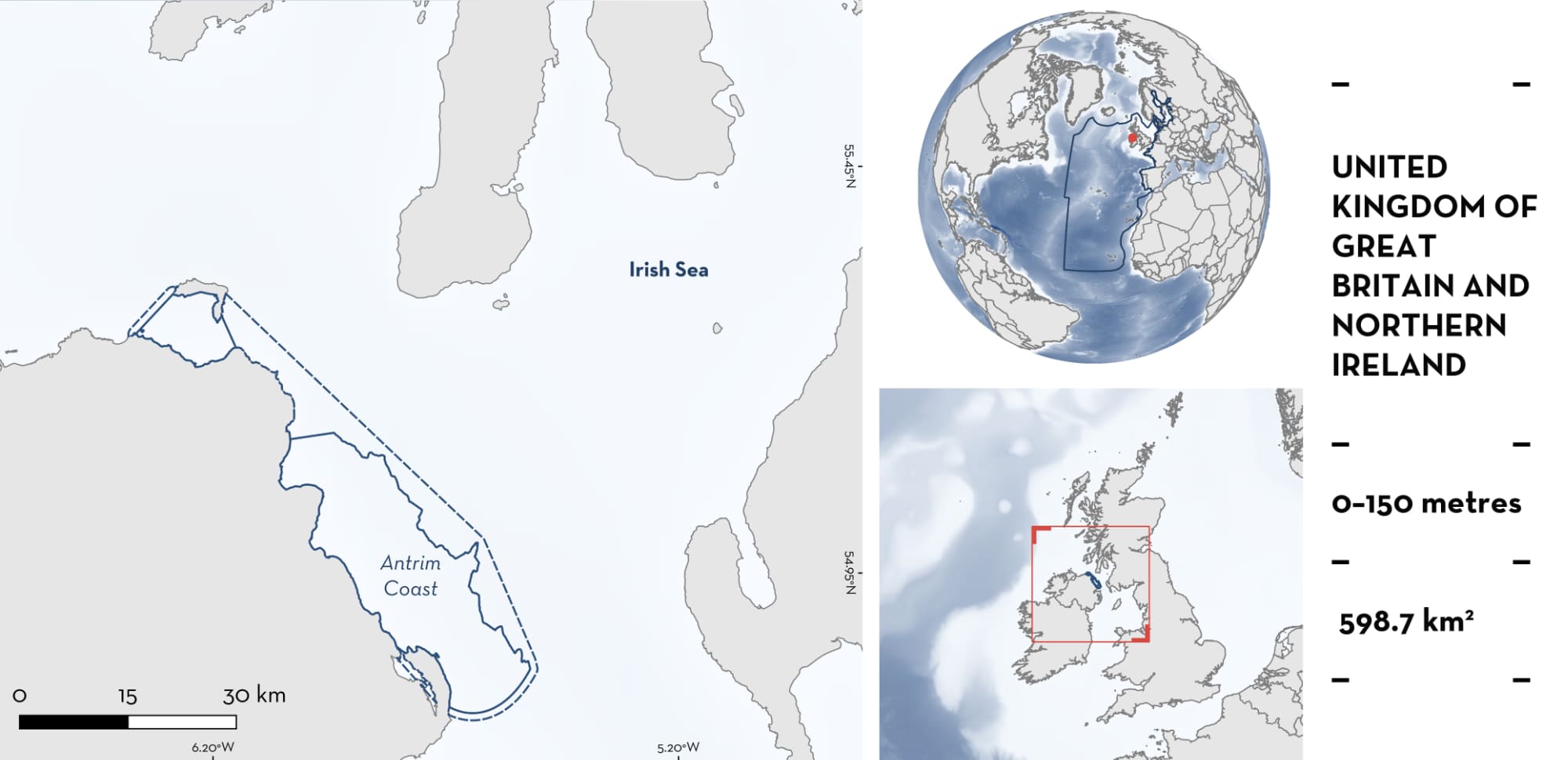
Antrim Coast
Summary
Antrim Coast is located on the coast of Northern Ireland in the United Kingdom of Great Britain and Northern Ireland. The area is characterised by a variety of demersal habitat features including mudflats, gravel, maerl, and sandbanks, as well as deeper water areas and submerged sea caves. The area connects the North Atlantic Ocean and the Irish Sea, encompassing fast flowing currents and the deep North Channel. The area overlaps with three Key Biodiversity Areas and one Ramsar Site. Within this area there are: threatened species and undefined aggregations (Spiny Dogfish Squalus acanthias).
Download factsheet
Antrim Coast
DESCRIPTION OF HABITAT
Antrim Coast is s located on the coast of Northern Ireland in the United Kingdom of Great Britain and Northern Ireland. The area encompasses many bays and inlets including Red Bay, which is characterised by sandbanks of live maerl, gravel, cobbles, and sub-fossil maerl (DAERA 2025a), and Belfast Lough, a large intertidal estuary of the River Lagan. The outer lough is mainly rocky shores and small sandy bays, and the inner lough consists of mudflats and lagoons (Ramsar 2025). Just offshore and north of Belfast Lough is the Maidens, a group of small rocky reefs off northeast Larne. These reefs have rare habitats due to regional hydrographic conditions. The Maidens is within the North Channel, which connects the Atlantic Ocean to the Irish Sea, experiencing fast flowing currents and in close proximity to deep upwelling water (DAERA 2025b). Rathlin Island is in the north of the area and includes reefs, submerged sea caves, shallow sandbanks, and vegetated sea cliffs of the Atlantic coast (DAERA 2025c). Larne Lough consists of mudflats and mussel-beds (KBA 2025b).
The area encompasses the Belfast Lough Ramsar Site (Wetland of International Importance; Ramsar 2025) and three Key Biodiversity Areas (KBA): Rathlin Island KBA (KBA 2025a), Larne Lough KBA (KBA 2025b), and Belfast Lough KBA (KBA 2025c).
This Important Shark and Ray Area is benthic and pelagic and is delineated from inshore and surface waters (0 m) to a depth of 150 m based on the bathymetry of the area.
CRITERION A
VULNERABILITY
One Qualifying Species considered threatened with extinction according to the IUCN Red List of Threatened Species regularly occurs in the area. This is the Vulnerable Spiny Dogfish (Finucci et al. 2021).
CRITERION C
SUB-CRITERION C5 – UNDEFINED AGGREGATIONS
Antrim Coast is an important area for undefined aggregations of one shark species.
Data were obtained from the Inland Fisheries Ireland’s (IFI) Marine Sportfish Tagging Programme (IFI 2023; IFI unpubl. data 2025). The programme provides data from sharks and rays caught on rod-and-line by sports fishers, tagged with conventional tags, released, and reported to IFI’s Marine Sportfish Tagging Programme. Fishing trips were either from shore or from a boat and ranged from 2–8 hours per day. Reports are limited to successful trips, where at least one shark or ray was captured. Catch is reported as the number of individuals of a species caught per angling trip in one day, and aggregations refer to trips in which >3 individuals were caught. The angling season spans April–October with peak aggregations of species between June–August annually.
Antrim Coast is a popular fishing site for Spiny Dogfish, and is visited by anglers each year, which is highlighted in angling blogs, forums, and social media pages. Local ecological knowledge informs that this area is a hotspot for Spiny Dogfish, with one angling blog stating “The north coast offers the greatest chance of running into a pack of Spurs (Spiny Dogfish), where they can be found on numerous marks dotted along the coastline from Downings in North Donegal and travelling south through Antrim into County Down and beyond” (Sea Angling Ireland 2025). A large number of angling websites share videos and reports of large numbers or ‘packs’ of Spiny Dogfish from this area.
Of the 412 Spiny Dogfish that were captured and tagged around the Irish coast between 2010–2024 through IFI’s Marine Sportfish Tagging Programme, almost half (47%; n = 192) were recorded in the area. Spiny Dogfish were recorded on 29 trips and aggregations were caught on 17 occasions (3–48 individuals) with a mean group size of 10.6 individuals. Almost all individuals were female (female:male 1:0.02). Months with observed aggregations were: January 2010, March 2011, July 2011, August 2011, February 2012, June 2012, August 2012, August 2013, August 2015, September 2015, February 2019, January 2020, July 2022, August 2023, and February 2024.
In addition, the Irish Specimen Fish Committee (ISFC; Casserly & Roche 2023) collects angling reports of large individuals of marine and freshwater fish. Species and length are verified using photographic evidence before inclusion in the ISFC report each year. Of the 745 reports to the IFSC of large (>5.4 kg or >105 cm total length [TL]) Spiny Dogfish from around the Irish coast from 2010–2024, almost half (49%; n = 363) were from the area. Aggregations were reported on nine occasions with a mean aggregation size of 3.5 individuals and a maximum aggregation of five individuals (Casserly & Roche 2023). Anglers do not chum the water when fishing for Spiny Dogfish indicating that these animals are naturally present in high abundances. Aggregating behaviour is common in Spiny Dogfish, which are known to form large aggregations segregated by sex (Colonello et al. 2016; FishBase 2025). Almost half of the data from the entire island of Ireland from both IFI’s Marine Sportfish Tagging Programme and the IFSC occur in this area, highlighting the regional importance of this area for Spiny Dogfish. However, more information is needed to understand the nature and function of these aggregations.
Download factsheet
SUBMIT A REQUEST
ISRA SPATIAL LAYER REQUEST
To make a request to download the ISRA Layer in either a GIS compatible Shapefile (.shp) or Google Earth compatible Keyhole Markup Language Zipped file (.kmz) please complete the following form. We will review your request and send the download details to you. We will endeavor to send you the requested files as soon as we can. However, please note that this is not an automated process, and before requests are responded to, they undergo internal review and authorization. As such, requests normally take 5–10 working days to process.
Should you have questions about the data or process, please do not hesitate to contact us.