ISRA FACTSHEETS
ISRA FACTSHEETS
ASIA REGION
Ariake–Amakusa
Summary
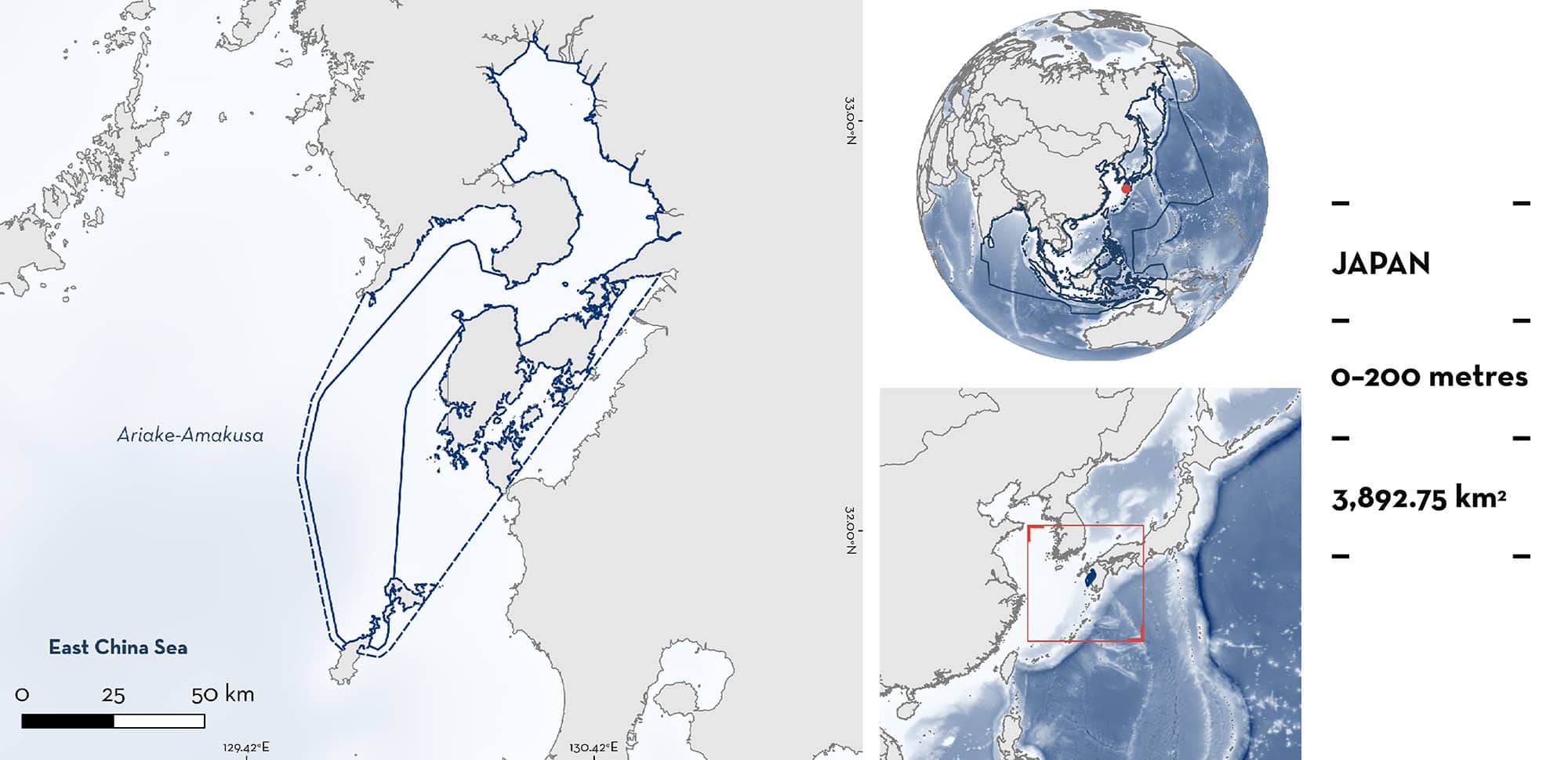
Ariake–Amakusa is located in northwest Kyushu Island, Japan. The area encompasses the unique ecosystem of Ariake Bay with a muddy substrate and the largest estuary in Japan, and the adjacent open water of the Amakusa Sea that borders the warm waters of the Kuroshio Current. The area overlaps with one Ecologically or Biologically Significant Marine Areas, five Key Biodiversity Areas, and three Wetlands of International Importance (Ramsar Sites). Within this area there are: threatened species and areas important for movement (Naru Eagle Ray Aetobatus narutobiei).
Download factsheet
Ariake–Amakusa
DESCRIPTION OF HABITAT
Ariake–Amakusa is located in northwest Kyushu Island, Japan. It encompasses Ariake Bay and the Amakusa Sea. Ariake Bay is the largest bay on Kyushu Island covering an area of 1,700 km2. The northern part of the bay is shallow (<20 m), while the southern part of the bay is relatively deep. The mouth of the bay is the deepest area in the southern bay, almost 200 m deep and very narrow, forming a bottleneck barrier or pseudo-closed bay where mixing with oceanic waters occurs (Furumitsu et al. 2019). Ariake Bay is fed by numerous rivers (Arifin et al. 2019) forming the largest estuary in Japan (Yamguchi et al. 2021). The water temperature of the estuary and shallow areas of Ariake Bay oscillates seasonally with the minimum below 10ºC during the boreal winter between December and February, increasing to 15ºC in late April or May (Yamaguchi et al. 2005). The bay is subject to a great difference in tidal rages (maximum 6 m) generating fast currents and large tidal flats.
The Amakusa Sea is influenced by the Kuroshio Current-derived warm waters (Yamaguchi et al. 2005). The Kuroshio Current is a western boundary current in the subtropical North Pacific, originating in the Philippines, moving northward along the west boundary of the Pacific Ocean (Zhang et al. 2012). This current is one of the most important routes for poleward heat transport, contributing to the development of rich marine ecosystems along coastal regions (Lizarbe Barreto et al. 2012; Andres et al. 2015; Morioka et al. 2019). The area encompasses the waters at the west of Amakusa Island extending until the waters surrounding Koshiki Islands.
The area overlaps with the Inland Seas of Western Kyushu Ecologically or Biologically Significant Marine Areas (CBD 2024), it also includes five Key Biodiversity Areas (Isahaya Bay, Inner Ariake Bay, Ariake Bay-Marine, Shimabara Bay, and Shirakawa Estuary) (KBA 2024), One National Park (Unzen amakusa), one Prefectural Natural Park (Misumi oyano kaihen), three Prefectural Wildlife Protection Areas (Ariake, Honmyogawa, and Kumamotoko), two Protected Water Surface as Kumamoto Prefectural Fisheries Coordination Regulations Article34-2, one Quasi National Park (Koshikijima), and three Wetlands of International Importance (Ramsar Sites: Higashiyoka-Higata, Hizenkashima-Higata, and Arao-Higata) (UNEP-WCMC & IUCN 2024; Ramsar 2024).
This Important Shark and Ray Area is benthopelagic and is delineated from inshore and surface waters (0 m) to 200 m based on the depth used by the Qualifying Species.
CRITERION A
VULNERABILITY
One Qualifying Species within the area is considered threatened with extinction according to the IUCN Red List of Threatened Species. The Naru Eagle Ray is assessed as Vulnerable (Rigby et al. 2021).
CRITERION C
SUB-CRITERION C4 – MOVEMENT AREAS
Ariake–Amakusa is an important movement area for one ray species.
Naru Eagle Rays move between Ariake Bay and the Amakusa Sea seasonally during spring and winter in a regular and predictable way. Based on telemetry data using Argos transmitters collected between 2011 and 2019, adult Naru Eagle Rays (n = 28) spend summer months (May to September) inside Ariake Bay (A Yamaguchi unpubl. data 2023), where they reproduce and feed (Yamaguchi et al. 2021). During late autumn (late November and December) animals move from the interior of Ariake Bay along the Nagasaki prefecture side of the bay towards the Hayasaki Seto, crossing the strait to the Amakusa Sea and moving south towards the waters north of the Koshiki islands. Animals overwinter at this location in deep waters between 100 and 200 m (A Yamaguchi unpubl. data 2023). According to fishers in Kumamoto, this species is usually caught by benthic gillnets at depths ~200 m during winter (A Yamaguchi pers. obs. 2024). Further, pop-up tags attached to rays in winter recorded swimming depths of ~200 m (A. Yamaguchi et al. unpubl data 2024). Based on the examinations of Naru Eagle Rays captured during the predator control program between autumn 2001 to summer 2003, animals did not grow at the overwinter location where feeding activity is low during winter (Yamaguchi et al. 2005). The journey is reversed during spring (between April and May), when they move back inside Ariake Bay for summer (A Yamaguchi unpubl. data 2023).
Between 2001 and 2023, similar patterns were observed in the total catches of the predator control program in the area (Yamaguchi at al. 2005; A Yamaguchi unpubl. data 2023). Naru Eagle Ray catches inside Ariake Bay increased from April and peaked during the summer months. None were captured during December and February when the water temperature was >15–17°C inside the bay. The rays reappeared in the bay in late March or April when the water temperatures increased to 15°C. Naru Eagle Rays were never caught inside Ariake Bay during winter, although they were caught in the Amakusa Sea during winter. The Amakusa Sea abuts Kuroshio Current-derived warm waters and the water temperatures during winter are >15 °C (Yamaguchi et al. 2005), linking the migration to fluctuations in water temperatures.
Finally, a study on the life history and reproductive biology of Naru Eagle Rays examined a total of 1,189 animals collected by commercial vessels as part of the predator control program (20 cm mesh size, 400 m length) at depths of 8–20 m in the northern part of Ariake Bay between August 2001 and November 2019 (Yamaguchi et al. 2021). Findings revealed that this species reproduces synchronously and annually with a reproductive strategy closely linked to its migration pattern. The reproductive strategy includes rapid embryonic development, parturition, and mating in Ariake Bay during late summer, and a long period of embryonic diapause in relation to seasonal migrations outside of Ariake Bay (Yamaguchi et al. 2021). Embryonic diapause is likely linked to prey abundance, water temperature, and predator presence. At the end of summer when Naru Eagle Rays give birth, bivalves are abundant in Ariake Bay’s estuary and summer water temperature in Ariake Bay is high, but with the onset of autumn, water temperatures decline. Water temperature of the estuary and shallow areas of Ariake Bay is below 10◦C during the winter period, which can threaten the survival of Naru Eagle Rays. Therefore, when water temperature reaches 18–19◦C in late October and November, Naru Eagle Rays gradually move from the shallow regions to the deeper, southern habitat within Ariake Bay, before migrating to the open sea to overwinter. The observations include a 200 km migration from the innermost area of Ariake Bay to the Amakusa Sea in the East China Sea over the period of a month (A Yamaguchi & K Furumitsu unpubl. data 2023).
Download factsheet
SUBMIT A REQUEST
ISRA SPATIAL LAYER REQUEST
To make a request to download the ISRA Layer in either a GIS compatible Shapefile (.shp) or Google Earth compatible Keyhole Markup Language Zipped file (.kmz) please complete the following form. We will review your request and send the download details to you. We will endeavor to send you the requested files as soon as we can. However, please note that this is not an automated process, and before requests are responded to, they undergo internal review and authorization. As such, requests normally take 5–10 working days to process.
Should you have questions about the data or process, please do not hesitate to contact us.