
ISRA FACTSHEETS
ISRA FACTSHEETS
CENTRAL AND SOUTH AMERICAN PACIFIC REGION
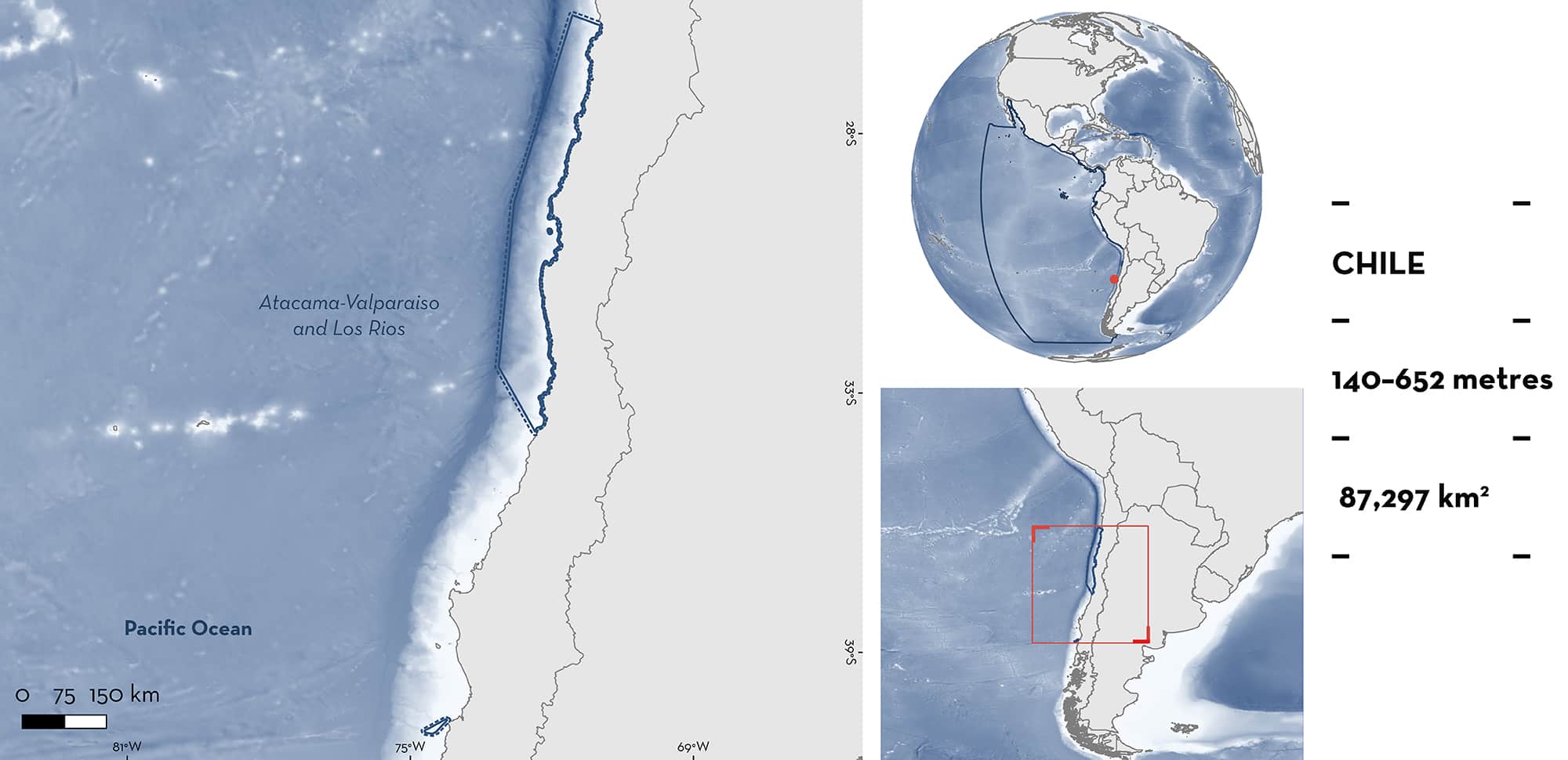
Atacama-Valparaiso and Los Rios
Summary
Atacama-Valparaíso and Los Rios are located off the central coast of Chile. This deep benthic area overlaps with two Ecologically or Biologically Significant Marine Areas, the Central and Southern Chile Humboldt Current Upwelling Systems. The area includes outer continental shelves, upper slopes, and marine canyons, and is characterised by the presence of fine clay and silt sediments, methane leaks, and deep-sea corals. Within this area there are: threatened species (e.g., Yellownose Skate Dipturus chilensis); range-restricted species (e.g., Yellownose Skate); reproductive areas (Dusky Catshark Bythaelurus canescens); and feeding areas (e.g., Dusky Finless Skate Gurgesiella furvescens).
Download factsheet
Atacama-Valparaiso and Los Rios
DESCRIPTION OF HABITAT
Atacama-Valparaíso and Los Rios is located off the central coast of Chile and border the Atacama, Coquimbo, Valparaíso, and Los Rios regions. This deep benthic area overlaps with two Ecologically or Biologically Significant Marine Areas, the Central and Southern Chile Humboldt Current Upwelling Systems (CBD 2017a, 2017b). The area includes outer continental shelves, upper slopes, and marine canyons, and is characterised by the presence of fine clay and silt sediments, methane leaks, and deep-sea corals.
The Central Chile Humboldt Current Upwelling System includes an important wind-driven upwelling centre located in its southern boundary and a topography- and current-driven upwelling centre in its northern boundary (CBD 2017a). The system is highly productive because the upwelling occurs year-round. It has a narrow continental shelf, for which there are great depths very close to the coast.
The Southern Chile Humboldt Current Upwelling System exhibits extremely high primary production values (>10 g C/m2/d). This region is characterised by strong seasonal upwellings, with intensive events taking place during the austral spring and summer period, along a relatively wide continental break (>50 km) interrupted by submarine canyons (CBD 2017b). Over the continental shelf, extended periods of hypoxia affect the benthic environment and this condition promotes the development of high biomass bacterial mats of the giant bacterium Thioploca. The high productivity of this ecosystem exhibits a strong inter-annual variability related to the El Niño-Southern Oscillation (ENSO) cycle.
The Humboldt Current krill Euphausia mucronata is a keystone and endemic species of the Humboldt Current Upwelling System. Within the 100-km coastal belt, it accounts for ~50% of the meso zooplankton wet weight in the austral winter, and along the Chilean coast its highest abundance is in northern-central Chile overlapping partly with this area (Antezana 2010). Also, Chilean Nylon shrimp Heterocarpus reedi is endemic to this area and sustains the main national shrimp fisheries and the largest deep shrimp fishery in the southeastern Pacific (Wehrtmann et al. 2012).
This Important Shark and Ray Area is delineated from a depth of 140 m to 652 m and is benthic following the continental slope based on the vertical distribution of the Qualifying Species within this area.
CRITERION A
VULNERABILITY
Two Qualifying Species considered threatened with extinction according to the IUCN Red List of Threatened SpeciesTM regularly occur in the area. These are the Endangered Yellownose Skate (Dulvy et al. 2021) and the Vulnerable Dusky Catshark (Concha et al. 2020).
CRITERION B
RANGE RESTRICTED
Atacama-Valparaíso and Los Rios holds the regular presence of Hooktooth Dogfish, Dusky Catshark, Dusky Finless Skate, and Yellownose Skate as resident range-restricted species. Hooktooth Dogfish, Dusky Catshark, and Yellownose Skate only occur in the Humboldt Current LME. Dusky Finless Skate occurs in the Humboldt Current LME and only marginally in the Pacific Central-American Coastal LME. These species have frequently been recorded since 1997 in the demersal crustacean trawl fishery operating along this area (Acuña & Villarroel 2002; Acuña et al. 2005; E. Acuña, unpubl. data 2022). For example, a study between 2007–2009 identified these species as frequently captured (30–35% of hauls for Hooktooth Dogfish, 23% for Dusky Finless Skate, 34–40% for Dusky Catshark) or relatively abundant (i.e., Yellownose Skate) with high catch-per-unit-effort (CPUE) compared to other elasmobranch species in the bycatch of demersal crustacean trawl fishery along this area (Queirolo et al. 2011). In contrast, these species are rarely seen in northern and central Peru (Quiroz et al. 1994; Kameya et al. 1997; Elliot & Samame 2001; Alfaro-Shigueto et al. in press).
CRITERION C
SUB-CRITERION C1 – REPRODUCTIVE AREAS
Atacama-Valparaíso and Los Rios is an important reproductive area for one shark species.
According to data collected from the deep-sea crustacean trawl fishery, Dusky Catshark gravid females and eggs-capsules regularly occur in the area with the highest abundance recorded off Taltal, Coquimbo, Valparaíso, Concepción, and Valdivia (C. Bustamante and E. Acuña, unpubl. data 2022). Twenty-four egg-bearing females and 70 egg-capsules were found off Santo Domingo, Valparaíso, at a depth range of 464–470 m (Gatica & Acuña in press). Fishery-dependent trawl data between 2006–2017 indicate that Taltal Bay foremost, and Concepción secondarily, present the highest CPUE for this species (E. Acuña, unpubl. data 2022). Moreover, in the southern part of this area, four egg-capsules were reported attached to the deep coral Antipathes speciosa at depths of 320 and 600 m (Concha et al. 2010). This species appears to exhibit sexual segregation, where pregnant females use deeper habitats mostly associated with deep-sea coral distribution (C. Bustamante unpubl. data 2022). Habitats in this area provide structures for entangling egg-capsules.
CRITERION C
SUB-CRITERION C2 – FEEDING AREAS
Atacama-Valparaíso and Los Rios is an important feeding area for two shark and one ray species. The high abundance of Hooktooth Dogfish, Dusky Catshark, and Dusky Finless Skate, and their prey (Chilean Nylon Shrimp) being the highest across their geographic ranges demonstrates the importance of this area for feeding purposes.
The stomach contents of 121 Hooktooth Dogfish and 312 Dusky Catsharks were examined from individuals collected as bycatch from the demersal crustacean trawl fishery from January 1997 to July 2000 (Acuña & Villarroel 2010). The most important prey by index of relative importance (IRI) and by frequency of occurrence in Hooktooth Dogfish was the Chilean Nylon Shrimp (21.6% IRI); while by number the euphausiid Humboldt Current Krill (37.9%) and by weight the Common Hake Merluccius gayi (11.1%). Chilean Nylon Shrimp was also the most important prey of the Dusky Catshark (45.3% IRI). The diet composition of Dusky Finless Skate was assessed in 2013 indicating that Chilean Nylon Shrimp (32.8% by weight), Chilean Knife Shrimp Haliporoides diomedeae (7.2% by weight), and indeterminate crustaceans (9% by weight) were the most important prey items (Ponce et al. in press).
This area encompasses the largest commercial fishery of deep shrimps in the geographic range of the three species. In contrast, in northern and central Peru, exploratory demersal trawling has determined that deepwater red shrimps represent only 8% of the total volume and sharks were rarely caught (Kameya et al. 1997; Elliot & Samame 2001). While in this area, the Chilean Nylon Shrimp is one of the most important commercially captured species (81.8% of the total catch) in the trawl fishery targeting demersal crustaceans (Acuña et al. 2005; Zilleruelo & Párraga 2009). This shrimp species is endemic to north and central Chile. A dependence by all three Qualifying Species on an endemic resource highlights the nutritional importance of this area.
Download factsheet
SUBMIT A REQUEST
ISRA SPATIAL LAYER REQUEST
To make a request to download the ISRA Layer in either a GIS compatible Shapefile (.shp) or Google Earth compatible Keyhole Markup Language Zipped file (.kmz) please complete the following form. We will review your request and send the download details to you. We will endeavor to send you the requested files as soon as we can. However, please note that this is not an automated process, and before requests are responded to, they undergo internal review and authorization. As such, requests normally take 5–10 working days to process.
Should you have questions about the data or process, please do not hesitate to contact us.

