ISRA FACTSHEETS
ISRA FACTSHEETS
EUROPEAN ATLANTIC
Azores-Great Meteor Seamount Corridor
Summary
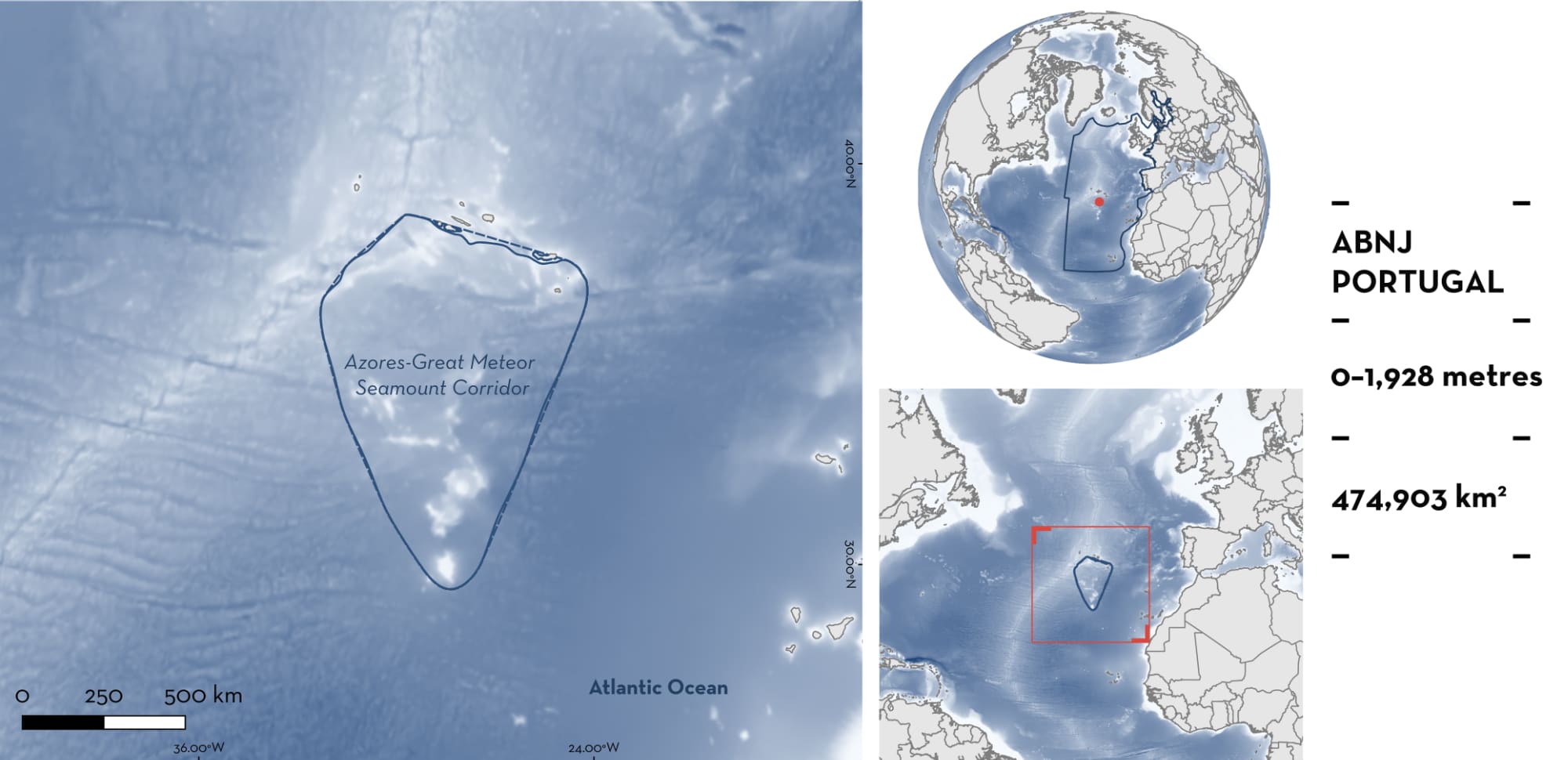
Azores-Great Meteor Seamount Corridor is located in the middle of the North Atlantic Ocean. It spans pelagic waters from the Azores Archipelago, Portugal, and areas beyond national jurisdiction (ABNJ) south of the Azores and around the Great Meteor Seamount. The area expands from the Azores slope and is characterised by the presence of multiple banks, seamounts of various summit depths, flat summit plateaus, terraces, and ridges. It overlaps with two Ecologically or Biologically Significant Marine Areas, two Key Biodiversity Areas, and three protected areas. Within this area there are: threatened species (e.g., Sicklefin Devil Ray Mobula tarapacana) and areas important for movement (e.g., Blue Shark Prionace glauca).
Download factsheet
Azores-Great Meteor Seamount Corridor
DESCRIPTION OF HABITAT
Azores-Great Meteor Seamount Corridor is located in the middle of the North Atlantic Ocean, in the Macaronesia region. It spans waters from the Azores Archipelago, an autonomous region of Portugal and areas beyond national jurisdiction (ABNJ) south of the Azores and around the Great Meteor Seamount. The area expands from the slope around the central and southern Azores islands and is characterised by the presence of multiple banks, seamounts of various summit depths, flat summit plateaus, terraces, and ridges (Morato et al. 2008, 2020; CBD 2025a).
The Great Meteor Seamount is one of the largest seamounts worldwide and is part of a volcanic chain found ~700 km south of the Azores (CBD 2025a). It rises from ~4,000 m depth up to a summit at ~350 m depth (Tojeira et al. 2025). It is characterised by terraces, steep slopes, and corals (Tojeira et al. 2025). Seamounts are considered hotspots for biodiversity due to an increase in productivity as eddies around them bring nutrient from deep waters (Coelho & Santos 2003; Mendonça et al. 2012; Afonso et al. 2020).
Dynamic features associated with the complex seabed topography of the Azores are typical of the region, such as seamount-related circulation patterns but also eddies and filaments generating from the southern branch of the Gulf Stream passing about 100 nm south of the area and traveling north (Caldeira & Reis 2017). The Azores represents an ecotone; its otherwise temperate geographic location is also influenced by subtropical waters from the North Atlantic subtropical gyre via the southeastern branch of the Gulf Stream (Afonso et al. 2020).
The area overlaps with the Ridge South of the Azores and Atlantis Meteor Seamount Complex Ecologically or Biologically Significant Marine Areas (EBSA; CBD 2025a, 2025b), Faial and Santa Maria Key Biodiversity Areas (KBA 2025a, 2025b), and three protected areas: Reserva Natural Marinha do Banco Condor, Reserva Natural Marinha do Banco Princesa Alice, and the Reserva Natural Marinha dos Ilhéus das Formigas (UNEP-WCMC & IUCN 2025).
This Important Shark and Ray Area is pelagic and is delineated from surface waters (0 m) to 1,928 m based on the depth range of Qualifying Species globally.
CRITERION A
VULNERABILITY
Two Qualifying Species considered threatened with extinction according to the IUCN Red List of Threatened Species regularly occur in the area. These are the Endangered Whale Shark (Pierce & Norman 2016) and Sicklefin Devil Ray (Marshall et al. 2022).
CRITERION C
SUB-CRITERION C4 – MOVEMENT
Azores-Great Meteor Seamount Corridor is an important area for movement of two shark and one ray species.
Telemetry of sharks tagged with satellite transmitters between 2009–2024 revealed that Blue Shark, Whale Shark, and Sicklefin Devil Ray regularly move between the Azores Exclusive Economic Zone (EEZ) and the Great Meteor Seamount (Thorrold et al. 2014; Vandeperre et al. 2014; Afonso et al. 2020; Braun et al. 2023; B Macena et al. unpubl. data 2025).
Of 34 Blue Sharks tagged with satellite transmitters (SPOT and PSAT) between 2009–2010, ten animals (29.4%) made movements to the Great Meteor Seamount before making movements to the south Atlantic and to the Newfoundland Basin suggesting that the Great Meteor Seamount may be a stopover for this species during larger migrations (Vandeperre et al. 2014). Individuals making these movements included juveniles and adults and two of the tagged Blue Sharks returned to the Azores (Vandeperre et al. 2014). In addition, of 17 Blue Sharks tagged (with PAT tags) in the Azores between 2010–2024, three made regular movements to the Great Meteor Seamount in multiple years (B Macena unpubl. data 2025). Blue Sharks are regularly caught in the Azores EEZ, with young-of-the-year (YOY) animals caught year-round and pregnant females caught during the boreal spring (Vandeperre 2013). The Azores EEZ has been identified as a hotspot for YOY and adult females in the Northeast Atlantic suggesting this may be an important reproductive area (Coelho et al. 2018).
Of nine Whale Sharks tagged between 2009–2024, five (55.5%) made movements to the Great Meteor Seamount in different years (B Macena unpubl. data 2025). Whale Sharks are known to regularly occur in the Azores EEZ during summer especially around seamounts of the southernmost islands (e.g., Pico Island, Santa María Island) where they feed regularly and predictably at several sites in aggregations (Afonso et al. 2014; Fontes et al. 2020). The Great Meteor Seamount seems to be a stopover for the species during migrations to the south Atlantic in a south-westerly direction (B Macena unpubl. data 2025).
Of 18 Sicklefin Devil Rays tagged between 2009–2024, seven (38.8%) made regular movements to the Great Meteor Seamount in multiple years (Thorrold et al. 2014; B Macena unpubl. data 2025). Sicklefin Devil Rays regularly occur during summer around seamounts inside the Azores EEZ (e.g., Princess Alice, Formigas, Ambrósio) where they aggregate (Sobral 2013; Sobral & Afonso 2014; Thorrold et al. 2014). Tracks of individuals tagged have shown that Great Meteor Seamount may be a stopover for larger movements to the south Atlantic (Thorrold et al. 2014; B. Macena unpubl. data 2025).
All three species appear to leave the Azores EEZ and move southwards at the end of summer and early autumn, before returning through the Great Meteor Seamount around spring/summer each year (B Macena unpubl. data 2025).
Download factsheet
SUBMIT A REQUEST
ISRA SPATIAL LAYER REQUEST
To make a request to download the ISRA Layer in either a GIS compatible Shapefile (.shp) or Google Earth compatible Keyhole Markup Language Zipped file (.kmz) please complete the following form. We will review your request and send the download details to you. We will endeavor to send you the requested files as soon as we can. However, please note that this is not an automated process, and before requests are responded to, they undergo internal review and authorization. As such, requests normally take 5–10 working days to process.
Should you have questions about the data or process, please do not hesitate to contact us.