ISRA FACTSHEETS
ISRA FACTSHEETS
EUROPEAN ATLANTIC
Baie de Seine
Summary
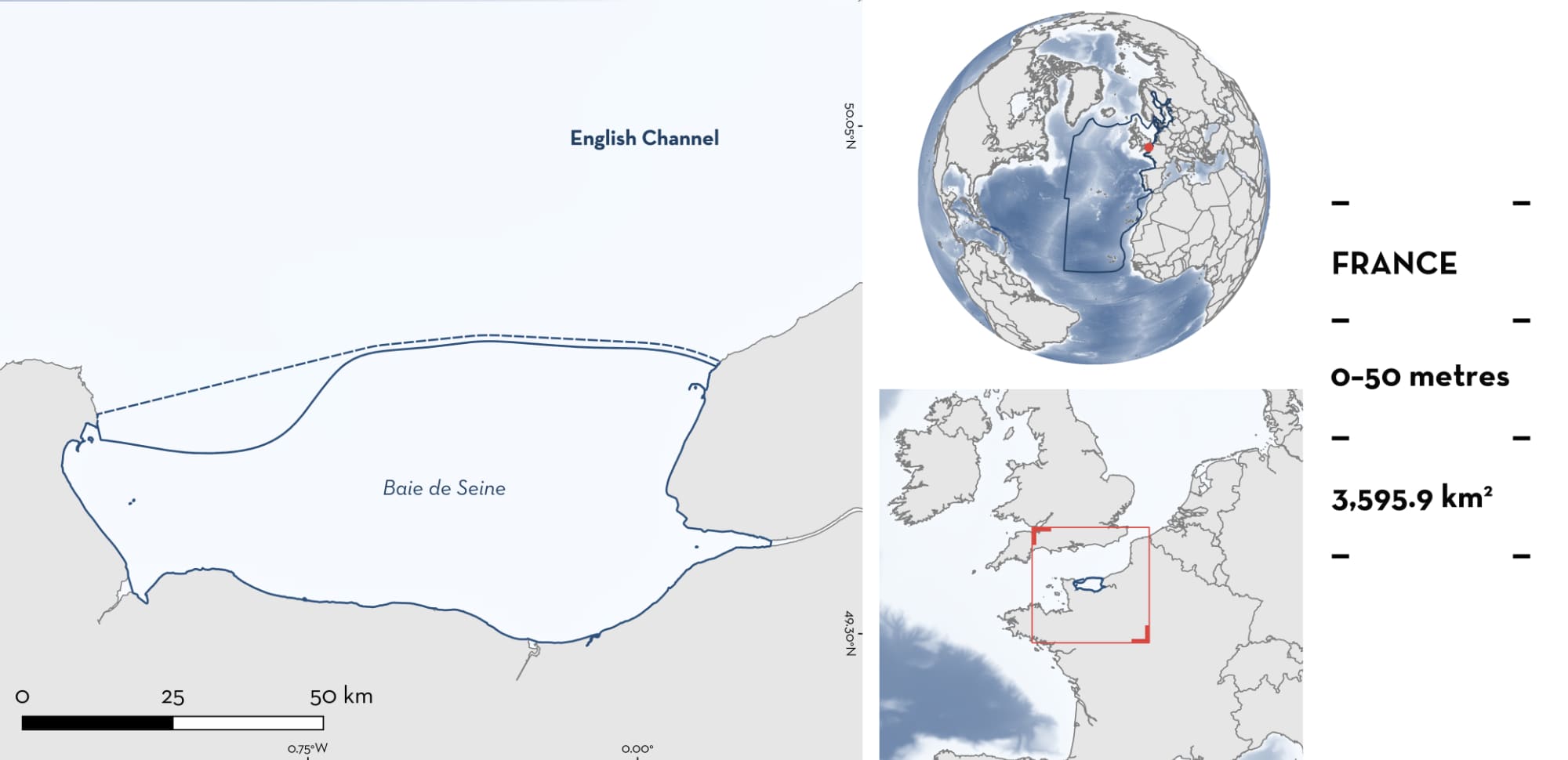
Baie de Seine is located in the eastern English Channel of northern France. This coastal area is characterised by soft sediments, with fine sand and silt in the Seine River estuary and along the coast, and coarse sand and gravel further offshore. It is influenced by river input, particularly in the east, and by large tides. Within this area there are: threatened species (Tope Galeorhinus galeus); reproductive areas (Thornback Skate Raja clavata); and feeding areas (e.g., Starry Smoothhound Mustelus asterias).
Download factsheet
Baie de Seine
DESCRIPTION OF HABITAT
Baie de Seine is located in northern France in the eastern English Channel. This large bay extends from the Seine River estuary and Cap d’Antifer in the east to Pointe de Barfleur in the west. The habitat is characterised mainly by soft substrates, with very fine and silted sediments at the coast and at the river mouth, and silted sediments and sand elsewhere (Toison 2013; De Roton & Toison 2015). There are also small gravel fields near the central coast. Fine sand dominates in the central part of the area while there is mostly coarse sand in the west. The bathymetry extends from the shallow estuary in the east to deeper areas in the northwest.
The area is influenced by river input, which are seasonally higher in boreal winter and early spring, and by a macrotidal regime. These conditions allow the deposition of very fine sediments at the coast, as well as in the mouth of the estuary, with increased siltation during river floods. The area therefore presents a sedimentary mosaic of sandbanks, with fine sand and silt at the coast and towards the estuary, and coarser sand towards the northwest (Toison 2013; De Roton & Toison 2015).
This Important Shark and Ray Area is benthic and pelagic and is delineated from inshore and surface waters (0 m) to 50 m based on the bathymetry of the area.
CRITERION A
VULNERABILITY
One Qualifying Species considered threatened with extinction according to the IUCN Red List of Threatened Species regularly occurs in the area. This is the Critically Endangered Tope (Walker et al. 2020).
CRITERION C
SUB-CRITERION C1 – REPRODUCTIVE AREAS
Baie de Seine is an important reproductive area for one ray species.
Neonate and young-of-the-year (YOY) Thornback Skates are regularly captured in this area (APECS & WWF 2023). An analysis of several scientific fishing trawl datasets (Beam Trawl Survey BTS 1990–2021, annually in July–September; French Channel Ground Fish Survey FR-CGFS 1998–2021, annually in September and October; North Sea International Bottom Trawl Survey NS-IBTS 2007–2022, annually in the 1st quarter in January–February and the 3rd quarter in August–September) and on-board observations of commercial fisheries (ObsMer 2009–2021, year-round) showed that the hotspot for captures of neonate Thornback Skates in the eastern English Channel is in this area (APECS & WWF 2023). Neonates were defined by a size of <14 cm total length (TL). The size-at-birth for the species is 10–13 cm TL (Last et al. 2016) and fast initial growth rates suggest a size of up to 25 cm TL at one year old (Serra-Pereira et al. 2005). Captures of neonates were concentrated in the eastern part of Baie de Seine. Of a total of 96 neonates recorded in these broad surveys, 28 neonates (29%) were captured in this area. Additionally, of a total of 4,469 YOY recorded in the surveys, 447 YOY (10%) were captured in this area (APECS & WWF 2023). A second analysis of data collected by on-board observers of commercial fisheries (ObsMer 2009–2021, year-round) only considered data from fishing methods that were capable of capturing small Thornback Skates, mainly benthic trawls with a maximum mesh size of 10 cm (APECS & WWF 2023). Although large Thornback Skates with a size of >25 cm TL were captured throughout the region, the vast majority of neonate and YOY (<25 cm TL) was found in the eastern part of this area (APECS & WWF 2023), highlighting that Baie de Seine is important for hatching and the early life stages of Thornback Skates.
CRITERION C
SUB-CRITERION C2 – FEEDING AREAS
Baie de Seine is an important feeding area for two shark species.
A study collected Tope and Starry Smoothhounds from commercial trawls in this area in April–June 2021 and analysed their stomach contents (Biton-Porsmoguer 2022) using the index of relative importance (IRI).
Of 63 Tope, half had empty stomachs, leaving 31 individuals (15 males, 16 females) for analysis. They were all juveniles, based on size measurements of total length (Biton-Porsmoguer 2022). Their diet was dominated by three fish species: Atlantic Mackerel Scomber scombrus (%IRI = 52.5), Whiting-Pout Trisopterus luscus (%IRI = 27.0), and Atlantic Herring Clupea harengus (%IRI = 11.3). The Atlantic Mackerel is a seasonally very common species targeted by fishers in this area (Arrêté n°027 2025). Baie de Seine is an annual nursery area for Atlantic Herring and Whiting-Pout, among other species (Regimbart et al. 2018). Although stomach content data are only available from one survey year, the clear preference for the three fish prey species (combined %IRI = 90.8) combined with those prey species’ regular availability in this area highlights that Baie de Seine is an important feeding ground for Tope. Commercial catches from fishing boats registered in Caen and fishing mostly in Baie de Seine regularly capture emissoles (i.e., Mustelus spp. and Tope; Biton-Porsmoguer 2022) as well as their prey species. For example, catches of emissoles of 480 t in 2017 and 766 t in 2023 highlight that Tope are regularly captured in this area, while the same fishery also captured 1,725 t (2017) and 1,201 t (2023) of Atlantic Mackerel and 555 t (2017) and 680 t (2023) of Whiting-Pout (Ifremer 2018, 2024).
Of 71 Starry Smoothhounds, 38% had empty stomachs, leaving 44 individuals (21 males, 23 females) for analysis (Biton-Porsmoguer 2022). These were mainly young adults, based on size measurements of their total length (Biton-Porsmoguer 2022). Their diet was dominated by crustaceans, particularly European Green Crabs Carcinus maenas (%IRI = 67.1), Flying Crabs Polybius holsatus (%IRI = 20.7), and Common Hermit Crabs Pagurus bernhardus (IRI% = 10.6). Starry Smoothhounds showed a preference for mixed and coarse sediments (Biton-Porsmoguer 2022), which characterise this area and are usually found near coasts and estuaries (Sguotti et al. 2016). The abundance of crustacean prey generally depends on the quality of the sediments and benthic environment. European Green Crabs are restricted to wave-protected sheltered bays, estuaries, and harbours (Young & Elliot 2020), such as Baie de Seine. Settling megalopae and young juveniles are found in the intertidal (Young & Elliot 2020), which is wide in this area. The species broadly prefers areas with high structural complexity and adults are also common in muddy sands where they can burrow for concealment (Young & Elliot 2020), which is available in this area. Additionally, commercial catches from fishing boats registered in Caen and fishing mostly in Baie de Seine regularly capture emissoles (i.e., Mustelus spp. and Tope; Biton-Porsmoguer 2022). For example, catches of 480 t in 2017 and 766 t in 2023 highlight that Starry Smoothhounds are regularly captured in this area (Ifremer 2018, 2024).
Download factsheet
SUBMIT A REQUEST
ISRA SPATIAL LAYER REQUEST
To make a request to download the ISRA Layer in either a GIS compatible Shapefile (.shp) or Google Earth compatible Keyhole Markup Language Zipped file (.kmz) please complete the following form. We will review your request and send the download details to you. We will endeavor to send you the requested files as soon as we can. However, please note that this is not an automated process, and before requests are responded to, they undergo internal review and authorization. As such, requests normally take 5–10 working days to process.
Should you have questions about the data or process, please do not hesitate to contact us.