ISRA FACTSHEETS
ISRA FACTSHEETS
AUSTRALIA AND SOUTHEAST INDIAN OCEAN
Bondi
Summary
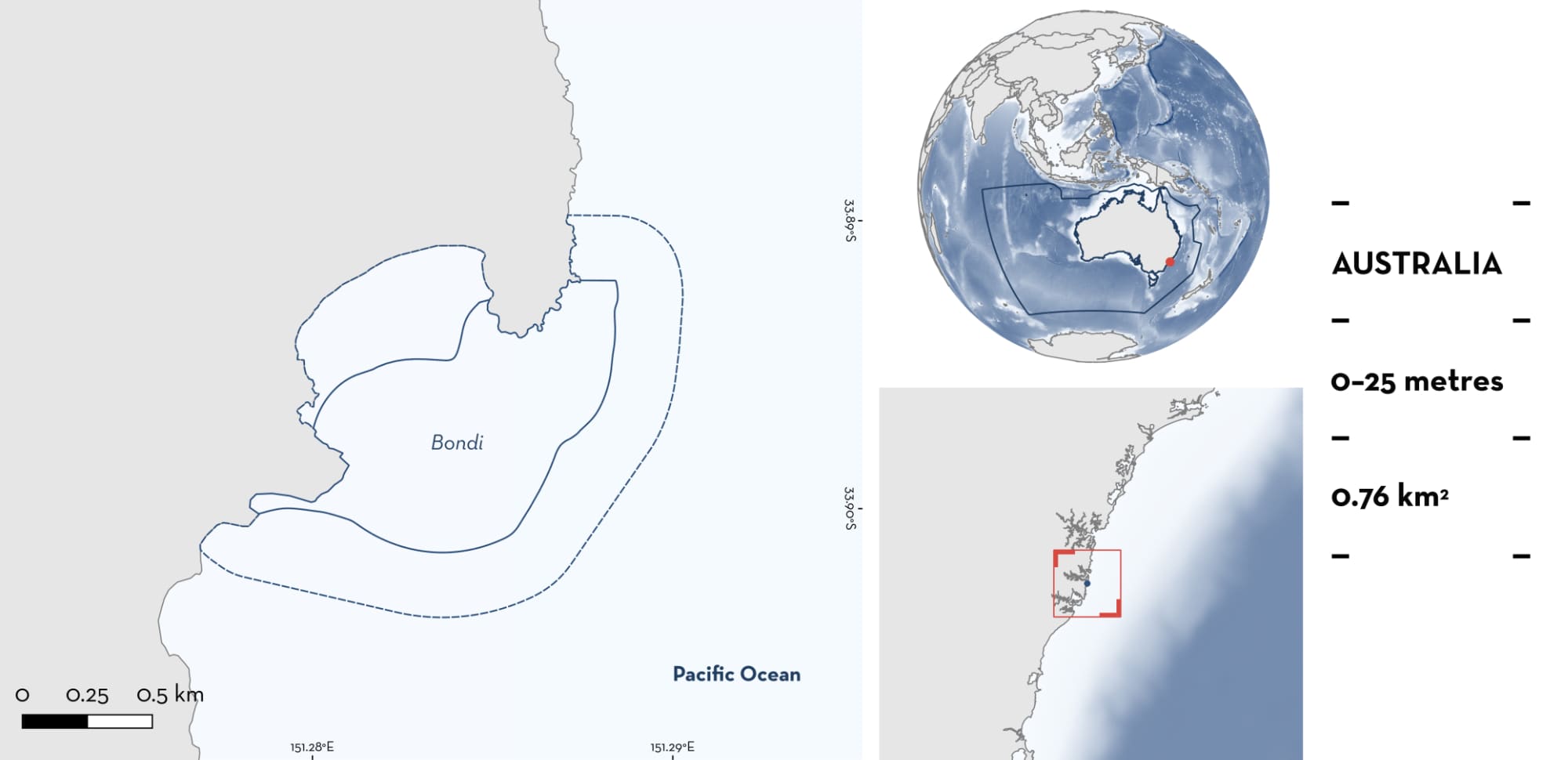
Bondi is located in Sydney, New South Wales, Australia. The area encompasses two headlands connected across a shallow bay by sandy substrates. The headlands are comprised of rocky overhangs and caves, with large boulders forming gullies. The area is influenced by seasonal fluctuations in the strength of the East Australian Current. Within the area there are: threatened species and resting areas (Sand Tiger Shark Carcharias taurus).
Download factsheet
Bondi
DESCRIPTION OF HABITAT
Bondi is located in Sydney, New South Wales, Australia. The area encompasses two headlands connected across a shallow bay by sandy substrates. The headlands are popular dive sites, known as South Bondi and North Bondi. South Bondi is a shallow (to 15 m depth) rocky region with three overhangs and a cave. The rocks are covered in kelp and algae (S Han-de-Beaux pers. obs. 2025). North Bondi includes deeper areas (to 25 m depth), with large boulders, caves, and rocky overhangs. The habitat is characterised by sandy substrates and large boulders forming gullies.
Bondi is influenced by the East Australian Current, the poleward flowing western boundary current of the South Pacific Gyre (Suthers et al. 2011). The East Australian Current flow is strongest in the austral summer, and the formation of eddies along this coastline also fluctuate seasonally (Ridgway & Hill 2009).
This Important Shark and Ray Area is benthic and pelagic and is delineated from inshore and surface waters (0 m) to 25 m based on the bathymetry of the area.
CRITERION A
VULNERABILITY
One Qualifying Species considered threatened with extinction according to the IUCN Red List of Threatened Species regularly occurs in the area. This is the Critically Endangered Sand Tiger Shark (Rigby et al. 2025).
CRITERION C
SUB-CRITERION C3 – RESTING AREAS
Bondi is an important resting area for one shark species.
Between 2008–2025, the citizen science project Spot a Shark collected 251 photographs of Sand Tiger Sharks from SCUBA divers and freedivers in the area (Sharkbook 2025). Bondi offers two main sites for resting sharks, with a topography of overhangs, gullies, and caves providing shelter and protection (S Han-de-Beaux pers. obs. 2025). Dive effort is low in the area, owing to difficult entry and exit conditions to access the sites (S Han-de-Beaux pers. obs. 2025). Between 2012 and 2025, photo submissions were from 62 diving days (average 5.2 surveys per year; Spot a Shark unpubl. data 2025). Most submissions (n = 198) were from the South Bondi part of the area due to its accessibility, however, local ecological knowledge suggests Sand Tiger Sharks form resting aggregations just as regularly in the North Bondi part of the area (n = 34 submissions), just with much lower survey effort (S Han-de-Beaux pers. obs. 2025). Sand Tiger Sharks are observed in a calm resting state of docily navigating gullies and rock formations in the area (S Han-de-Beaux pers. obs. 2025). Hovering and milling are also characteristic behaviours of resting Sand Tiger Sharks and comprise the majority of swimming behaviours observed at other aggregation sites on Australia’s east coast (Smith et al. 2015). When hovering, sharks face into the water current and their tail beats allow them to maintain a stationary position, whereas milling involves slow movements and directional changes generally confined to a particular area within a gutter (Smith et al. 2015).
Sand Tiger Sharks are observed year-round in the area, but there is a seasonal peak in sightings during the winter (June–August). Groups of 3–10 Sand Tiger Sharks are observed on a single dive (average 4.5 individuals; Spot a Shark unpubl. data 2025). Using photo-identification, at least 54 individual Sand Tiger Sharks were identified based on left flank images, with some individuals sighted over consecutive years between 2017 and 2024 (Spot a Shark unpubl. data 2025). Regular observations of resting Sand Tiger Sharks are also made from drone surveys in the area (Drone Shark App unpubl. data 2025). Repeated use of the area for resting across multiple years highlights the importance of this area for resting for Sand Tiger Sharks undertaking migrations along the east coast of Australia.
Download factsheet
SUBMIT A REQUEST
ISRA SPATIAL LAYER REQUEST
To make a request to download the ISRA Layer in either a GIS compatible Shapefile (.shp) or Google Earth compatible Keyhole Markup Language Zipped file (.kmz) please complete the following form. We will review your request and send the download details to you. We will endeavor to send you the requested files as soon as we can. However, please note that this is not an automated process, and before requests are responded to, they undergo internal review and authorization. As such, requests normally take 5–10 working days to process.
Should you have questions about the data or process, please do not hesitate to contact us.