ISRA FACTSHEETS
ISRA FACTSHEETS
AUSTRALIA AND SOUTHEAST INDIAN OCEAN
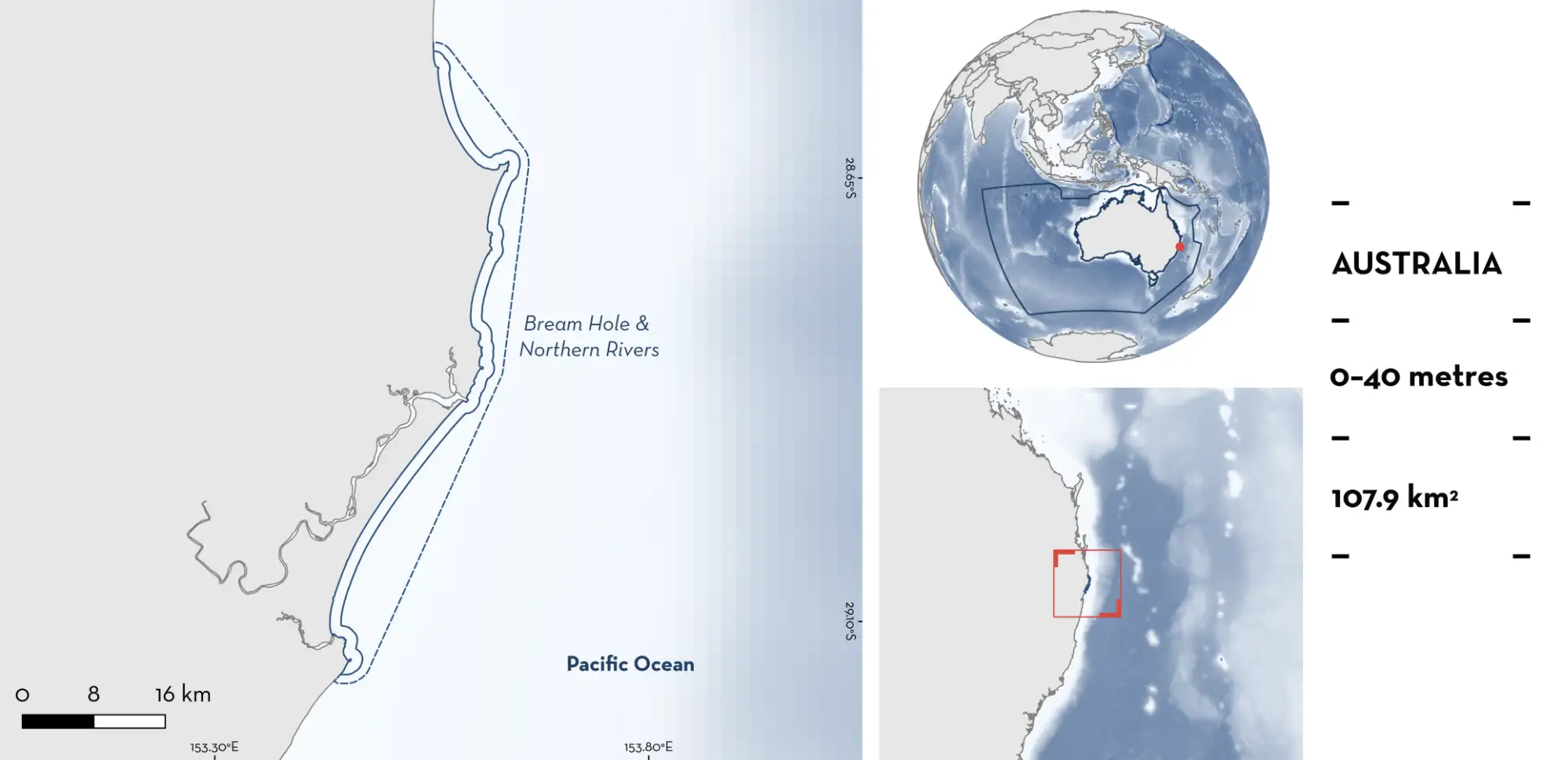
Bream Hole & Northern Rivers
Summary
Bream Hole & Northern Rivers is located on the northern New South Wales coast, Australia. It comprises shallow coastal waters with sandy beaches interspersed with rocky headlands. The area encompasses the Bream Hole, a shallow protected lagoon habitat of seagrass and sandy substrates north of the Lennox Head township. The area is influenced by freshwater, nutrient, and sediment input from several rivers, and by the East Australian Current. It partially overlaps with Cape Byron Marine Park. Within this area there are: undefined aggregations (e.g., Australian Cownose Ray Rhinoptera neglecta).
Download factsheet
Bream Hole & Northern Rivers
DESCRIPTION OF HABITAT
Bream Hole & Northern Rivers is located on the northern New South Wales coast, Australia. The area is a subtropical, inshore coastal zone with a habitat characterised primarily by sandy beaches punctuated by small rocky outcrops and headlands. These headlands include Cape Byron, Broken Head, Ballina Head, and Evans Head. The Bream Hole is a site within the area, at the southern end of Seven Mile Beach, north of Lennox Head township. It is a semi-enclosed oceanic lagoon with a complex substrate mosaic of intertidal boulder reef, subtidal ledges, crevices, overhangs, and sheltered sandy patches, and uniquely hosts oceanic seagrass beds rarely found elsewhere in the broader region. The Bream Hole is known for high invertebrate diversity (Owler 2012).
The area is influenced by several riverine outflows (e.g., Brunswick River, Richmond River, and Evans River) that add nutrients, sediment, and freshwater into this coastal habitat. It is also influenced by the East Australian Current, which drives the formation of eddies and upwelling events in the broader region (Archer et al. 2017).
This area overlaps with Cape Byron Marine Park (NSW DPIRD 2025).
This Important Shark and Ray Area is benthic and pelagic and is delineated from inshore and surface waters (0 m) to 40 m based on the bathymetry of the area.
CRITERION C
SUB-CRITERION C5 – UNDEFINED AGGREGATIONS
Bream Hole & Northern Rivers is an important area for undefined aggregations of four ray species.
Between 2022–2025, weekly recreational snorkels were conducted at the Bream Hole (within the area) during austral summer and autumn (December–April) (T Hughes & N Swain pers. obs. 2025). Anecdotal observations of shark and ray species were made during these 50-minute snorkels, with photographic evidence available to support species identification and habitat use. Due to the seasonal survey effort, it is difficult to determine whether this area is important for these species year-round or seasonally, however, observations of sharks and rays in the area were noted in warmer months during fauna surveys of the invertebrate community at this site (Owler 2012).
Eastern Shovelnose Rays were observed on ~80% of recreational snorkels at the Bream Hole. On average, five Eastern Shovelnose Rays were observed during each snorkel with up to 10 individuals seen depending on weather conditions and visibility. During almost all observations, Eastern Shovelnose Rays were resting in the sand, with only their eyes and tail visible. The sheltered and shallow waters of the area, with rocky and weedy habitat interspersed with sandy substrates, likely provide ideal resting habitat for this species (T Hughes & N Swain pers. obs. 2025). While the species is usually observed resting on the benthos, more information is needed to determine whether resting is the primary function for their aggregations in this area.
On average, 10 Coral Sea Maskrays were observed on every recreational snorkel at the Bream Hole, with a range of 5–20 depending on weather conditions and visibility (T Hughes & N Swain pers. obs. 2025). Feeding has been observed >20 times for this species – defined by actively searching and then sifting through the sand for prey (DP Robinson pers. obs. 2025). The only other location in this region where aggregations of Coral Sea Maskrays have been observed is at Nguthungulli Julian Rocks (>20 km away) outside this area, highlighting the importance of this site for this species. More information is needed to confirm whether feeding is the primary function for this species aggregating in this area.
Aggregations of Australian Cownose Rays are regularly observed in this area (Kelaher et al. 2020; Tagliafico et al. 2020; Chan et al. 2024). A drone survey was conducted at Byron Bay, Lennox Head, Ballina, and Evans Head, all located within the area, in September–December 2016 and in June–July and September–October 2017 (Tagliafico et al. 2020; Kelaher et al. 2020). Two kilometre along-shore transects were flown at 60 m altitude, spanning ~110 m in width from the surfline. Australian Cownose Rays were observed in 36% of the 293 flights (Tagliafico et al. 2020). An average of 20.4 individuals were counted per transect, including flights when the species was not seen. Aggregation size varied, with up to 412 individuals in a group. Most observations (~47%) had 1–20 individuals, 23% had 21–60 individuals, 18% had 61–150 individuals, and 10% had large aggregations of 150–412 individuals. Rays were primarily observed at Byron Bay, Ballina, and Evans Head, with few rays observed at Lennox Head.
A second study conducted aerial surveys in seven regions of the New South Wales coast between January 2017 and June 2019 (Chan et al. 2024). These surveys covered half of the New South Wales coast (~980 km), consisting of a northbound leg that was flown 500 m offshore with observers looking towards the coast and surveying a 300 m strip width behind the last line of waves. A subsequent southbound leg, with a track line over the beach, allowed observers to face seaward and survey a 300 m strip width over the inshore area. The region from Tweed Heads to Ballina (which partially overlaps with this area) had the second highest number of sightings of Australian Cownose Rays (n = 317) and a large average group size (108.1 individuals), second only to the southernmost region that recorded few observations (n = 17). Most sightings (62.1%) and the largest groups (estimates up to 2,000 individuals) occurred in the southern half of the survey region, between Brunswick Heads and South Ballina in this area, where the average group size was 154 individuals.
Additionally, between 2016 and 2018, two shark meshing trials were conducted by the NSW Department of Primary Industries (NSW DPI 2017, 2018). The trials deployed a single bather protection gillnet (150 m long x 6 m depth, 600 mm stretched mesh openings) at five beaches in this area (Lennox Head, Sharpes Beach, Shelly Beach, South Ballina, and Evans Head). Over the course of the two trials, a total of 123 Australian Cownose Rays were caught in the gillnets, 81 during the first trial (November 2016 to May 2017) and 42 in the second trial (November 2017 to May 2018; NSW DPI 2017, 2018). Of the five beaches where nets were deployed, 74% of the total Australian Cownose Ray catch occurred at Evans Head.
Common Stingarees were observed on all weekly snorkels in the Bream Hole. On average, ~15 Common Stingarees were observed on a single 50-minute snorkel, with a range of 5–30 depending on weather conditions and visibility (T Hughes & N Swain pers. obs. 2025). Visibly pregnant Common Stingarees were observed >10 times at the site, defined by a visibly extended ventral and dorsal abdominal area (DP Robinson pers. obs. 2025). Sizes were visually estimated to be ~30 cm total length (TL). Size-at-maturity for the species is ~35 cm TL in males and ~41 cm TL in females (Last et al. 2016). Courtship and mating were also observed on multiple occasions (~10 times). Feeding and hunting – defined by actively searching and sifting through the sand for prey – was observed on multiple occasions during the survey months (>10 times). While Common Stingarees are observed in smaller numbers in waters adjacent to this site, this is the only location where aggregations of the species, as well as reproductive and feeding behaviour has been regularly observed (T Hughes & N Swain pers. obs. 2025).
Further information is required to understand the nature and function of these aggregations.
Download factsheet
SUBMIT A REQUEST
ISRA SPATIAL LAYER REQUEST
To make a request to download the ISRA Layer in either a GIS compatible Shapefile (.shp) or Google Earth compatible Keyhole Markup Language Zipped file (.kmz) please complete the following form. We will review your request and send the download details to you. We will endeavor to send you the requested files as soon as we can. However, please note that this is not an automated process, and before requests are responded to, they undergo internal review and authorization. As such, requests normally take 5–10 working days to process.
Should you have questions about the data or process, please do not hesitate to contact us.