ISRA FACTSHEETS
ISRA FACTSHEETS
AUSTRALIA AND SOUTHEAST INDIAN OCEAN
Brisbane River
Summary
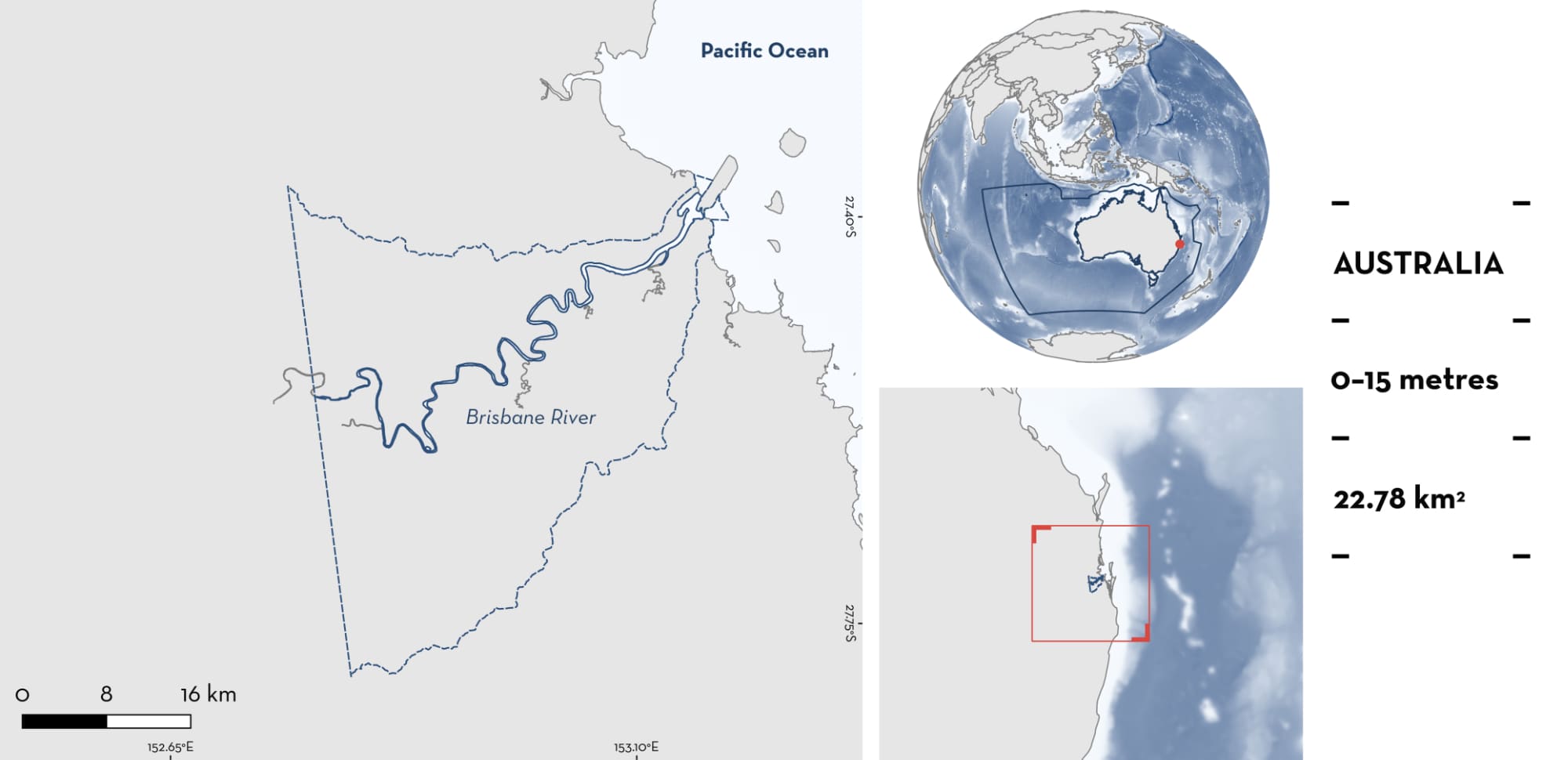
Brisbane River is located in southeast Queensland, Australia. It comprises freshwater areas up to ~82 km upstream, brackish waters, and estuarine waters at the river mouth. The habitat is characterised by mud substrate, highly turbid river water, mangroves, and urban riverbanks. It is influenced by a subtropical climate with high variation in river flow, and by tides that result in a wide gradient of salinity levels. Within this area there are: threatened species and reproductive areas (Bull Shark Carcharhinus leucas).
Download factsheet
Brisbane River
DESCRIPTION OF HABITAT
Brisbane River is located in southeast Queensland, Australia. This area comprises freshwater parts of the Brisbane River up to ~84 km upstream, brackish water in the lower river, and estuarine waters at the river mouth opening into Moreton Bay (Pillans 2006). The upstream boundary is College’s Crossing and the lower boundary is the river mouth. The river in this area flows through the city of Brisbane and Brisbane’s port at the river mouth. The habitat is characterised by mud substrate, turbid river water, mangroves, and urban riverbanks.
The area is influenced by tides, with saltwater intruding at high tide, and by freshwater flow from the river. The tidal limit is just outside the boundary of this area, ~86 km upstream, and saltwater intrudes up to ~60 km upstream (Yu et al. 2013). River flow is influenced by the subtropical climate, with higher flow during the austral summer and exceptionally high flow of up to ~12,500 m3 s-1 during floods (Kemp et al. 2016).
This Important Shark and Ray Area is benthic and pelagic and is delineated from inshore and surface waters (0 m) to 15 m based on the bathymetry of the area.
CRITERION A
VULNERABILITY
One Qualifying Species considered threatened with extinction according to the IUCN Red List of Threatened Species regularly occurs in the area. This is the Vulnerable Bull Shark (Rigby et al. 2021).
CRITERION C
SUB-CRITERION C1 – REPRODUCTIVE AREAS
Brisbane River is an important reproductive area for one shark species.
Neonate, young-of-the-year (YOY), and juvenile Bull Sharks are regularly observed in this area (Pillans 2006; Lubitz 2023; N Lubitz unpubl. data 2025). A historical research study captured 714 Bull Sharks with rod-and-line in this area and the adjacent Moreton Bay in 2001–2004 (Pillans 2006). Catch-per-unit-effort (CPUE) in the upper freshwater reaches of the river was high, with 1.18 sharks per hour of fishing or 2.8 sharks per fishing trip. It was much higher in the freshwater section of the river compared to the river mouth (0.09 sharks per hour) or Moreton Bay (0.08). The middle- and upper estuary sections had intermediate CPUE of 0.26 and 0.3 sharks per hour of fishing, respectively. Almost all sharks were captured from November–May. Most of the individuals captured in the river (68%) were neonates with open umbilical scars and a size range of 56–83 cm total length (TL). The size-at-birth for the species is 56–81 cm TL (Ebert et al. 2021). The remaining individuals were YOY and small juveniles up to 130 cm TL, while in Moreton Bay, outside the area, only sub-adults and adults were captured. No pregnant females were captured (Pillans 2006).
In 2021, 2024, and 2025, Bull Sharks were captured in research surveys in this area mostly using rod-and-line during the spring and summer from October–January (N Lubitz unpubl. data 2025). A total of 43 Bull Sharks were captured over nine fishing days, with a CPUE of 4.8 sharks per day, similar to the previous study. Individuals ranged in size from 70–85 cm TL and all were either neonates with an open umbilical scar or YOY with a semi-healed umbilical scar (N Lubitz unpubl. data 2025). Genetic analysis of tissue samples from these neonates/YOY identified six full-sibling and half-sibling pairs suggesting that this area is used by multiple females to give birth (N Lubitz unpubl. data 2025). There are many additional contemporary records across multiple years of small Bull Sharks in the Brisbane River in the media. Combined, the data show that Brisbane River is important for the early life stages of the species.
Download factsheet
SUBMIT A REQUEST
ISRA SPATIAL LAYER REQUEST
To make a request to download the ISRA Layer in either a GIS compatible Shapefile (.shp) or Google Earth compatible Keyhole Markup Language Zipped file (.kmz) please complete the following form. We will review your request and send the download details to you. We will endeavor to send you the requested files as soon as we can. However, please note that this is not an automated process, and before requests are responded to, they undergo internal review and authorization. As such, requests normally take 5–10 working days to process.
Should you have questions about the data or process, please do not hesitate to contact us.