
ISRA FACTSHEETS
ISRA FACTSHEETS
EUROPEAN ATLANTIC
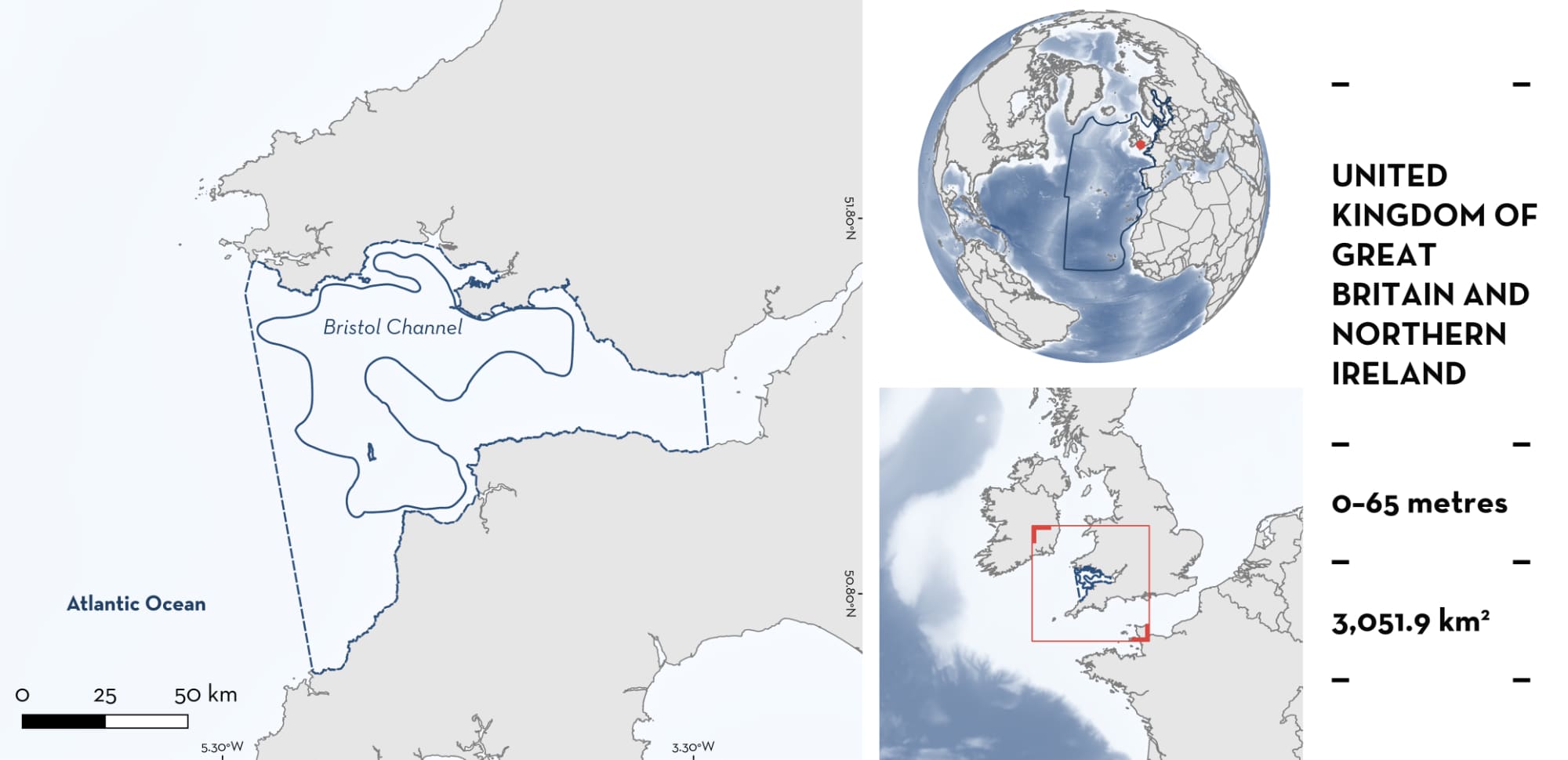
Bristol Channel
Summary
Bristol Channel is located on the west coast of England and Wales, United Kingdom of Great Britain and Northern Ireland. The area includes estuarine systems and is characterised by muddy and sandy substrates. It is influenced by the mix of saltwater from the Celtic Sea and freshwater from numerous river inputs. The area encompasses the Lundy Island No Take Zone. Within this area there are: reproductive areas (e.g., Starry Smoothhound Mustelus asterias).
Download factsheet
Bristol Channel
DESCRIPTION OF HABITAT
Bristol Channel is located on the west coast of England and Wales, in the United Kingdom of Great Britain and Northern Ireland. It includes estuarine systems, and is connected to the Celtic Sea, separating the United Kingdom of Great Britain and Northern Ireland and Ireland. The area encompasses Lundy Island. The area is characterised by muddy and sandy substrates (Collins 1987).
The area is influenced by the mix of saltwater from the Celtic Sea and freshwater from numerous river inputs. It is also influenced by some of the largest tidal ranges in the world (South Wales Sports 2025).
This area overlaps with the Lundy Island No Take Zone (IUCN 2009).
This Important Shark and Ray Area is benthic and pelagic and is delineated from inshore and surface waters (0 m) to a depth of 65 m based on the bathymetry of the area.
CRITERION C
SUB-CRITERION C1 – REPRODUCTIVE AREAS
Bristol Channel is an important reproductive area for one shark and three ray species.
Early life stages of Starry Smoothhound, Blonde Skate, Thornback Skate, and Small-eyed Skate are regularly and predictably observed, year-to-year, at one fixed survey station, and other surveys, in this area (ICES 2025). Data from the Bristol Channel and Irish Sea beam trawl survey (BTS) (2010–2024) were analysed (ICES 2025) which uses a four-metre beam. The size threshold for young-of-the-year (YOY) individuals of each species was supported by analysis of catch data from across the United Kingdom of Great Britain and Northern Ireland (J Ellis & S McCully Phillips unpubl. data 2025).
A total of 1,530 Starry Smoothhounds were recorded across all survey years of the BTS in this area. Of these, more than half (n = 883, 57.7%) were neonate/young-of-the-year (YOY) measuring =< 41 cm total length (TL). The size-at-birth of this species is 28–32 cm TL (Ebert et al. 2021). Neonate/YOY Starry Smoothhounds were reported in 2010 (n = 45), 2011 (n = 49), 2012 (n = 61), 2013 (n = 101), 2014 (n = 55), 2015 (n = 47), 2016 (n = 166), 2017 (n = 73), 2018 (n = 77), 2019 (n = 96), 2020 (n = 33), 2021 (n = 22), 2022 (n = 22), 2023 (n = 10), and 2024 (n = 26). Overall, 408 neonate Starry Smoothhounds were caught in this area in 2010 (n = 23), 2011 (n = 22), 2012 (n = 34), 2013 (n = 65), 2014 (n = 14), 2015 (n = 23), 2016 (n = 97), 2017 (n = 19), 2018 (n = 49), 2019 (n = 28), 2020 (n = 4), 2021 (n = 12), 2022 (n = 8), 2023 (n = 1), and 2024 (n = 9). This is the largest known hotspot for early life stages of this species within the United Kingdom of Great Britain and Northern Ireland.
A total of 528 Blonde Skates were recorded across all survey years of the BTS in this area. Of these, more than half (n = 302, 57.2%) were neonate/YOY measuring =< 34 cm TL. The size-at-birth of this species is 16–18 cm TL (Last et al. 2016). Neonate/YOY Blonde Skates were reported in 2010 (n = 11), 2011 (n = 13), 2012 (n = 12), 2013 (n = 24), 2014 (n = 29), 2015 (n = 9), 2016 (n = 30), 2017 (n = 22), 2018 (n = 33), 2019 (n = 16), 2020 (n = 23), 2021 (n = 25), 2022 (n = 26), 2023 (n = 21), and 2024 (n = 8). This is one of the only known hotspots for early life stages of this species within the United Kingdom of Great Britain and Northern Ireland.
A total of 1,757 Thornback Skates were recorded across all survey years of the BTS in this area. Of these, nearly one third (n = 538, 30.6%) were neonate/YOY measuring =< 30 cm TL. The size-at-birth of this species is 10–13 cm TL (Last et al. 2016), with individuals up to 30 cm TL being considered neonate/YOY in other regions (Alkusairy 2019). Neonate/YOY Thornback Skates were reported in 2010 (n = 26), 2011 (n = 17), 2012 (n = 16), 2013 (n = 46), 2014 (n = 28), 2015 (n = 29), 2016 (n = 56), 2017 (n = 24), 2018 (n = 45), 2019 (n = 34), 2020 (n = 52), 2021 (n = 44), 2022 (n = 48), 2023 (n = 20), and 2024 (n = 53). Overall, 45 neonate Thornback Skates were caught in this area in 2010 (n = 1), 2011 (n = 2), 2012 (n = 5), 2013 (n = 1), 2014 (n = 1), 2015 (n = 2), 2016 (n = 3), 2017 (n = 2), 2018 (n = 4), 2019 (n = 2), 2020 (n = 6), 2021 (n = 3), 2022 (n = 8), 2023 (n = 2), and 2024 (n = 3). This is one of the largest known hotspots for early life stages of this species within the United Kingdom of Great Britain and Northern Ireland.
A total of 605 Small-eyed Skates were recorded across all survey years of the BTS in this area. Of these, nearly half (n = 287, 47.4%) were YOY measuring ≤31 cm TL. The size-at-birth of this species is 10–13 cm TL (Last et al. 2016). The smallest size-at-maturity of the species ranges from 66–73 cm TL in this part of the region (McCully et al. 2012). YOY Small-eyed Skates were reported in 2010 (n = 10), 2011 (n = 17), 2012 (n = 10), 2013 (n = 4), 2014 (n = 3), 2015 (n = 14), 2016 (n = 13), 2017 (n = 24), 2018 (n = 15), 2019 (n = 16), 2020 (n = 36), 2021 (n = 27), 2022 (n = 37), 2023 (n = 35), and 2024 (n = 26). This is the largest known hotspot for early life stages of this species within the United Kingdom of Great Britain and Northern Ireland.
Download factsheet
SUBMIT A REQUEST
ISRA SPATIAL LAYER REQUEST
To make a request to download the ISRA Layer in either a GIS compatible Shapefile (.shp) or Google Earth compatible Keyhole Markup Language Zipped file (.kmz) please complete the following form. We will review your request and send the download details to you. We will endeavor to send you the requested files as soon as we can. However, please note that this is not an automated process, and before requests are responded to, they undergo internal review and authorization. As such, requests normally take 5–10 working days to process.
Should you have questions about the data or process, please do not hesitate to contact us.

