ISRA FACTSHEETS
ISRA FACTSHEETS
EUROPEAN ATLANTIC
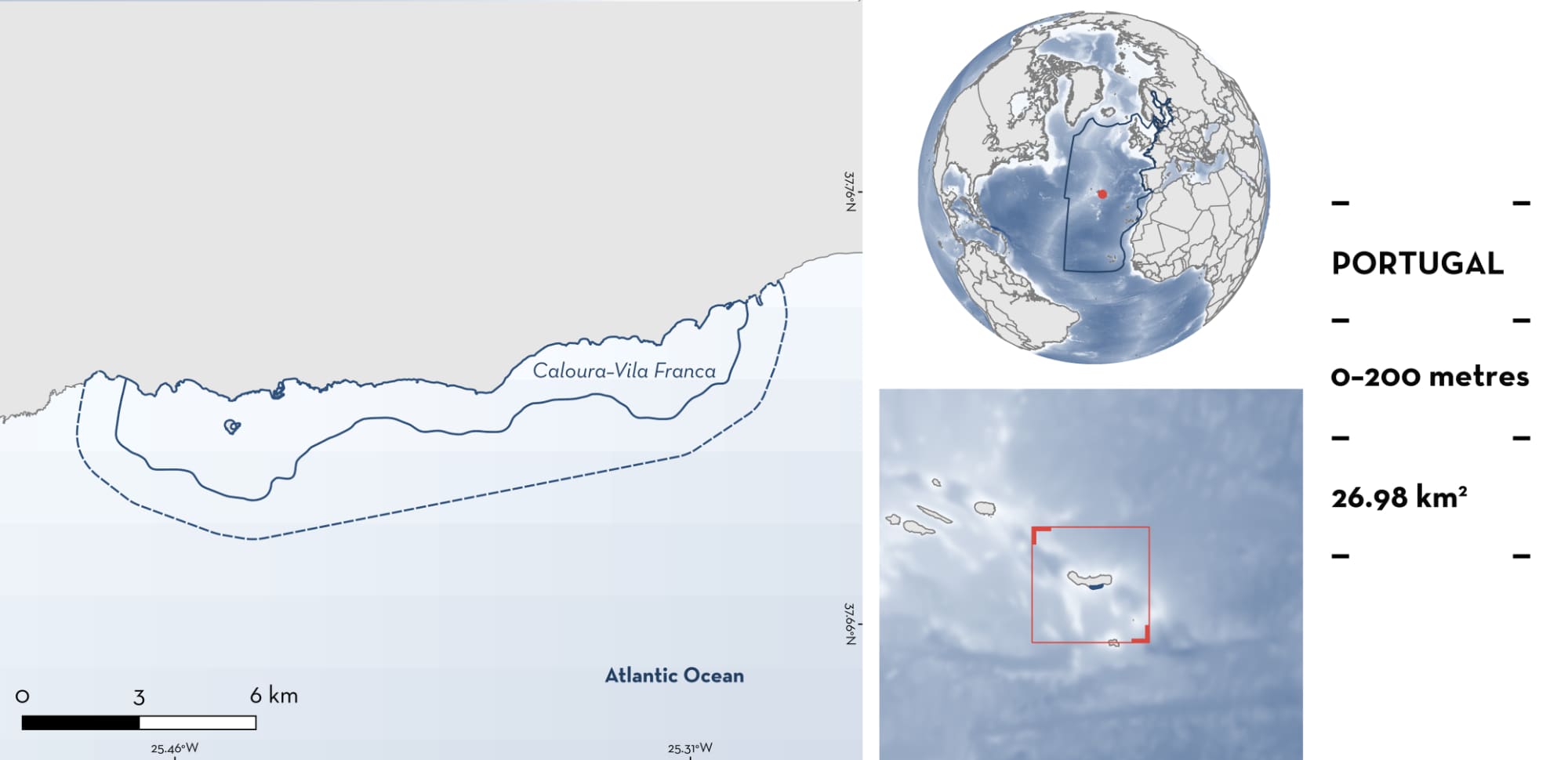
Caloura-Vila Franca
Summary
Caloura-Vila Franca is located on the southern coast of São Miguel Island, Azores, Portugal. This area is situated on the island’s narrow shelf and steep upper slope. The substrate is characterised by rugged slopes and rocky drop-offs, alternating with soft sediments, and black coral gardens. Within this area there are: threatened species and reproductive areas (Tope Galeorhinus galeus).
Download factsheet
Caloura-Vila Franca
DESCRIPTION OF HABITAT
Caloura-Vila Franca is located on the southern coast of São Miguel Island, Azores, Portugal. This area is situated on the island’s narrow shelf and steep upper slope. The substrate is characterised by rugged slopes and rocky drop-offs, alternating with soft sediments, and black coral gardens below 40 m depth (Esteban et al. 2024).
Oceanic turbulence and local winds cause vertical mixing in winter, deepening the summer thermocline from 30–60 m to around 200 m. The surface seawater temperature varies annually between 15°C and 23°C (Esteban et al. 2024).
This Important Shark and Ray Area is benthic and pelagic and is delineated from surface waters (0 m) to 200 m based on the depth range of the habitat in the area.
CRITERION A
VULNERABILITY
One Qualifying Species considered threatened with extinction according to the IUCN Red List of Threatened Species regularly occurs in the area. This is the Critically Endangered Tope (Walker et al. 2020).
CRITERION C
SUB-CRITERION C1 – REPRODUCTIVE AREAS
Caloura–Vila Franca is an important reproductive area for one shark species.
Baited Remote Underwater Video Stations (BRUVS) and social media records demonstrate the importance of the area for neonate and young-of-the-year (YOY) Tope. Between 2018–2022, 589 benthic and pelagic stereo-BRUVS were deployed around nine islands of the Azores Archipelago at 5–60 m depth; P Afonso unpubl. data 2018–2022). Of these, 65 stereo-BRUVS were deployed around São Miguel Island (18 pelagic and 47 benthic) during August–September (48 within Caloura–Vila Franca; 10 pelagic and 38 benthic). Neonate and YOY (<70 cm TL) Tope were recorded only in benthic BRUVS (at 30–60 m depth), at São Miguel (n = 13 deployments) and Faial Island (n = 2 deployments), and the maximum number of neonates/YOY of a species observed in a single frame (MaxN) ranged between 1–13. Of the 13 deployments with neonates and YOY around São Miguel Island, eight were within Caloura–Vila Franca (21% of benthic deployments in the area), and included six with a MaxN of 5–13 (P Afonso unpubl. data 2018–2020). Size-at-birth for Tope is 30–40 cm total length (TL) (Ebert et al. 2021). Between July and August 2024, seven BRUVS were deployed across the area at 13–23 m depth (ElasmoAzores unpubl. data 2024). Neonate and YOY Tope (~30 cm TL visually estimated) were recorded in all deployments, and the MaxN ranged 1–7. In three deployments, MaxN was =>3 sharks (Elasmobase Project unpubl. data 2024). A record of a neonate caught by line fishing in June 2021 is also available on a citizen science platform (iNaturalist 2024). BRUVS surveys occurred mostly in late summer–early autumn, but according to the biology of the species, juveniles remain in nursery grounds for up to two years and may move into deeper water in winter (Ebert et al. 2021).
Download factsheet
SUBMIT A REQUEST
ISRA SPATIAL LAYER REQUEST
To make a request to download the ISRA Layer in either a GIS compatible Shapefile (.shp) or Google Earth compatible Keyhole Markup Language Zipped file (.kmz) please complete the following form. We will review your request and send the download details to you. We will endeavor to send you the requested files as soon as we can. However, please note that this is not an automated process, and before requests are responded to, they undergo internal review and authorization. As such, requests normally take 5–10 working days to process.
Should you have questions about the data or process, please do not hesitate to contact us.