
ISRA FACTSHEETS
ISRA FACTSHEETS
AUSTRALIA AND SOUTHEAST INDIAN OCEAN
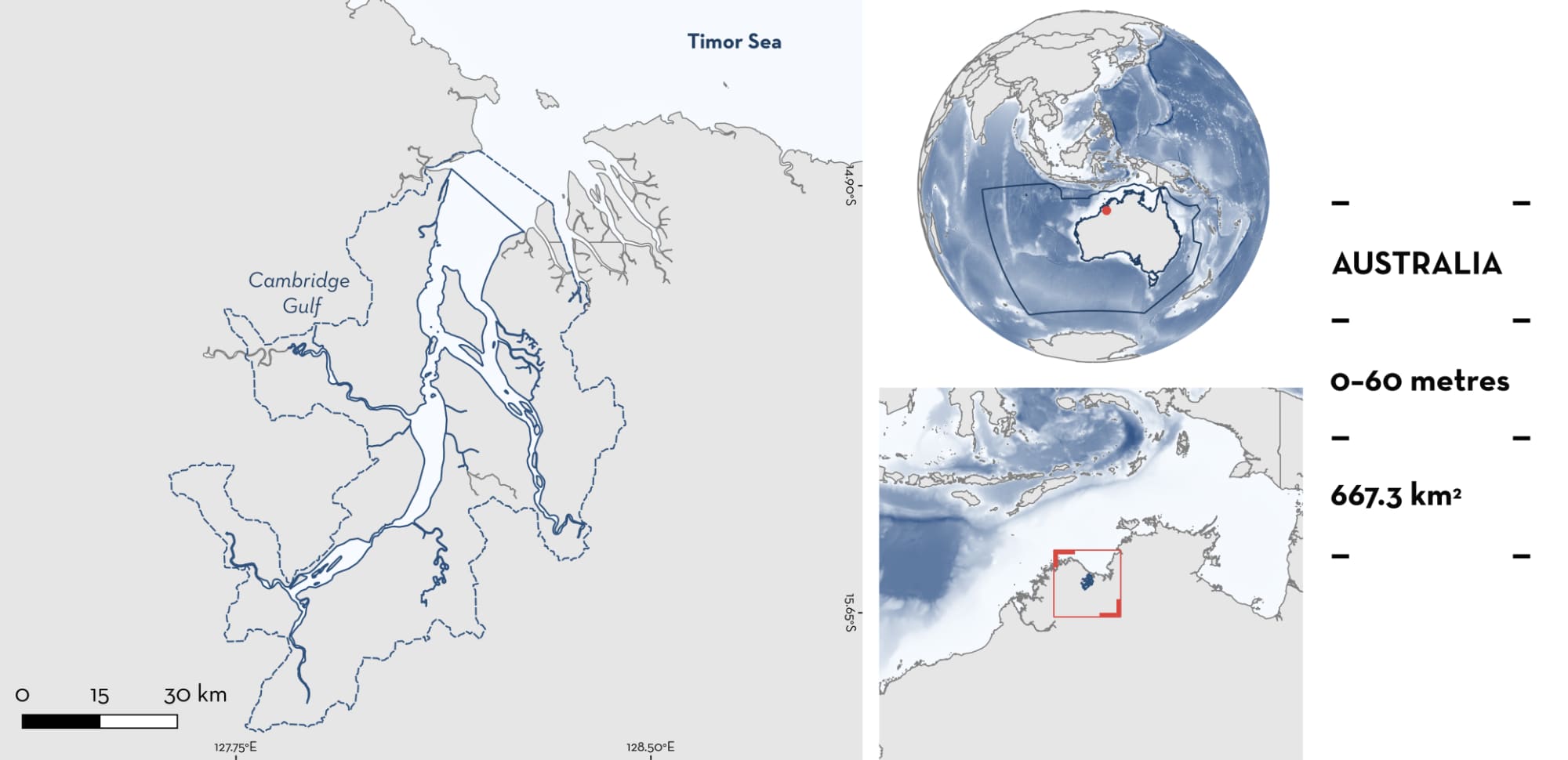
Cambridge Gulf
Summary
Cambridge Gulf is located in the Kimberley region of Western Australia, Australia. The area encompasses the lower reaches of several rivers (e.g., Ord, Durack, and Pentecost rivers) and the West Arm of Cambridge Gulf. It is characterised by muddy substrates, mudflats, deep channels, rocky escarpments, and fringing vegetation ranging from mangroves to savanna grassland. Cambridge Gulf is a highly dynamic estuarine environment heavily influenced by a large tidal range (up to 9 m) and freshwater inflow during the wet season. Within the area there are: threatened species (e.g., Northern River Shark Glyphis garricki); and reproductive areas (e.g., Speartooth Shark Glyphis glyphis).
Download factsheet
Cambridge Gulf
DESCRIPTION OF HABITAT
Cambridge Gulf is located in the Kimberley region of Western Australia, Australia. The area opens into Joseph Bonaparte Gulf and the Timor Sea. The area encompasses the lower reaches of five rivers (Ord, Durack, Pentecost, King, and Forrest Rivers) and the West Arm of Cambridge Gulf. Numerous islands occur in the area, the largest of which, Adolphus Island, sits at the convergence of the Ord River and the West Arm. Cambridge Gulf is characterised by muddy substrates, mudflats, deep channels, rocky escarpments, and fringing vegetation ranging from mangroves to savanna grassland (DPIRD 2025). Bathymetry is highly variable with vast areas of exposed mudflats at low tide to deep channels reaching 60 m depth (DPIRD 2025).
Cambridge Gulf is a highly dynamic estuarine environment heavily influenced by very large semi-diurnal tides (tidal range up to 9 m) (DPIRD 2025). The region experiences a wet-dry monsoonal climate with nearly all rainfall occurring in the wet season (~November–April). During these months, the gulf is influenced by freshwater inflow from rivers. During the dry season, tides push marine/brackish water far inland. Uneven bathymetry including deep channels and the narrow opening to the lower West Arm, produce highly turbulent waters (DPIRD 2025). Tropical storms and cyclonic activity are frequent during the wet season.
This Important Shark and Ray Area is benthic and pelagic and is delineated from inshore and surface waters (0 m) to 60 m based on the bathymetry of the area.
CRITERION A
VULNERABILITY
Two Qualifying Species considered threatened with extinction according to the IUCN Red List of Threatened Species regularly occur in the area. These are the Vulnerable Northern River Shark (Kyne et al. 2021a) and Speartooth Shark (Kyne et al. 2021b).
CRITERION C
SUB-CRITERION C1 – REPRODUCTIVE AREAS
Cambridge Gulf is an important reproductive area for two shark species.
Surveys for Northern River Shark and Speartooth Shark were conducted in Cambridge Gulf in November 2015, December 2015, and November 2019 using rod-and-line (Feutry et al. 2020; PM Kyne unpubl. data 2015–2019). Surveys focused on highly turbid brackish reaches of the lower Ord River, Durack River, Pentecost River, and West Arm of Cambridge Gulf, all within the area. Sharks captured were measured (total length; TL), sexed, and tagged with PIT tags to monitor recaptures. An additional longline survey was conducted in the lower Ord River in September 2019 (AV Harry pers. comm. 2019). Published size-at-birth for both species is 50–65 cm TL (Pillans et al. 2009) and age-and-growth undertaken on Speartooth Sharks gives a maximum size threshold of 75 cm TL for young-of-the-year (YOY) (Kyne et al. 2026). Age-and-growth data are not available for Northern River Sharks but given a similar size-at-birth, this threshold is also applied to that species.
A total of 79 Northern River Sharks were caught across all surveys. Of these, 15 were from the Durack-Pentecost-West Arm, and 64 were from the lower Ord River. Measured sharks (n = 78) ranged 52.5–127.5 cm TL (mean ± standard deviation = 82.74 ± 17.55 cm TL) and comprised 15 neonates (19.2%), 14 YOY (17.9%), and 49 juveniles (62.8%). Early life-stages (neonates and YOY combined; n = 29) represented 37.2% of sharks and were sampled in November 2015 (n = 14), December 2015 (n = 3), and November 2019 (n = 12) (Feutry et al. 2020; PM Kyne unpubl. data 2015–2019). One neonate (60.5 cm TL) caught in November 2015 was recaptured 6.37 km away from the initial capture location almost four years later in November 2019, demonstrating use of the same stretch of river (PM Kyne unpubl. data 2015–2019). No adults were caught although adults have been recorded in the same habitat as juveniles in Northern Territory rivers (PM Kyne unpubl. data 2025).
A total of 29 Speartooth Sharks were caught, all of which were from the lower Ord River. Sharks ranged 46–129 cm TL (mean ± standard deviation = 81.1 ± 21.0 cm TL) and comprised 6 neonates (20.7%), 9 YOY (31.0%), and 14 juveniles (48.3%; 2–5 years old). Early life-stages (neonates and YOY combined; n = 15) represented 51.7% of sharks and were sampled in November 2015 (n = 5) and November 2019 (n = 10) (PM Kyne unpubl. data 2015–2019). A further three juvenile Speartooth Sharks (90–97 cm TL; ~3 years old) were caught in the lower Ord River during the longline survey in September 2019 (AV Harry pers. comm. 2019). It is unknown where females give birth as very few adult Speartooth Sharks have been observed (none in Western Australia).
Juveniles of both Northern River Sharks and Speartooth Sharks, including neonates and YOY, are habitat specialists of brackish, highly turbid waters of large tidal rivers and estuaries and remain in these habitats throughout their juvenile years. The Cambridge Gulf populations of both species are genetically distinct and reproductively isolated (Feutry et al. 2020; Kyne et al. unpubl. data 2025). This highlights the importance of each breeding location across their limited geographic ranges (northern Australia and southern Papua New Guinea).
Download factsheet
SUBMIT A REQUEST
ISRA SPATIAL LAYER REQUEST
To make a request to download the ISRA Layer in either a GIS compatible Shapefile (.shp) or Google Earth compatible Keyhole Markup Language Zipped file (.kmz) please complete the following form. We will review your request and send the download details to you. We will endeavor to send you the requested files as soon as we can. However, please note that this is not an automated process, and before requests are responded to, they undergo internal review and authorization. As such, requests normally take 5–10 working days to process.
Should you have questions about the data or process, please do not hesitate to contact us.

