ISRA FACTSHEETS
ISRA FACTSHEETS
EUROPEAN ATLANTIC
Capbreton Canyon
Summary
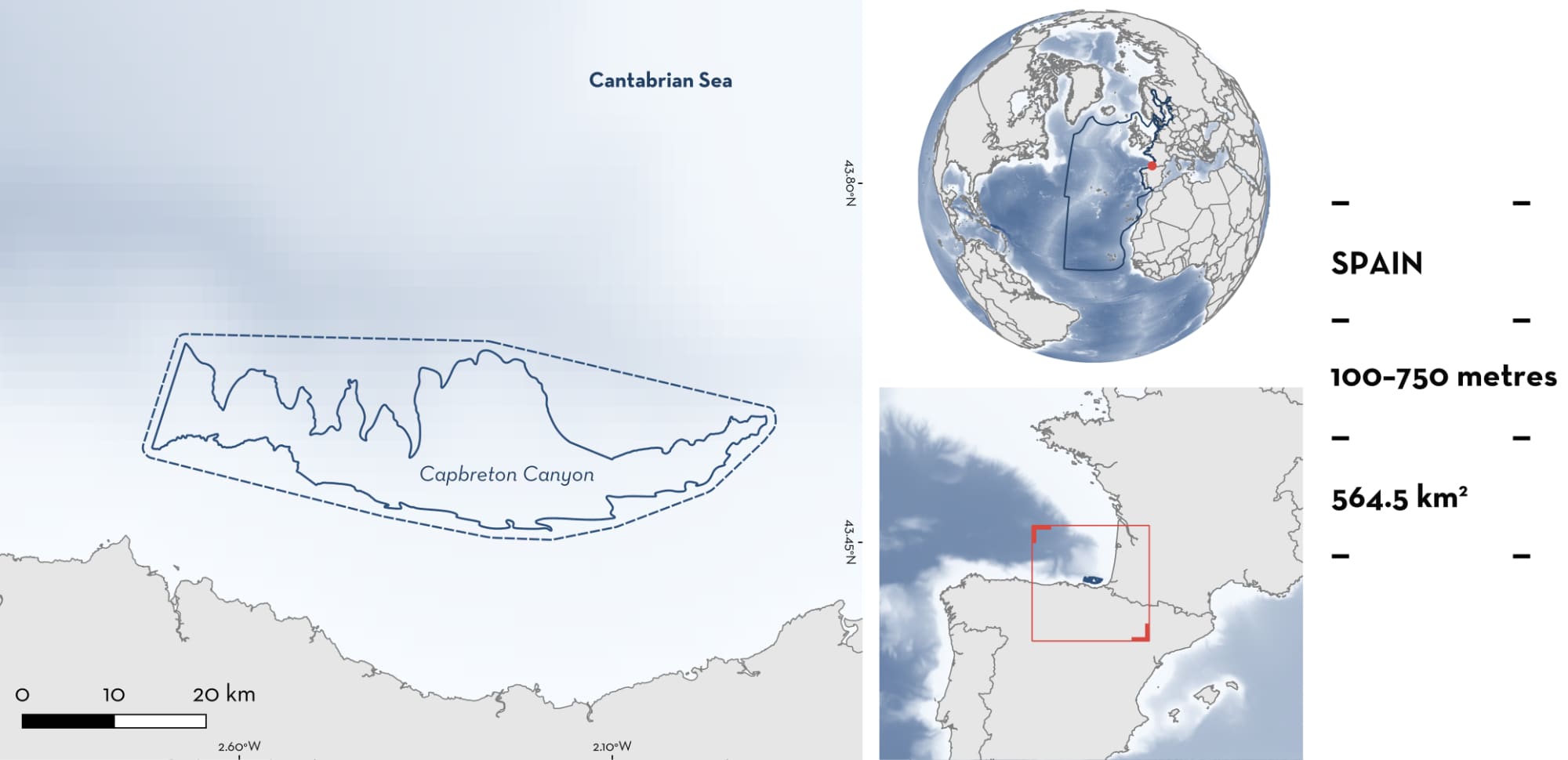
Capbreton Canyon is located offshore of Vizcaya and Guipúzcoa Provinces, Basque Country, Spain. It encompasses part of the continental shelf and part of the slope towards the Capbreton canyon system. The area is characterised by rocky, sandy-muddy, and sandy substrates with the presence of contourite channels. The area is influenced by a system of boundary currents. The area overlaps with the Cantabrian Sea (Southern Bay of Biscay) Ecologically or Biologically Significant Marine Area. Within this area there are: reproductive areas (Blackmouth Catshark Galeus melastomus).
Download factsheet
Capbreton Canyon
DESCRIPTION OF HABITAT
Capbreton Canyon is located offshore of Vizcaya and Guipúzcoa Provinces, Basque Country, Spain. This area encompasses part of the continental shelf and part of the slope towards the Capbreton Canyon system. Capbreton Canyon is characterised by shallower areas on the continental shelf which are predominantly rocky and occasionally covered by sandy-muddy and sandy substrates, to the slope in which muddy-sandy or muddy sedimentation predominates with the presence of contourite channels with pockmarks (cone-shaped, circular, or elliptical depressions) (Jané et al. 2010; Galparsoro et al. 2020).
The area is influenced by a system of boundary currents of varying densities, formed in the North Atlantic or resulting from the interaction of Atlantic water masses with those formed in the Mediterranean Sea, leading to stratification through the water column (Llave et al. 2015).
The area overlaps with the Cantabrian Sea (Southern Bay of Biscay) Ecologically or Biologically Significant Marine Area (EBSA; CBD 2025).
This Important Shark and Ray Area is benthic and subsurface and is delineated from 100–750 m based on the bathymetry of the area.
CRITERION C
SUB-CRITERION C1 – REPRODUCTIVE AREAS
Capbreton Canyon is an important reproductive area for one shark species.
Between 1990–2024, Blackmouth Catshark neonates and young-of-the-year (YOY) were captured during the Northern Spanish Shelf Groundfish Survey in the area and wider Cantabrian Sea and off Galicia, using a stern trawler with a horizontal opening of ~20 m and a vertical opening of 4 m, during 30 min hauls at a towing speed of four knots (ICES 2015; Fernández-Zapico et al. 2023). During this period, 3,834 Blackmouth Catsharks were caught in the area. Of these, 30% (n = 1,136) were neonates/YOY measuring 13–25 cm total length (TL) (ICES 2025). Size-at-maturity for the species ranges from 33–45 cm TL (Ebert et al. 2021), and size-at-birth is estimated at 8.5 cm TL, attaining ~24-25 cm TL at 1-yr of age (Baptista et al. 2010), confirming these were neonates and YOYs. Individuals in this size range were observed in every year of the survey, and during contemporary years, numbers were: 2010 (n = 59), 2011 (n = 13), 2012 (n = 52), 2013 (n = 28), 2014 (n = 26), 2015 (n = 40), 2016 (n = 37), 2017 (n = 14), 2018 (n = 50), 2019 (n = 64), 2020 (n = 23), 2021 (n = 18), 2022 (n = 23), 2023 (n = 27), and 2024 (n = 41) (ICES 2025). The surveys in this area were undertaken in October, and therefore additional temporal data are required to confirm seasonality in reproductive behaviour (ICES 2025). Neonates and YOY were captured between 148–565 m depth in the area (ICES 2025). Although there are records of neonates/YOY Blackmouth Catshark in the wider Cantabrian Sea and off Galicia, this area has national importance as it has one of the highest known catch records of Blackmouth Catshark at this life history stage in northern Spain (ICES 2025).
Download factsheet
SUBMIT A REQUEST
ISRA SPATIAL LAYER REQUEST
To make a request to download the ISRA Layer in either a GIS compatible Shapefile (.shp) or Google Earth compatible Keyhole Markup Language Zipped file (.kmz) please complete the following form. We will review your request and send the download details to you. We will endeavor to send you the requested files as soon as we can. However, please note that this is not an automated process, and before requests are responded to, they undergo internal review and authorization. As such, requests normally take 5–10 working days to process.
Should you have questions about the data or process, please do not hesitate to contact us.