ISRA FACTSHEETS
ISRA FACTSHEETS
EUROPEAN ATLANTIC
Carlingford Lough & Dundalk Bay
Summary
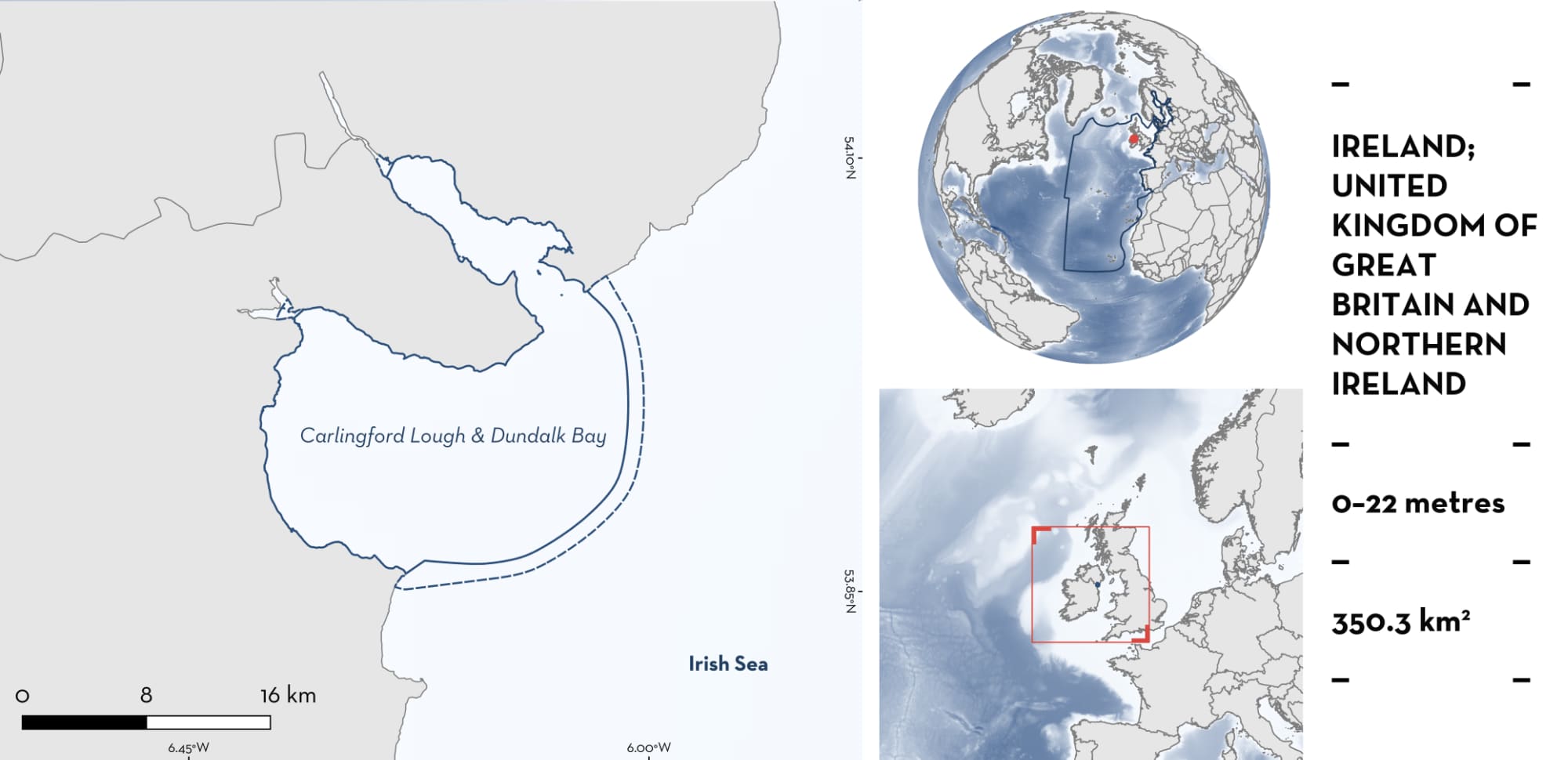
Carlingford Lough & Dundalk Bay is located on Ireland’s northeast coast. The area extends 15 km offshore into the Irish Sea and encompasses a glacial fjord and a bay supporting habitats such as saltmarshes, intertidal mudflats, infralittoral mud, and eelgrass beds. The area overlaps the Dundalk Bay Ramsar Site. Within this area there are: threatened species and undefined aggregations (Tope Galeorhinus galeus).
Download factsheet
Carlingford Lough & Dundalk Bay
DESCRIPTION OF HABITAT
Carlingford Lough & Dundalk Bay is located on Ireland’s northeast coast. The area borders Northern Ireland and County Louth, extending 15 km offshore. This coastal system encompasses diverse marine and estuarine habitats. Carlingford Lough is a glacial fjord ~15 km long and 3–4 km wide. It is predominantly shallow, with depths ranging from 2–5 m, deepening to 25 m in the navigation channel and reaching a maximum of 36 m near Carlingford Harbour. Dundalk Bay is a broad, shallow embayment with depths generally less than 15 m, characterised by extensive intertidal flats that extend 3 km offshore, as well as saltmarshes and eelgrass beds (AQUAFACT 2011; NPWS 2025). Carlingford Lough contains 15 km of intertidal mud and sandflats, supporting habitats like saltmarshes and infralittoral muds. Mill Bay, in the centre of the area, supports the largest intact block of saltmarsh in Northern Ireland (DAERA 2025).
Both areas exhibit dynamic processes, including tidal mixing and seasonal stratification, which enhance nutrient cycling and support episodic phytoplankton blooms. They experience semi-diurnal tides with significant ranges; Dundalk Bay has a mean spring tidal range of 4.7 m. Carlingford Lough receives a small amount of freshwater input from rivers such as the Newry, Ryland, and Moygannon, creating estuarine gradients in salinity and temperature. However, the freshwater influence on salinity is small and only significant at low tide (AQUAFACT 2011). Seasonal stratification and mixing events influence nutrient distribution and biological productivity in both systems.
The area overlaps with the Dundalk Bay Ramsar Site (Wetland of International Importance; Ramsar 2025).
This Important Shark and Ray Area is benthic and pelagic and is delineated from inshore and surface waters (0 m) to a depth of 22 m based on the depth range of the Qualifying Species in the area.
CRITERION A
VULNERABILITY
One Qualifying Species considered threatened with extinction according to the IUCN Red List of Threatened Species regularly occurs in the area. This is the Critically Endangered Tope (Walker et al. 2020).
CRITERION C
SUB-CRITERION C5 – UNDEFINED AGGREGATIONS
Carlingford Lough & Dundalk Bay is an important area for undefined aggregations of one shark species.
This area has the highest density of Tope out of the four Tope hotspots around the Irish coast and is a well-known location among sportfishers. Anglers describe this area as having Tope in ‘packs’ or traveling in ‘schools’ with no chumming needed during trips because of the number of animals present during the fishing season (N Dunlop 2009; Fair Seas 2022). Between 2010–2024, Tope were caught on rod-and-line by sportfishers, tagged with unique conventional tags, released, and reported to the Inland Fisheries Ireland’s Marine Sportfish Tagging Programme (IFI 2023; IFI unpubl. data 2025). Trips were either from shore or from a boat and were limited to a few hours within one day (range: 2–8 hours). Reports were limited to successful trips (i.e., when one or more Tope were caught and tagged) and catch was reported as the number of individual Tope per angling trip per day. The angling season spans April to October with peak aggregations reported between June–August annually. A total of 3,388 Tope were recorded around the Irish coast between 2010–2024. A quarter (24%; n = 826) of all Tope tagged within this timeframe were recorded in the area by 18 different sportfishers. Tope were recorded on 210 trips in total (including singular individuals and pairs). Aggregations (3+ individuals) were recorded on 80 trips with a mean group size of five individuals (maximum = 16). Anglers report capturing small males and large females in this area with pregnant individuals frequently caught (Ireland Fishing Diaries 2017). However, further information is needed to understand the nature and function of these aggregations.
Download factsheet
SUBMIT A REQUEST
ISRA SPATIAL LAYER REQUEST
To make a request to download the ISRA Layer in either a GIS compatible Shapefile (.shp) or Google Earth compatible Keyhole Markup Language Zipped file (.kmz) please complete the following form. We will review your request and send the download details to you. We will endeavor to send you the requested files as soon as we can. However, please note that this is not an automated process, and before requests are responded to, they undergo internal review and authorization. As such, requests normally take 5–10 working days to process.
Should you have questions about the data or process, please do not hesitate to contact us.