ISRA FACTSHEETS
ISRA FACTSHEETS
WESTERN INDIAN OCEAN REGION
Chavakkad
Summary
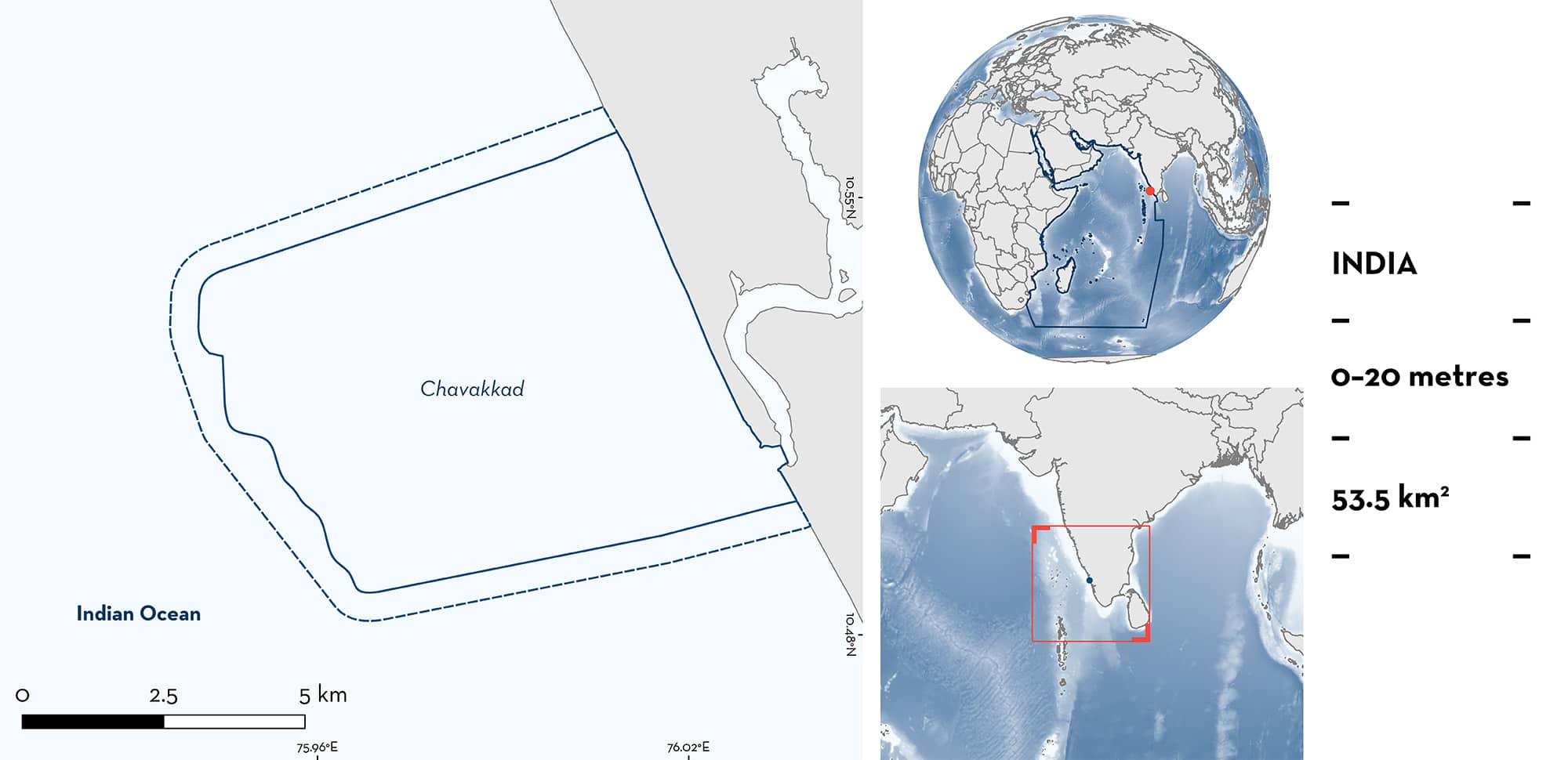
Chavakkad is located in Kerala, India. This ~10 km long shallow coastal area is linked to the Chettuva estuary, which constantly replenishes the coast with significant freshwater influx from the Karuvannur, Kecheri, and Puzhakkal rivers. The area is characterised by nutrient-rich waters from convective mixing and eutrophication especially during the monsoon season (June–July). Within this area there are: threatened species (e.g., Stripenose Guitarfish Acroteriobatus variegatus); range-restricted species (e.g., Bengal Guitarfish Rhinobatos annandalei); and reproductive areas (e.g., Widenose Guitarfish Glaucostegus obtusus).
Download factsheet
Chavakkad
DESCRIPTION OF HABITAT
Chavakkad is a shallow coastal area situated in the Thrissur district of Kerala on the west coast of India, southeastern Arabian Sea. The area includes shallow coastal waters and the mouth of the Chettuva estuary, which constantly replenishes the coast with significant freshwater influx from the Karuvannur, Kecheri, and Puzhakkal rivers. The coastal zone is characterised by a long sandy beach. The coastal belt also has a high biodiversity of mangroves, including True Mangrove Rhizophora mucronata and Bruguiera cylindrica (Varghese et al. 2021).
The area is under the influence of a monsoonal climate. During the onset of the monsoon (June–July), there are frequent occurrences of mudbanks and the area is characterised by nutrient-rich waters from convective mixing and eutrophication.
This Important Shark and Ray Area is benthic and is delineated from inshore waters (0 m) to 20 m based on the bathymetry of the area.
CRITERION A
VULNERABILITY
Three Qualifying Species considered threatened with extinction according to the IUCN Red List of Threatened SpeciesTM regularly occur in the area. These are the Critically Endangered Stripenose Guitarfish (Kyne et al. 2017), Bengal Guitarfish (Dulvy et al. 2021), and Widenose Guitarfish (Kyne & Jabado 2021).
CRITERION B
RANGE RESTRICTED
This area holds the regular presence of Stripenose Guitarfish and Bengal Guitarfish as resident range-restricted species. A combination of semi-structured interviews with artisanal and commercial fishers (n = 36) and local recreational anglers (n = 20), and landing site surveys during 2020–2023 (n = 41 surveys; generally fortnightly) provided information on guitarfish in the area. These species are regularly reported by artisanal and commercial fishers in Chavakkad mostly during the post-monsoon season (November–December) and by recreational anglers who operate during the same period. Both species are restricted to the Arabian Sea Large Marine Ecosystem (LME) and the Bay of Bengal LME.
CRITERION C
SUB-CRITERION C1 – REPRODUCTIVE AREAS
Chavakkad is an important reproductive area for three ray species. A combination of semi-structured interviews with artisanal and commercial fishers (n = 36) and local recreational anglers (n = 20), and landing site surveys during 2020–2023 (n = 41 surveys; generally fortnightly) provided information on guitarfish in the area. Guitarfish aggregations are reported by fishers in the Chavakkad area mostly during the post-monsoon season (November-December) as well as by recreational anglers who operate during the same period.
Data collected between 2020–2022 show that Bengal Guitarfish gives birth in this area between November and December (Wilson et al. 2023). All sixteen mature females encountered at landing sites were pregnant (body size range: 76–84 cm total length [TL]) with near-term embryos (10–11 embryos per female). Five neonates were also observed at landing sites during the same period within the size range of 18–21 cm TL, which is similar to the reported size-at-birth of 20 cm TL (Last et al. 2016).
According to data obtained between 2020 and 2022, Widenose Guitarfish gives birth in this area between October and December (Wilson et al. 2023). All eleven individuals (eight females and three males) encountered at landing sites were mature individuals, including five pregnant females with near-term embryos (5–6 embryos per female). The size of the females observed was 89–92 cm TL. Two neonates of 19–20 cm TL were also observed at landing sites during the same period (Wilson et al. 2023). There have been regular observations of live guitarfishes including neonates during October–December in shallow coastal waters. Neonates of these species were seen in the shallow (0–2 m depth) habitats of the area, particularly in the sandy habitats along the Chettuva estuary. Direct observations were made by researchers while both artisanal and commercial fishers and recreational anglers mentioned these events during interviews.
Nine Stripenose Guitarfish were recorded at landing sites from Chavakkad coastal waters during November and December between 2020 and 2022. All individuals (eight females of 65–70 cm TL and one male) encountered were mature, including four pregnant females with near-term embryos (5–6 embryos per female) (Wilson et al. 2023).
Download factsheet
SUBMIT A REQUEST
ISRA SPATIAL LAYER REQUEST
To make a request to download the ISRA Layer in either a GIS compatible Shapefile (.shp) or Google Earth compatible Keyhole Markup Language Zipped file (.kmz) please complete the following form. We will review your request and send the download details to you. We will endeavor to send you the requested files as soon as we can. However, please note that this is not an automated process, and before requests are responded to, they undergo internal review and authorization. As such, requests normally take 5–10 working days to process.
Should you have questions about the data or process, please do not hesitate to contact us.