ISRA FACTSHEETS
ISRA FACTSHEETS
AUSTRALIA AND SOUTHEAST INDIAN OCEAN
Cherubs Cave & Henderson Rock
Summary
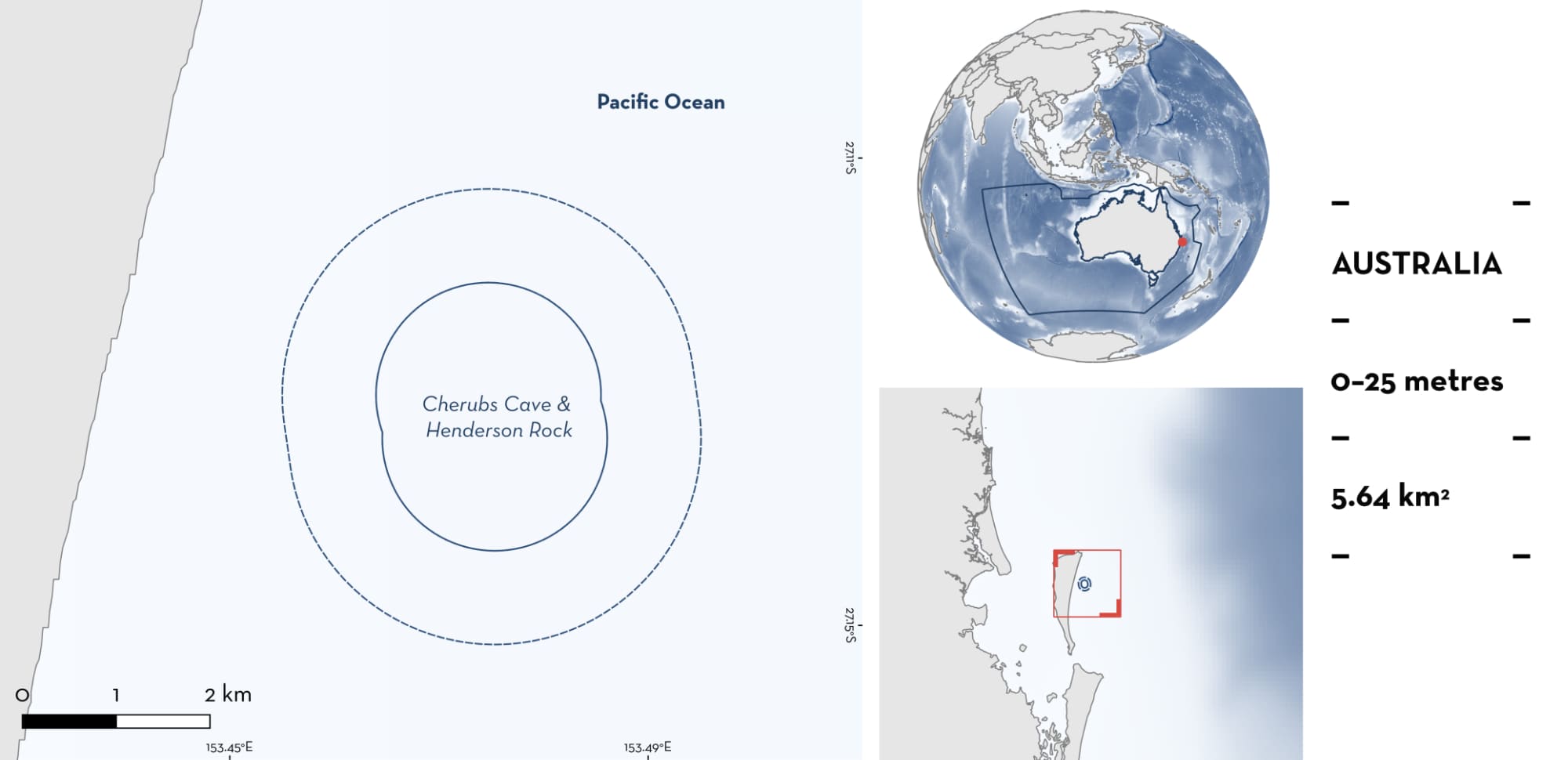
Cherubs Cave & Henderson Rock is located in southeast Queensland, Australia. The area is situated in offshore waters, off northeast Moreton Island. Cherubs Cave is a large, circular cave surrounded by rocky gullies, smaller caves, overhangs, and kelp beds. Henderson Rock is characterised by extensive granite outcrops with ledges, overhangs, caves, and a long deep gutter. The area overlaps with the Moreton Bay Marine Park. Within the area there are: threatened species and resting areas (Sand Tiger Shark Carcharias taurus).
Download factsheet
Cherubs Cave & Henderson Rock
DESCRIPTION OF HABITAT
Cherubs Cave & Henderson Rock is located in southeast Queensland, Australia. The area is situated in offshore waters, off northeast Moreton Island. Cherubs Cave is a large, circular cave, roughly 20 by 15 metres, with 4–6 entrances. The area is surrounded by rocky gullies, smaller caves, overhangs, and kelp beds (Unidive 2025). Henderson Rock is characterised by extensive granite outcrops. From the top of the pinnacle, which lies in about 12 m of water, the rock drops gradually at first but then more steeply to about 24 m. There are several ledges, overhangs, and caves whose entrances are often obscured by thick kelp. To the south and east of the base of the pinnacle there is a long deep gutter (Unidive 2025). The area is characterised by kelp beds on the western side and bare rock on the top with large caverns away from the pinnacle in waters to 25 m depth.
The area is influenced by its proximity to the East Australian Current, the poleward flowing western boundary current of the South Pacific Gyre (Suthers et al. 2011). The East Australian Current flow is strongest in the austral summer, and the formation of eddies along this coastline also fluctuate seasonally (Ridgway & Hill 2009).
The area overlaps with the Moreton Bay Marine Park – marine national park (green) zone (Queensland Government 2019).
This Important Shark and Ray Area is benthic and pelagic and is delineated from inshore and surface waters (0 m) to 25 m depth based on the bathymetry of the area.
CRITERION A
VULNERABILITY
One Qualifying Species considered threatened with extinction according to the IUCN Red List of Threatened Species regularly occurs in the area. This is the Critically Endangered Sand Tiger Shark (Rigby et al. 2025).
CRITERION C
SUB-CRITERION C3 – RESTING AREAS
Cherubs Cave & Henderson Rock is an important resting area for one shark species.
The rocky structures located at Cherubs Cave & Henderson Rock are regularly and predictably used by resting aggregations of Sand Tiger Sharks. This area is located towards the northern extent of the species’ migratory corridor, which runs from Montague Island in the south to Wolf Rock in the north (Otway & Ellis 2011; Reid-Anderson et al. 2019; Dwyer et al. 2023). Between 2003–2008, 15 Sand Tiger Sharks were tracked using pop-up archival satellite tags deployed at aggregation sites in New South Wales (Otway & Ellis 2011). Two of the tags (13.3%) released in the vicinity of Henderson Rock, highlighting this area as part of their annual migration.
Between 1991–2025, Sand Tiger Sharks were observed forming regular seasonal aggregations in the gutters, caves, and ledges of Cherubs Cave & Henderson Rock. This aggregation has been documented via photo-identification studies and acoustic telemetry confirming regular and predicable persistence of aggregations over multiple years (Bansemer & Bennett 2011; Otway & Ellis 2011; Dwyer et al. 2023). Photo-identification surveys between 2004–2008 (n = 9), revealed both males (22%) and females (78%) (including visibly pregnant individuals; 67% of total) were recorded yearly at sites within this area (Bennett & Bansemer 2011), yet direct evidence of mating in the area (e.g., fresh mating scars) or neonates are scarce (RG Dwyer pers. obs. 2025). Hovering and milling are characteristic behaviours of resting Sand Tiger Sharks and comprise the majority of swimming behaviours observed at their main aggregation sites on Australia’s east coast (Smith et al. 2015). When hovering, sharks face into the water current and their tail beats allow them to maintain a stationary position, whereas milling involves slow movements and directional changes generally confined to a particular area within a gutter (Smith et al. 2015).
Between 2015–2022, an acoustic telemetry study tracked 18 Sand Tiger Sharks (10 males, 8 females [one tagged within the area]; Dwyer et al. 2023). Seventeen of the tagged sharks were detected at the two receivers placed at Cherubs Cave & Henderson Rock (total detections = 27,801 detections). Multiple tagged sharks were detected over consecutive years (n = 2 over two years, n = 5 over three years, n = 1 over four years; Dwyer et al. 2023). Tagged female Sand Tiger Sharks were detected in the area between June to December, while males were detected between July and January. Residency analyses indicated that tagged female Sand Tiger Sharks remained at the site for an average of 11.2 days (range: 56 minutes–44 days), compared with males which averaged 2.5 days (range: 30 minutes–15 days; Dwyer et al. 2023). Both acoustic receivers were not active in the area for the whole study duration, potentially underestimating use of the area by the sharks. Between 2017–2021, when both acoustic receivers were active, there were 83 movements recorded by 12 tagged sharks between the sites of Cherubs Cave and Henderson Rock (~1.7 km distance), demonstrating the connectivity of the two main resting sites within the area. The predictable seasonal resting aggregation in the area suggest that Cherubs Cave & Henderson Rock is used by Sand Tiger Sharks as part of their annual migration (Otway & Ellis 2011; Reid-Anderson et al. 2019; Dwyer et al. 2023), either prior to the mating period (Bansemer & Bennett 2011), or for pregnant females as they move southward from Wolf Rock to pup.
Download factsheet
SUBMIT A REQUEST
ISRA SPATIAL LAYER REQUEST
To make a request to download the ISRA Layer in either a GIS compatible Shapefile (.shp) or Google Earth compatible Keyhole Markup Language Zipped file (.kmz) please complete the following form. We will review your request and send the download details to you. We will endeavor to send you the requested files as soon as we can. However, please note that this is not an automated process, and before requests are responded to, they undergo internal review and authorization. As such, requests normally take 5–10 working days to process.
Should you have questions about the data or process, please do not hesitate to contact us.