ISRA FACTSHEETS
ISRA FACTSHEETS
AUSTRALIA AND SOUTHEAST INDIAN OCEAN
Clerke Reef
Summary
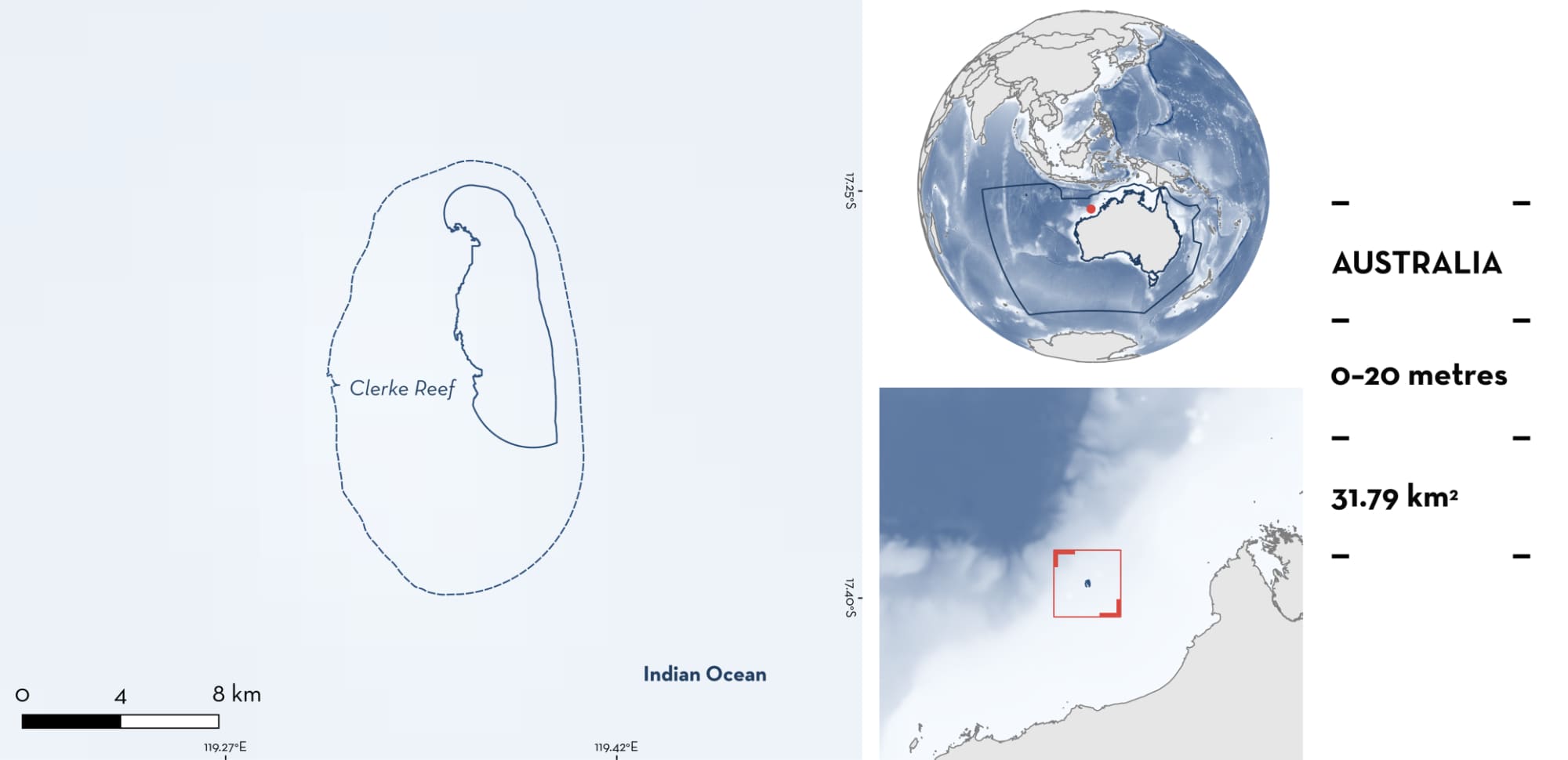
Clerke Reef is located off Western Australia, Australia. This area is part of the Rowley Shoals that is composed of three large, isolated reefs: Clerke, Imperieuse, and Mermaid which sit at the edge of the continental shelf. The area rises steeply from ~230–440 m depth to a narrow reef rim encircling a lagoon. The habitat is composed by high-energy fore-reef slopes, reef passages, and a lagoon. The area overlaps with Rowley Shoals Marine Park. Within this area there are: threatened species and undefined aggregations (Grey Reef Shark Carcharhinus amblyrhynchos).
Download factsheet
Clerke Reef
DESCRIPTION OF HABITAT
Clerke Reef is located off Western Australia, Australia. This area is part of the Rowley Shoals that is composed of three large reefs: Clerke (15.8 km long and 7.6 km wide), Imperieuse (17.8 km long and 9.5 km wide), and Mermaid (14.5 km long and 7.6 km wide). Rowley Shoals is isolated, situated ~250 km from the mainland, at the edge of the continental shelf in the Timor Sea (Berry 1986). The reefs are orientated in a northeasterly direction and separated by 30–40 km of deep (~230–440 m) water (Ferreira et al. 2025). Each rises steeply to a narrow rim enclosing clear, shallow lagoons with patch reefs, sand mounds, and bommies; the outer flanks fall quickly into mesophotic slopes (Ferreira et al. 2025). This area is situated on the northeast side of Clerke Reef encompassing the lagoon, the only three reef passages of Clerke Reef (i.e., channels that connect oceanic habitats with the lagoon), and the outer reef crest next to the passages. Water masses are largely sourced from the Indonesian Throughflow and the Eastern Indian Ocean’s South Equatorial Current (Suthers & Waite 2007). Rainfall is typically restricted to the relatively short summer monsoonal period between December–May.
This area overlaps with Rowley Shoals Marine Park (WA DBCA 2025).
This Important Shark and Ray Area is benthic and is delineated from inshore and surface waters (0 m) to 20 m based on the depth range of Qualifying Species in the area.
CRITERION A
VULNERABILITY
One Qualifying Species considered threatened with extinction according to the IUCN Red List of Threatened Species regularly occurs in the area. This is the Endangered Grey Reef Shark (Simpfendorfer et al. 2020).
CRITERION C
SUB-CRITERION C5 – UNDEFINED AGGREGATION
Clerke Reef is important for undefined aggregations of one shark species.
Acoustic telemetry data were used to determine movements and habitat use of Grey Reef Sharks on the Rowley Shoals (Imperieuse and Clerke Reefs; Field et al. 2011). From December 2007 to November 2008, 12 male and 14 female sharks ranging from 79–169 cm total length (TL) were tagged and monitored by an array of 11 acoustic receivers on the two atoll reefs. Over 26,000 detections were recorded over the 325 days of receiver deployment. The highest number of detections occurred on three receivers located on Clerke Reef (14,388; 55%). The array recorded many tagged Grey Reef Sharks on the same receivers often on the same day in this area providing evidence for the co-occurrence of multiple individuals.
In 2007, 2011, and 2012 across Rowley Shoals, 44 Grey Reef Sharks (19 males, 33 females, two unknown sex) were tagged (Ferreira et al. 2025). Sharks measured on average 146.1 cm TL (standard deviation ± 19.5 cm TL). For this species, the size-at-birth is 45–64 cm TL, and the size-at-maturity is 130–145 cm TL for males and 120–142 cm TL for females (Ebert et al. 2021). Therefore, most individuals tagged were large juveniles or adults. An array of 41 receivers covering the three reefs of the Rowley Shoals were used to monitor their movement. Sharks were tracked for a median of 458 days (range: 20–1,415). In this area between August 2011 to June 2016, ~400,000 detections were recorded from 22 sharks from a receiver range of 300 m radius. Aggregations were defined as three or more tagged individuals detected on a receiver within five minutes. Aggregations in consecutive 5-minute bins were grouped into an event, and its duration was calculated. A total of 736 five-minute bins with aggregations of 3–6 sharks were recorded, grouped into 573 events, with a duration of 0–42 minutes. A strong long-term residency and/or frequent returns were recorded by many individuals in this area with both male and female sharks showing high use of the same zones. Movement networks showed frequent connections between Clerke, Imperieuse, and Mermaid reefs, with Clerke acting as the central hub. Reef passages have been identified as super-habitats for Grey Reef Sharks, supporting feeding, resting, mating, and parturition (Papastamatiou et al. 2021, 2025). Further information is required to determine the nature and function of these aggregations.
Download factsheet
SUBMIT A REQUEST
ISRA SPATIAL LAYER REQUEST
To make a request to download the ISRA Layer in either a GIS compatible Shapefile (.shp) or Google Earth compatible Keyhole Markup Language Zipped file (.kmz) please complete the following form. We will review your request and send the download details to you. We will endeavor to send you the requested files as soon as we can. However, please note that this is not an automated process, and before requests are responded to, they undergo internal review and authorization. As such, requests normally take 5–10 working days to process.
Should you have questions about the data or process, please do not hesitate to contact us.