
ISRA FACTSHEETS
ISRA FACTSHEETS
AUSTRALIA AND SOUTHEAST INDIAN OCEAN
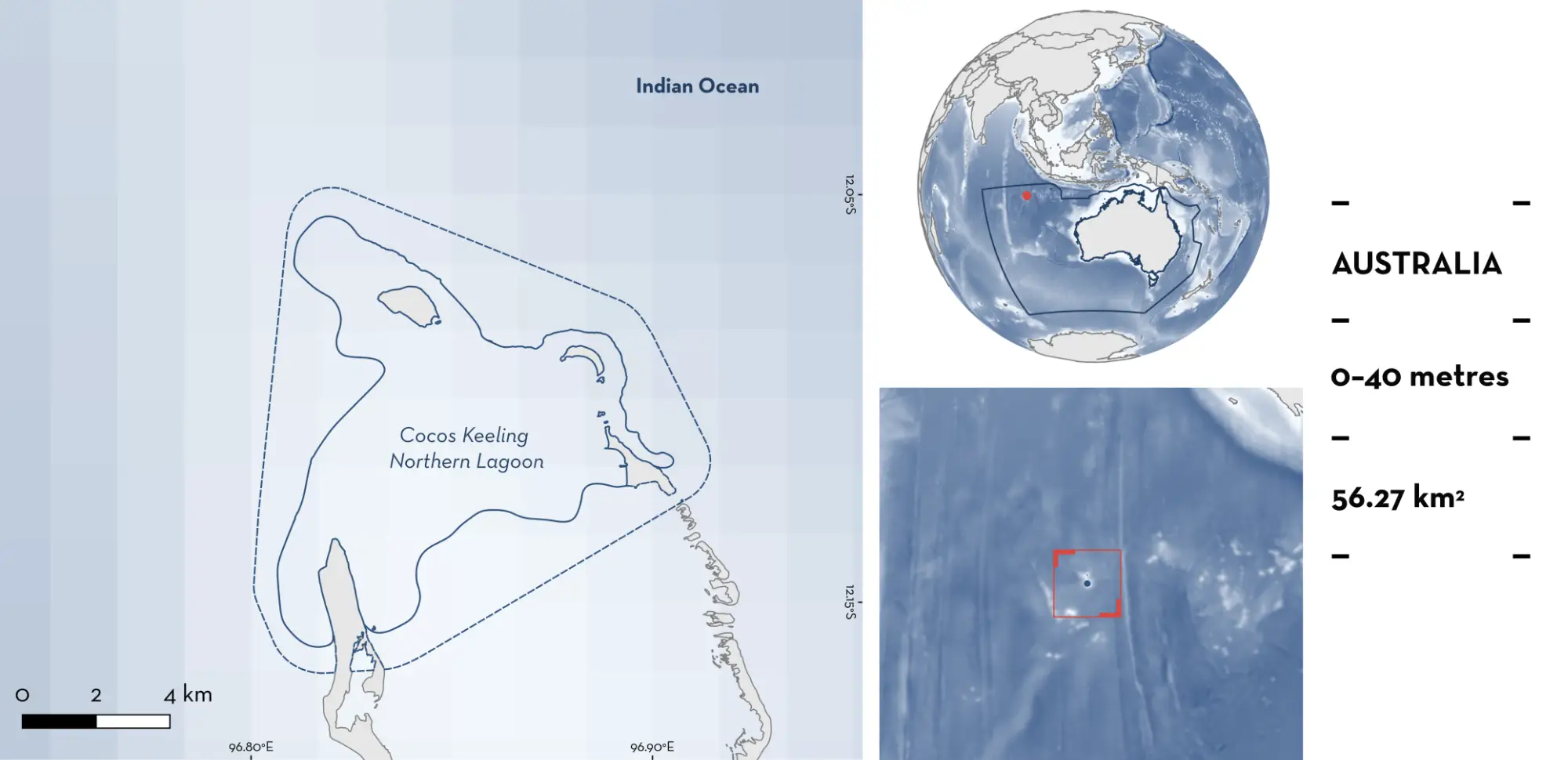
Cocos Keeling Northern Lagoon
Summary
Cocos Keeling Northern Lagoon is located in the Cocos (Keeling) Islands, a remote Australian territory in the Eastern Indian Ocean. This area encompasses two of the three largest passages of the atoll and is characterised by high speed tidal and wave driven current patterns. The area overlaps with Cocos (Keeling) Islands Marine Park. Within this area there are: threatened species (e.g., Reef Manta Ray Mobula alfredi); resting areas (Whitetip Reef Shark Triaenodon obesus); and undefined aggregations (e.g., Grey Reef Shark Carcharhinus amblyrhynchos).
Download factsheet
Cocos Keeling Northern Lagoon
DESCRIPTION OF HABITAT
Cocos Keeling Northern Lagoon is located in the Cocos (Keeling) Islands, a remote Australian territory in the Eastern Indian Ocean. This area comprises several small islands, including Horsburgh Island (also known as Pulu Luar), Direction Island (Pulau Tikus), and Home Island (Pulau Selma, the only inhabited island in this area). The islands are approximately 2,800 km northwest of Perth, Australia, and 1,200 km southwest of Jakarta, Indonesia (Evans et al. 2016). The habitat is predominantly formed by coral reef and unconsolidated sediment (O’Keeffe et al. 2017). The surrounding waters of the atoll reach depths of 5,000–6,000 m, creating an isolation barrier (Parks Australia 2025). The Cocos (Keeling) Islands represent the westernmost extension of the Western Pacific marine biogeographic region and have been reported to host marine species typically affiliated with both the Indian and Pacific Oceans (Hobbs & Allen 2014).
Swell predominantly comes from the southeast, associated with the trade winds. There is usually a westward-flowing equatorial current; however, in November–December, when the Intertropical Convergence Zone moves south of the equator, an eastward-flowing equatorial counter current may develop. Tides are mixed, mainly semi-diurnal, with large inequalities in range and timing between consecutive tides. The maximum tidal range is 1.2 m (Woodroffe & Falkland 2004). This area encompasses two of the three largest passages of the atoll and is characterised by high speed tidal and wave driven current patterns (O’Keeffe et al. 2017).
The area overlaps with Cocos (Keeling) Islands Marine Park (Parks Australia 2025).
This Important Shark and Ray Area is benthic and pelagic and is delineated from inshore and surface waters (0 m) to 40 m based on the bathymetry of the area.
CRITERION A
VULNERABILITY
Four Qualifying Species considered threatened with extinction according to the IUCN Red List of Threatened Species regularly occur in the area. These are the Endangered Grey Reef Shark (Simpfendorfer et al. 2020a), and the Vulnerable Blacktip Reef Shark (Simpfendorfer et al. 2020b), Whitetip Reef Shark (Simpfendorfer et al. 2020c), and Reef Manta Ray (Marshall et al. 2022).
CRITERION C
SUB-CRITERION C3 – RESTING AREAS
Cocos Keeling Northern Lagoon is an important resting area for one shark species.
Between 2000–2019, recreational dives were conducted year-round in this area. Whitetip Reef Sharks were observed on almost every dive at the southern atoll of Cocos (Keeling Islands). However, within this area of the northern section of the atoll, they are observed resting in larger numbers (K Wilshaw person. obs. 2000–2019). Aggregations of ~5 individuals resting on the sandy substrate and under ledges at depths of 10–18 m are observed year-round but peak between January–February. Aggregations of between 20–50 Whitetip Reef Sharks have also been observed resting in this area (K Wilshaw pers. obs. 2000–2019). Along with Pulu Keeling (the northern atoll), Cocos (Keeling) Islands are among the most isolated islands in the Indian Ocean, highlighting the importance of this area for resting Whitetip Reef Sharks.
CRITERION C
SUB-CRITERION C5 – UNDEFINED AGGREGATIONS
Cocos Keeling Northern Lagoon is an important area for undefined aggregations of two shark and one ray species.
In June 2016, stereo-Baited Remote Underwater Video Station (BRUVS) surveys (n = 183) were deployed for 60 mins on the seafloor, of which 120 (65.6%) were in this area (Simpfendorfer et al. 2023). Grey Reef Sharks were recorded on 30 deployments in this area (25% of deployments in this area) and 16 outside this area (25.4% deployments outside this area; Simpfendorfer et al. 2023). Of deployments with Grey Reef Shark records in this area, four (13.3%) had a maximum number of individuals in a single frame (MaxN) >4 (range = 5–12; average = 8), while outside this area only one (6.3%) had a MaxN >4 (MaxN = 5). A further 113 BRUVS were deployed in April 2017, 26 (23%) of which were in this area (Simpfendorfer et al. 2023). Grey Reef Sharks were recorded on 15 deployments in this area (57.7% of deployments in this area), and on 20 deployments outside this area (23.0% of deployments outside the area; Simpfendorfer et al. 2023). All deployments with MaxN >4 were in this area (n = 5; 33.3% of deployments with Grey Reef Shark records) ranging 5–25 individuals per frame (average = 9), which is the highest MaxN for the species among 876 deployments that recorded Grey Reef Sharks in northwest and northeast Australia. Based on recreational diver encounters between 2000–2019, aggregations of ~5 Grey Reef Sharks between ~100–200 cm total length (TL) were observed year-round on >90% of dives, mostly at 10–40 m depth (K Willshaw pers. obs. 2000–2019). Aggregations can occasionally exceed 100 individuals on the northern shelf break of Horsburgh Island where currents are stronger (K Willshaw pers. obs. 2000–2019). On the west side of this area at a dive site named ‘The Entrance’, Grey Reef Sharks are mostly ~100 cm TL and observed in January–February (K Willshaw pers. obs. 2000–2019). The higher MaxN in this area compared to the whole atoll along with recreational diver observations support the importance of this area for aggregations of Grey Reef Sharks.
In June 2016, stereo- BRUVS (n = 183) were deployed for 60 mins on the seafloor, of which 120 (65.6%) were in this area (Simpfendorfer et al. 2023). Blacktip Reef Sharks were recorded on 49 deployments in this area (40.8% of 120) and 31 (49.2%) outside this area (Simpfendorfer et al. 2023). Within this area, 24.5% of deployments with Blacktip Reef Sharks (n = 12) had a MaxN >4 (range = 5–7), while outside this area, 9.7% (n = 3) deployments had a MaxN >4 (range = 4–6). In November 2016, of 243 BRUVS deployed in the atoll, 133 recorded Blacktip Reef Sharks, of which 89 were in this area (Marine Futures Lab unpubl. data 2006–2024). The average MaxN in this area was 3.2 (range = 1–10), while outside this area it was 2.5 (range = 1–6). Deployments with MaxN >4 in this area represent 21.3% of deployments with Blacktip Reef Shark records (n = 19) and outside this area they represented 11.4% (n = 5) (Marine Futures Lab unpubl. data 2006–2024). In 2017, 23 deployments in this area (88.5% of deployments) recorded Blacktip Reef Sharks, and outside this area, 81 recorded this species (93.1% of deployments outside of this area; Simpfendorfer et al. 2023). Within this area, 30.4% of deployments with Blacktip Sharks (n = 7) had MaxN >4 (range = 5–13; average = 7.3), while outside this area, 37.0% (n = 30) deployments had MaxN >4 (range = 5–13; average = 6.7). Social media records (n = 5) support that aggregations of Blacktip Reef Sharks are regularly observed in this area as well as in the whole atoll. Social media records spanning 2021–2025 show aggregations of 4–10+ individuals, including one mating event. Additionally, two records from 2011 and 2021 show assemblages of more than 60 Blacktip Reef Sharks and Grey Reef Sharks feeding on a school of fish.
Reef Manta Rays aggregate in the area, predominantly at sites around Direction Island. Between 2003–2023, Reef Manta Ray sightings from citizen science were collated in a photo-identification database for Cocos (Keeling) Islands (Project Manta unpubl. data 2025). There were 208 sightings submitted from Cocos (Keeling) Islands during this timeframe, all from the area, and 122 individuals were identified using photo-identification (n = 60 females; n = 57 males; n = 5 unknown sex; Project Manta unpubl. data 2025). Sightings are year-round, with a seasonal peak in January and February (Project Manta unpubl. data 2025). Of 208 records in the area, 50 had the observed behaviour recorded (24.0%). Reef Manta Rays were reportedly mostly cleaning (n = 45, 90%; Project Manta unpubl. data 2025). Up to 14 Reef Manta Rays were observed cleaning at any one time. Additionally, the remaining five observations were courtship (n = 4) and feeding (defined as swimming at the surface with an open mouth and cephalic lobes forming a funnel to aid prey capture; n = 1). In addition, social media records (n = 7) spanning 2021–2025 show aggregations of 5–30 individuals in this area, mostly near Direction Island.
Further information is needed to understand the nature and function of these aggregations.
Download factsheet
SUBMIT A REQUEST
ISRA SPATIAL LAYER REQUEST
To make a request to download the ISRA Layer in either a GIS compatible Shapefile (.shp) or Google Earth compatible Keyhole Markup Language Zipped file (.kmz) please complete the following form. We will review your request and send the download details to you. We will endeavor to send you the requested files as soon as we can. However, please note that this is not an automated process, and before requests are responded to, they undergo internal review and authorization. As such, requests normally take 5–10 working days to process.
Should you have questions about the data or process, please do not hesitate to contact us.

