ISRA FACTSHEETS
ISRA FACTSHEETS
NORTH AMERICAN PACIFIC
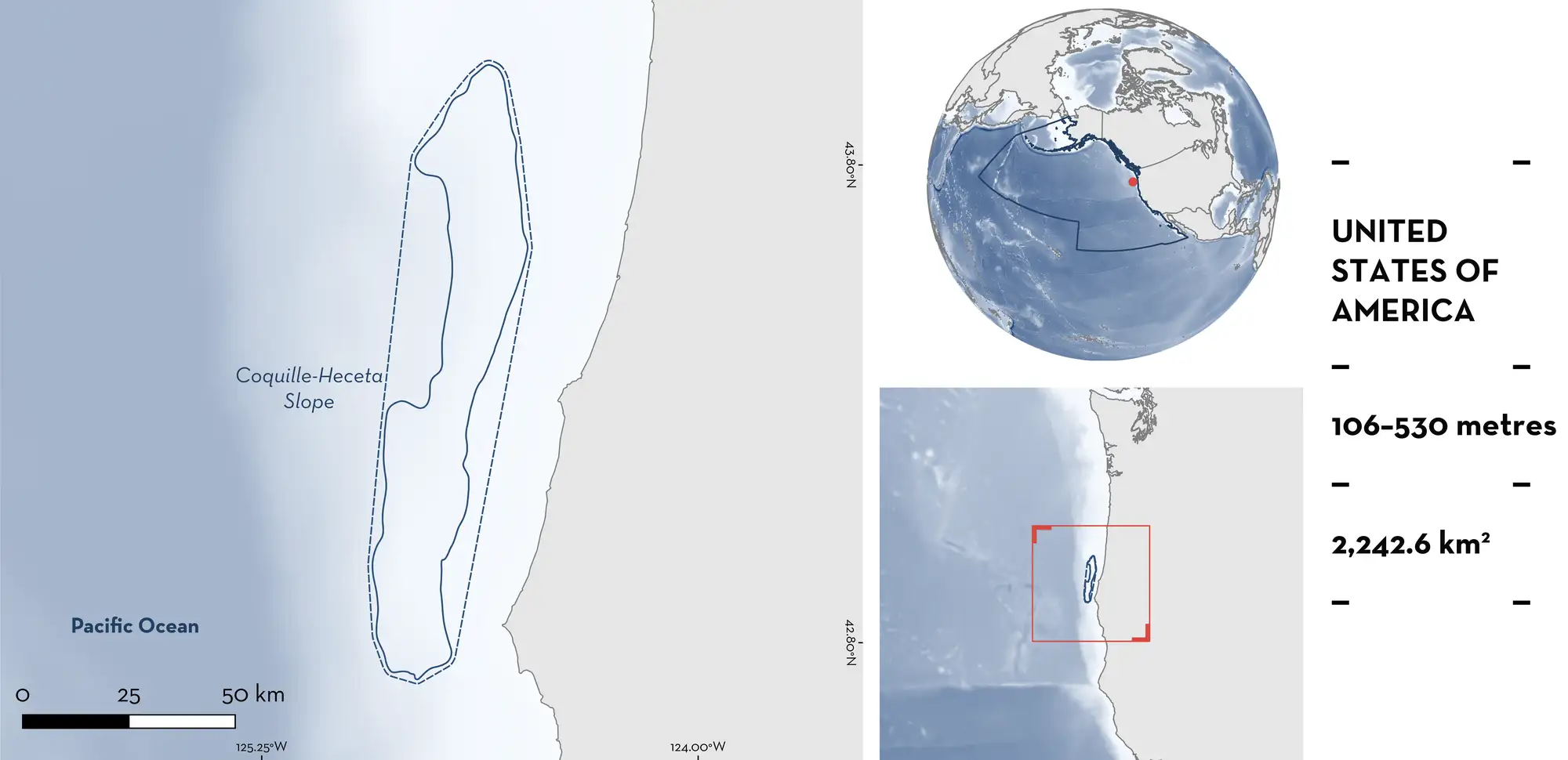
Coquille-Heceta Slope
Summary
Coquille-Heceta Slope is located off Oregon, United States of America. It encompasses extensive zones of mud and mud-sand and a low-relief offshore bank characterised by eroded ridges and scattered hard rocky patches. These are covered by a thin layer of sediment providing stable surfaces for a variety of sessile invertebrates. Within this area there are: range-restricted species (Sandpaper Skate Bathyraja kincaidii).
Download factsheet
Coquille-Heceta Slope
DESCRIPTION OF HABITAT
Coquille-Heceta Slope is located off Oregon, United States of America (USA). The area is situated along the outer continental shelf and upper continental slope. It encompasses a low-relief offshore bank (Coquille Bank) characterised by eroded ridges and scattered hard rocky patches composed primarily of sedimentary rocks (Kulm & Fowler 1974). These rocky outcrops are often covered by a thin layer of sediment and provide stable surfaces for a variety of sessile invertebrates, including cold-water corals. Surrounding the bank, the seabed transitions to softer muddy habitats across the middle and outer continental shelf. In these areas, mud supplied by regional rivers mixes with relict and modern sands and is further reworked by benthic organisms, creating extensive zones of mud and mud-sand (Scheidegger et al. 1971; Kulm et al. 1975). The area is also associated with geological features related to the movement of gas-rich sediments from deeper layers, forming localised seep structures, carbonate deposits, and sites where gas bubbles are released from the seafloor (Clarke et al. 1985; Merle et al. 2021).
This Important Shark and Ray Area is benthic and subsurface and is delineated from 106–530 m based on the depth range of Qualifying Species in the area.
CRITERION B
RANGE RESTRICTED
This area holds the regular presence of Sandpaper Skate as a range-restricted species.
The West Coast Groundfish Bottom Trawl Survey (WCGBTS) is conducted annually between May –July and August–October along the USA West Coast between the USA–Canada border and the USA–Mexico border, at depths ranging from 55 to 1,280 m (Keller et al. 2017). The survey area is subdivided into ~12,000 equal-area grid cells, from which 188 cells are randomly selected each year within depth and latitudinal strata to ensure representative spatial sampling. All rays captured are sorted to species level (or the lowest possible taxonomic resolution) and weighed, and subsamples of selected species are measured. The trawl net used in the survey has a headrope measuring 25.9 m and a footrope measuring 31.7 m. Trawling is conducted during daylight hours at a target speed of 2.2 ± 0.5 knots, with a standard tow duration of 15 minutes (approximately 0.55 km) (Keller et al. 2017).
Between 2011–2025, 8,386 tows were conducted in the entire survey area, of which 238 were within this area (2.8%) (NOAA NWFSC FRAM 2026). Sandpaper Skates were captured in 2,413 tows in the entire survey area (28.8% of total tows) at depths between 56–1,229 m, with 213 in this area (89.5% of tows in this area) at depths between 147–530 m. The average catch-per-unit-effort (CPUE; number of individuals per square kilometre; ind/km2) outside this region was 290 ind/km2, while in this area it was 598 ind/km2. The average maximum number of individuals in a single tow in this area was 11 (maximum = 61) and outside this area it was 5 individuals for the same average area (0.02 km2) (NOAA NWFSC FRAM 2026).
Sandpaper Skate is restricted to the California Current Large Marine Ecosystem (LME) and the Gulf of Alaska LME.
Download factsheet
SUBMIT A REQUEST
ISRA SPATIAL LAYER REQUEST
To make a request to download the ISRA Layer in either a GIS compatible Shapefile (.shp) or Google Earth compatible Keyhole Markup Language Zipped file (.kmz) please complete the following form. We will review your request and send the download details to you. We will endeavor to send you the requested files as soon as we can. However, please note that this is not an automated process, and before requests are responded to, they undergo internal review and authorization. As such, requests normally take 5–10 working days to process.
Should you have questions about the data or process, please do not hesitate to contact us.