ISRA FACTSHEETS
ISRA FACTSHEETS
AUSTRALIA AND SOUTHEAST INDIAN OCEAN
Coral Bay
Summary
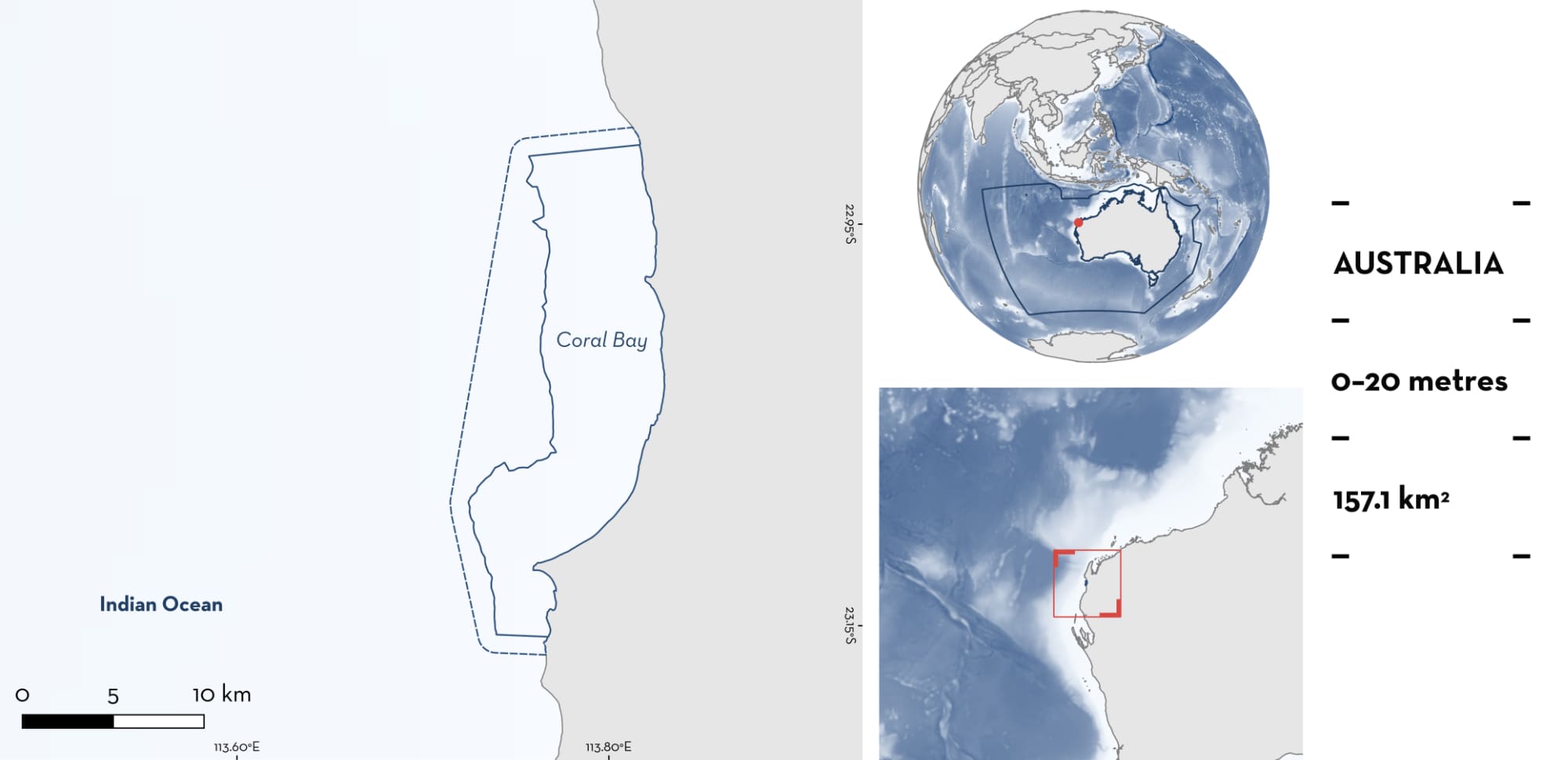
Coral Bay is located in the Gascoyne region of Western Australia, Australia. It is situated in Nyinggulu Ganyarjarrri Country. This area, located in Ningaloo, encompasses Bateman Bay, Skeleton Bay, and Asho’s Gap. It is characterised by a shallow coastal system bordered offshore by one of the world’s longest and most extensive fringing reefs. The habitat is characterised by shallow sand flats and coral and macroalgal reef habitats. This area overlaps with the Ningaloo Marine Park. Within this area there are: threatened species (e.g., Reef Manta Ray Mobula alfredi); feeding areas (e.g., Tiger Shark Galeocerdo cuvier); undefined aggregations (Blacktip Reef Shark Carcharhinus melanopterus); and distinctive attributes (Grey Reef Shark Carcharhinus amblyrhynchos).
Download factsheet
Coral Bay
DESCRIPTION OF HABITAT
Coral Bay is located in Ningaloo, the Gascoyne region, Western Australia, Australia. It is situated in Nyinggulu Ganyarjarrri Country. The area encompasses Bateman Bay and northern nearby areas (e.g., Stanley Pools), Skeleton Bay, and Asho’s Gap. It encompasses a shallow coastal system bordered offshore by one of the world’s longest and most extensive fringing reefs (Vanderklift et al. 2020). The habitat is characterised by shallow sand flats and coral and macroalgal reef habitats (Andrzejaczek et al. 2019).
Bateman Bay is the largest lagoon within Ningaloo Reef. The sandy bay of ~ 100 km2 extends up to 7 km from shore and has a wide deep channel (8–20 m depth). Sand flats and low ridges dominate the sea floor, with occasional areas of sponge and small coral growth in the shallower regions of the bay. Seagrass (predominantly Posidonia coriacea, Amphibolis antarctica, and ephemeral Halophila ovalis), and macroalgal beds (mainly Sargassum sp.) are also present throughout the bay. Due to the presence of the Cardabia Passage, a 5 km wide gap in the reef, Bateman Bay is partially open to the ocean and therefore receives increased wave energy and flushing rates compared to the usually shallow and protected waters of the Ningaloo lagoon (van Keulen et al. 2002). Skeleton Bay is dominated by shallow (1–3 m) coral reef habitats and sand flats. Two ridges of reef run parallel to the shore in a north–south direction, of which the outer is partially exposed at low tide. Sand flats at the southern end of the bay become exposed during spring low tides (Speed et al. 2011). Asho’s Gap is located in the southern side of this area. This area features coral outcrops and reef formations, with cleaner-fish habitat embedded among coral structures. The cleaning station is located on a large cabbage coral (Turbinaria sp.) in ~ 12 m depth (Huisman & van Keulen 2017).
The climate of the area is warm, dry tropical to arid. Rainfall is primarily in the austral summer months. The area is susceptible to tropical cyclones between December–April.
This area overlaps with the Ningaloo Marine Park (WA DBCA 2025a).
This Important Shark and Ray Area is benthic and pelagic and is delineated from inshore and surface waters (0 m) to 20 m based on the depth range of Qualifying Species in the area.
CRITERION A
VULNERABILITY
Three Qualifying Species considered threatened with extinction according to the IUCN Red List of Threatened Species regularly occur in the area. These are the Endangered Grey Reef Shark (Simpfendorfer et al. 2020a) and the Vulnerable Blacktip Reef Shark (Simpfendorfer et al. 2020b) and Reef Manta Ray (Marshall et al. 2022).
CRITERION C
SUB-CRITERION C2 – FEEDING AREAS
Coral Bay is an important feeding area for one shark and one ray species.
Biologging tags were used to understand the three-dimensional fine-scale movement ecology of Tiger Sharks in this area (Andrzejaczek et al. 2019). Tags were deployed on 21 adult Tiger Sharks (265–380 cm total length; TL) in April–May 2017 for durations of 5–48 h. Size-at-maturity is 226–305 cm TL for males and 250–350 cm TL for females (Ebert et al. 2021). Tags recorded both physical parameters such as depth and temperature, and, through the use of accelerometers, gyroscopes, and compasses, in situ measurements of animal trajectory and locomotion. Animal-borne-video enabled the recording of interactions with prey, specifically sea turtles (e.g., Loggerhead Turtle Caretta caretta). Sharks displayed tortuous movements (twists and turns) associated with prey searching for 27% of their tracks, and interactions with prey elicited varied responses including highly tortuous paths and burst movements. The cameras recorded 18 interactions with sea turtles, during which Tiger Sharks exhibited tortuous, circling movements and short bursts of acceleration near the turtles. These encounters likely represent prey investigations or exploratory hunting attempts. Several investigations of prey were immediately preceded by burst, stalking, and/or turning behaviours. Sea turtles are important grazers that occur in significant numbers at Ningaloo Reef (Preen et al. 1997). Research has revealed that Tiger Sharks continuously oscillate through the water column, presumably to search for benthic prey on descent, and silhouetted air-breathing prey on ascent (Heithaus et al. 2002a; Nakamura et al. 2011). Sandflats may be preferred habitats for foraging by Tiger Sharks because prey here have less room to perform evasive manoeuvres and to escape (Heithaus et al. 2002b), increasing the efficiency of hunting. This is corroborated by reports from local ecotourism operators at Coral Bay who frequently observe Tiger Sharks hunting sea turtles in this area (Andrzejaczek et al. 2019). Tiger Sharks are also commonly observed by passive citizen scientists feeding on sea turtles in this area.
In June 2007, August 2008, and May–June 2010, eight Tiger Sharks (185–399 cm TL) were satellite-tagged off the northwest coast of Australia (Ferreira et al. 2015). One shark’s movements were restricted to a relatively small space within this area and its surroundings for six months, showing long-term residency. Another two sharks, transmitting for 7 and 14 days, respectively, stayed within or near this area. It is hypothesized that these sharks were also using this area as a feeding ground.
Reef Manta Rays have regularly and predictably used this area for feeding, attracting tourists since the early 1990s. Their reliable presence has led to a steady growth in manta tour operations, which can now accommodate over 130 passengers per day to swim with these rays (Venables et al. 2016). Ventral photographs of Reef Manta Rays sighted in this area have been catalogued since 2006 in a photo-identification image database along with metadata such as date and location of sighting (McGregor et al. 2019; Armstrong et al. 2020). Photos were collected primarily by tourism operators who run in-water megafauna interaction tours year-round (2002–2018). As of 2015, long-term photo-identification studies have identified 800 individuals (Venables et al. 2016; Armstrong et al. 2020; F McGregor unpubl. data 2015). The behaviour displayed by each individual when sighted was categorised (Germanov et al. 2019) and was informed by ancillary observations reported by tourism operators or trained observers, or through indications of behaviour evident in photographs. A total of 4,382 behavioural observations of Reef Manta Rays were recorded in this area (Armstrong et al. 2020). Feeding was the most common reported behaviour with 56.2% of observations. Between March–May, large feeding aggregations of up to 70 individuals were recorded (McGregor et al. 2019). The core resident population consists of 40–50 individuals, mostly mature females (McGregor et al. 2019).
CRITERION C
SUB-CRITERION C5 – UNDEFINED AGGREGATIONS
Coral Bay is important for undefined aggregations of one shark species.
Between November and December of 2007–2009 and in August 2009, a total of 58 sharks were caught from the beach at Skeleton Bay within the area using hand reels and baited barbless hooks. For each individual, species, sex, and size (TL) were recorded and acoustic tags implanted for telemetry monitoring. An array of five acoustic receivers was deployed to monitor movement patterns of 36 Blacktip Reef Sharks in Skeleton Bay (Speed et al. 2011). Visual census surveys were also undertaken from the top of a sand dune located at the back of the beach (Speed et al. 2011). Observations of sharks in Skeleton Bay were noted and individuals counted hourly, when possible, between 08:00 and 17:00 h over 25 days in November/December 2008, 19 days in November/December 2009, four days in August 2009, and four days in February 2010. An ‘aggregation’ was defined as five or more individuals present in the same zone at the same time (as per Heupel & Simpfendorfer 2005).
Blacktip Reef Shark was the most abundant species caught in Skeleton Bay (n = 36; 62%) and forming the core of the multi-species reef shark assemblage (Speed et al. 2011). Telemetry detections reported that multiple tagged Blacktip Reef Sharks (adult males and females) were recorded on the same day and during the same hours (~13:00–14:00 h). Visual census indicated that assemblages were dominated by adult Blacktip Reef Shark, with up to 44 individuals counted in a single aggregation and a maximum of 74 across Skeleton Bay during November 2008. This species was present regularly throughout the year and observed in ~ 62% of 158 censuses. Individuals ranged between 88–144 cm TL. The average (± standard deviation) body length of tagged individuals ranged from 103 ± 0.16 cm TL to 129 ± 0.13 cm TL across years (2007–2009), indicating that most were mature adults. Size-at-birth is 45–64 cm and size-at-maturity is 130–145 cm TL for males and 120–142 cm TL for females (Ebert et al. 2021). The sex ratio was skewed toward females (1.4: 1.0), and numerous females displayed fresh mating scars and signs of pregnancy (distended abdomen), providing strong evidence of reproductive activity within the aggregation site. Courtship behaviour was also documented, and both adult males and pregnant females were commonly seen together, suggesting that Skeleton Bay functions as a mating area. Juvenile Blacktip Reef Shark were consistently detected over multiple years, although neonates were not reported. Still, more information is needed to confirm that this area functions as a reproductive area. Aggregations of reef sharks within this area could be facilitating thermoregulation as these animals actively seek warmer waters to elevate body temperature (Speed et al. 2011, 2012).
Coral Bay is a recognised shark aggregation site. Skeleton Bay belongs to the shark dreaming of the Nyinggulu Ganyarjarrri people, the Traditional Owners of the Ningaloo Coast, who call it Nhuga Malinmayi, meaning the shark birthing place. It is recognised as a culturally sacred and natural nursery, where juvenile sharks use the sheltered coastal waters for protection until they mature and move offshore. This reflects the importance of this area for centuries. This knowledge is also supported by passive citizen-science posts from 2022–2024 and by the Western Australia Department of Biodiversity, Conservation and Attractions. More than 200 individuals—mostly Blacktip Reef Sharks—have been recorded in Skeleton Bay between October–March (CBET 2025; WA DBCA 2025b; Tripadvisor 2025). Further information is required to understand the nature and function of these aggregations.
CRITERION D
SUB-CRITERION D1 – DISTINCTIVENESS
Coral Bay is an important area for the distinct behaviour of one shark species.
Grey Reef Sharks regularly visit Asho’s Gap which functions as a cleaning station where divers and snorkelers report sharks being cleaned by Bluestreak Cleaner Wrasse (Labroides dimidiatus) and Moon Wrasse (Thalassoma lunare). The most common behaviour for potential shark clients was to cruise over the cleaning station, although some clients would hover (Coward 2017). During cleaning interactions, individuals slowly swim over the coral cleaning station and will adopt a vertical tail-stand pose with their mouth open. Usually, one cleaner wrasse will approach to remove parasites and dead tissue from their gills, mouth, and body surfaces for an average of 7.9 seconds (Coward 2017; Huisman & van Keulen 2017). This site is well-known by passive citizen scientists and researchers (Speed et al. 2012; Huisman & van Keulen 2017; AMA 2025; CBA 2025; Exmouth Resort 2025; SSI 2025). Sharks are seen year-round, either individually (including those attending the cleaning station) or in groups of up to 20 individuals swimming. Aggregations peak in summer and autumn where individuals are observed been cleaned (Coward 2017). This area is especially important as it is the only known cleaning station for Grey Reef Sharks within the Eastern Indian Ocean. Globally, cleaning behaviour of Grey Reef Sharks has been reported only in two Important Shark and Ray Areas (ISRA), both in the Maldives (Southern Laamu Atoll ISRA and Laamu Maavah Kandu ISRA; Jabado et al. 2023).
Download factsheet
SUBMIT A REQUEST
ISRA SPATIAL LAYER REQUEST
To make a request to download the ISRA Layer in either a GIS compatible Shapefile (.shp) or Google Earth compatible Keyhole Markup Language Zipped file (.kmz) please complete the following form. We will review your request and send the download details to you. We will endeavor to send you the requested files as soon as we can. However, please note that this is not an automated process, and before requests are responded to, they undergo internal review and authorization. As such, requests normally take 5–10 working days to process.
Should you have questions about the data or process, please do not hesitate to contact us.