ISRA FACTSHEETS
true
ISRA FACTSHEETS
EUROPEAN ATLANTIC
Cornwall
Summary
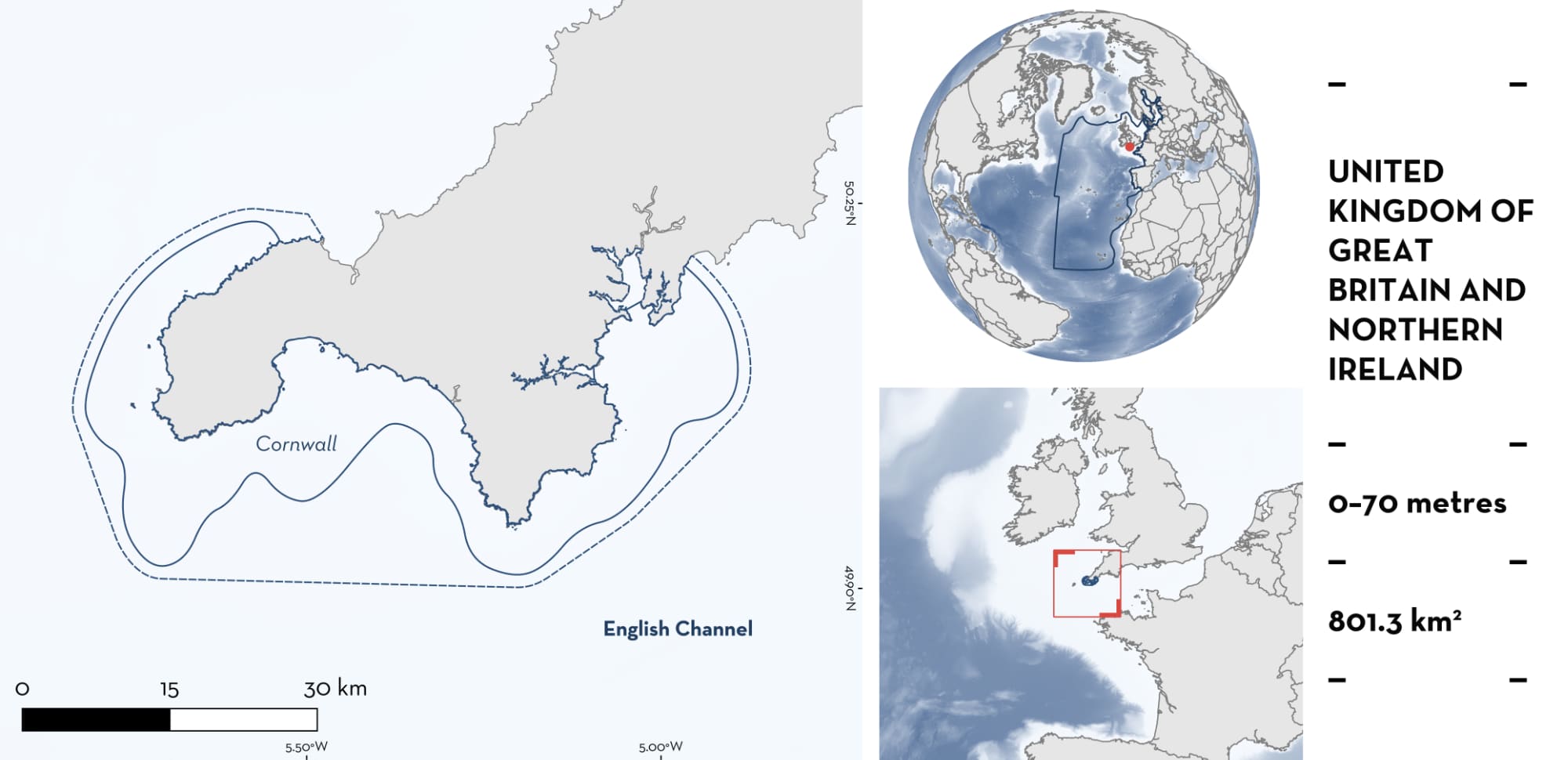
Cornwall is located on the southwest coast of England, United Kingdom of Great Britain and Northern Ireland. It is situated between St. Ives on the northern coast and Gerrans Bay on the southern coast. This area is characterised by sandy beaches and muddy substrates, interspersed with rocky reefs, seagrass meadows, and kelp forests. The area is influenced by Atlantic Ocean currents in the north and the Gulf Stream in the south. Within this area there are: threatened species (e.g., Basking Shark Cetorhinus maximus); reproductive areas (Nursehound Scyliorhinus stellaris); and undefined aggregations (Basking Shark).
Download factsheet
Cornwall
DESCRIPTION OF HABITAT
Cornwall is located on the southwest coast of England, United Kingdom of Great Britain and Northern Ireland. It is situated between St. Ives on the northern coast and Gerrans Bay on the southern coast and encompasses the entire southern tip of England. The area includes various beaches and bays, including Castle Beach, Falmouth Bay, and Mounts Bay. The habitat is characterised by sandy beaches and muddy substrates, interspersed with rocky reefs, seagrass meadows, and kelp forests.
The northern part of this area is influenced by Atlantic Ocean currents while the southern part is exposed to the warmer English Channel, which is influenced by the Gulf Stream (Select Cornwall 2025).
This Important Shark and Ray Area is benthic and pelagic and is delineated from inshore and surface waters (0 m) to 70 m based on the bathymetry of the area.
CRITERION A
VULNERABILITY
Two Qualifying Species considered threatened with extinction according to the IUCN Red List of Threatened Species regularly occur in the area. These are the Endangered Basking Shark (Rigby et al. 2021) and the Vulnerable Nursehound (Finucci et al. 2021).
CRITERION C
SUB-CRITERION C1 – REPRODUCTIVE AREAS
Cornwall is an important reproductive area for one shark species.
Opportunistic sightings of Nursehound egg cases are regularly and predictably reported from Falmouth Bay and Mounts Bay in this area by citizen scientists undertaking recreational snorkeling and diving activities (Shark Trust unpubl. data. 2025). No surveys dedicated to this purpose have been undertaken in this area, so records represent opportunistic sightings from the general public. These reports are compiled into a dedicated database, and egg case identification is confirmed through species-specific guides (Shark Trust unpubl. data. 2025). Overall, 162 in-situ Nursehound egg cases have been reported from 29 observations. These observations were recorded in 2013 (n = 1 record; n = 1 egg case), 2015 (n = 2 records; n = 2 egg cases), 2016 (n = 2 records; n = 4 egg cases), 2017 (n = 3 records; n = 4 egg cases), 2018 (n = 5 records; n = 100 egg cases), 2019 (n = 3 records; n = 5 egg cases), 2020 (n = 4 records; n = 4 egg cases), 2021 (n = 4 records; n = 27 egg cases), 2022 (n = 2 records; n = 8 egg cases), 2023 (n = 1 record; n = 1 egg case), and 2024 (n = 2 records; n = 6 egg cases) (Shark Trust unpubl. data. 2025). There is no apparent seasonality to these observations. Records are associated with the rocky reef habitat in the area. This is one of the largest known regular and predictable clusters of observations of in situ egg cases of this species within the United Kingdom of Great Britain and Northern Ireland. In addition, recreational snorkelers have opportunistically observed Nursehounds within this area and shared observations on social media. These Nursehounds were estimated at 20–120 cm total length (TL) during 2024–2025 (G Reale pers. obs. 2024–2025), some of which would have been young-of-year based on a published size–at–birth of 10–16 cm TL (Ebert et al. 2021).
CRITERION C
SUB-CRITERION C5 – UNDEFINED AGGREGATIONS
Cornwall is an important area for undefined aggregations of one shark species.
Opportunistic land-based and vessel-based sightings reported by citizen scientists to the Shark Trusts’ Basking Shark Project are collated into a dedicated database, with records since 1987 (Shark Trust unpubl. data 2025). Observations of three or more individuals reported at one time were extracted, and duplicate records were removed. Between 2010–2021, a total of 1,419 Basking Sharks were observed from 235 aggregations (Shark Trust unpubl. data 2025). The average number of aggregations per year in this period was 15, comprising an average of 6 individuals (maximum = 50 individuals in one aggregation). Aggregations have been reported from this area in 2010 (76 aggregations; 466 individuals), 2011 (3 aggregations; 11 individuals), 2012 (103 aggregations; 686 individuals), 2013 (39 aggregations; 206 individuals), 2014 (3 aggregations; 10 individuals), 2015 (4 aggregations; 14 individuals), 2016 (2 aggregations; 6 individuals), 2018 (1 aggregation; 3 individuals), 2020 (1 aggregations; 3 individuals), and 2021 (3 aggregations; 14 individuals). This is one of the locations in the United Kingdom of Great Britain and Northern Ireland with the highest number of contemporary known citizen science reports of Basking Shark aggregations. This species may be aggregating in this area for feeding purposes based on direct observations by citizen scientists of animals feeding at the surface (Shark Trust unpubl. data 2025). Further information is required to understand the nature and function of these aggregations.
Download factsheet
SUBMIT A REQUEST
ISRA SPATIAL LAYER REQUEST
To make a request to download the ISRA Layer in either a GIS compatible Shapefile (.shp) or Google Earth compatible Keyhole Markup Language Zipped file (.kmz) please complete the following form. We will review your request and send the download details to you. We will endeavor to send you the requested files as soon as we can. However, please note that this is not an automated process, and before requests are responded to, they undergo internal review and authorization. As such, requests normally take 5–10 working days to process.
Should you have questions about the data or process, please do not hesitate to contact us.