ISRA FACTSHEETS
ISRA FACTSHEETS
EUROPEAN ATLANTIC
Costa Vicentina Slope
Summary
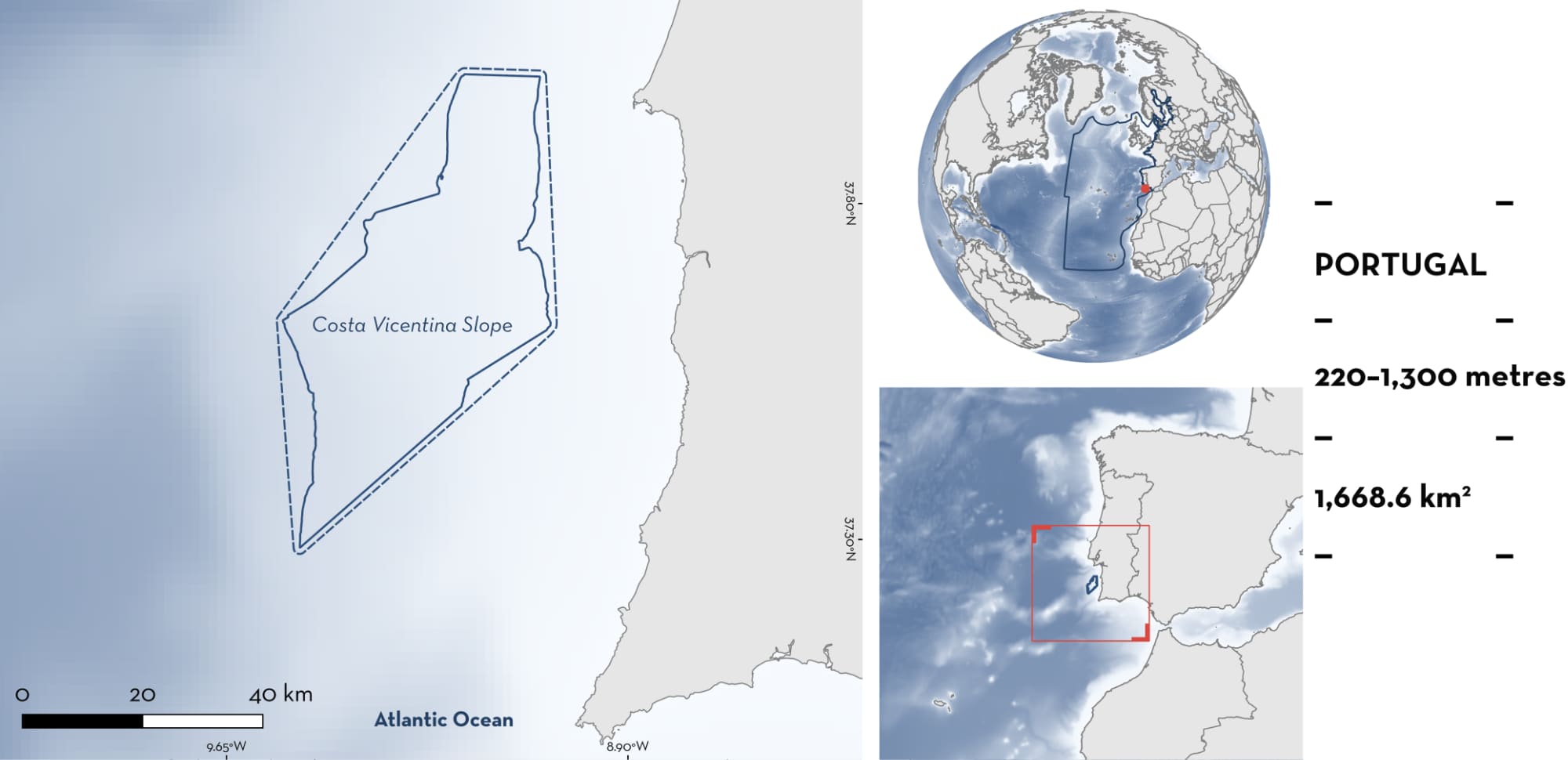
Costa Vicentina Slope is located off southwest Portugal. The area has a narrow continental shelf, a steep slope, submarine canyons, and rocky and sandy substrates. It overlaps with the West Iberia Canyons and Banks Ecologically or Biologically Significant Marine Area. Within this area there are: threatened species (Velvet Belly Lanternshark Etmopterus spinax); range-restricted species (Atlantic Sawtail Catshark Galeus atlanticus); reproductive areas (Portuguese Dogfish Centroscymnus coelolepis); and feeding areas (e.g., Blackmouth Catshark Galeus melastomus).
Download factsheet
Costa Vicentina Slope
DESCRIPTION OF HABITAT
Costa Vicentina Slope is located off southwest Portugal. The area is situated off the coast of Algarve and Setubal regions and extends from Sines in the north to Bordeira in the south. It is characterised by the presence of submarine canyons with rocky and sandy substrates (Cunha et al. 2013). The continental shelf within the area is relatively narrow descending quickly into the deeper Atlantic Ocean basin. This is a transition area between the Mediterranean Sea and Atlantic Ocean biogeographic zones.
The oceanographic conditions are marked by significant upwelling events, which are crucial for nutrient cycling and primary productivity. These upwelling events are most intense during the boreal summer, with a relaxation in autumn and high variability in spring and winter (Goela et al. 2016). These conditions, along with the presence of oceanic fronts and eddies, contribute to the aggregation of multiple species of fish, birds, and cetaceans and influence spawning events. The mixing of Atlantic Intermediate Water and Mediterranean Water flowing through the Strait of Gibraltar provides relatively warm (~13°C) and salty (~36.3 ppt) water at intermediate depths (~900 m; Tanhua et al. 2013; Aldama-Campino & Döös 2020).
The area overlaps with the West Iberia Canyons and Banks Ecologically or Biologically Significant Marine Area (EBSA; CBD 2025).
This Important Shark and Ray Area is benthic, pelagic, and subsurface and is delineated from 220–1,300 m based on the depth range of the Qualifying Species in the area.
CRITERION A
VULNERABILITY
One Qualifying Species considered threatened with extinction according to the IUCN Red List of Threatened Species regularly occurs in the area. This is the Vulnerable Velvet Belly Lanternshark (Finucci et al. 2021).
CRITERION B
RANGE RESTRICTED
This area holds the regular presence of Atlantic Sawtail Catshark as a resident range-restricted species. This species occurs in summer, autumn, and winter in the area and have been regularly encountered in research surveys and caught in commercial benthic trawlers operating in south and southwest Portugal (Graça Aranha 2025; Graça Aranha et al. 2023, 2025). Catch data were collected between June 2020–May 2022 from twelve fishing trips targeting shrimps (Aristaeomorpha foliacea, Aristeus antennatus, and Aristaeopsis edwardsiana), prawns (Parapenaeus longirostris and Penaeus monodon), and Norway Lobster (Nephrops norvegicus; Graça Aranha 2025; Graça Aranha et al. 2025). This was the area with the highest catch-per-unit-effort (CPUE) for Atlantic Sawtail (n = 336; CPUE = 3.8 individuals/hour) recorded in south and southwest Portugal (CPUE = 1.0 individuals/hour in the south; Graça Aranha et al. 2025). This species occurs primarily in the Iberian Coast Large Marine Ecosystem (LME) and marginally in the Canary Current and Mediterranean Sea LMEs.
CRITERION C
SUB-CRITERION C1 – REPRODUCTIVE AREAS
Costa Vicentina Slope is an important reproductive area for one shark species.
Reproductive data for Portuguese Dogfish were collected across Portuguese waters from commercial longliners and during research surveys (trawls and longlines) in 2006–2007 (Moura et al. 2014). This was part of a global assessment of reproductive processes for the species. Of 253 females recorded in Portugal, 43 (17%) were pregnant and 58 (23%) post-natal with the majority being recorded in this area and in south Portugal (Moura et al. 2014). This area and Iceland had the largest proportion of pregnant females in all of the Northeast Atlantic Ocean (Moura et al. 2014). In Portuguese waters, this species presents two reproductive peaks each year, with mating occurring in October–November and in March–April, and birth potentially occurring in March and August (Figueiredo et al. 2008). Contemporary data collected from research surveys and commercial benthic trawlers operating in south and southwest Portugal between 2020–2022 confirm the presence of mature females (Graça Aranha 2025; Graça Aranha et al. 2025).
CRITERION C
SUB-CRITERION C2 – FEEDING AREAS
Costa Vicentina Slope is an important feeding area for three shark species.
Ecological data were collected between June 2020–May 2022 from commercial benthic trawlers and research surveys operating off south and southwest Portugal (Graça Aranha 2025; Graça Aranha et al. 2025). Twelve fishing trips were sampled with vessels targeting shrimps, prawns, and Norway Lobster (Graça Aranha 2025; Graça Aranha et al. 2025). Stable isotope analysis and RNA/DNA ratios were conducted from a small fraction of recorded individuals to evaluate the trophic ecology and feeding activity in the area (Graça Aranha 2025; Graça Aranha et al. 2025). Stable isotope analysis included sampling of prey (shrimps A. foliacea and A. edwardsiana and Norway Lobster) targeted by fisheries. The RNA/DNA values provide a short-term measure of nutritional condition (1–3 days; Buckley et al. 1999).
The analysis of RNA/DNA indicated that an assemblage of three shark species, Velvet Belly Lanternshark, Atlantic Sawtail Catshark, and Blackmouth Catshark, fed in the area in the days immediately before their capture (Graça Aranha et al. 2023; Graça Aranha 2025). Given that deepwater sharks are generally slow swimmers compared to other species (Treberg et al. 2003; Condon et al. 2012; Pinte et al. 2020), and that RNA/DNA ratios are indicative of recent feeding activity (Buckley 1980; Clemmesen 1987), this evidence indicates that there is an assemblage of shark species actively using the area for feeding. Shrimps and lobsters consumed by this assemblage of species supported by historical stomach content analysis and contemporary stable isotope analysis are targeted by fisheries (Graça Aranha et al. 2023). This area is the second main fishing ground in Portugal for these crustacean species with intense trawling activity year-round larger than in adjacent areas (Borges et al. 2001; Bueno-Pardo et al. 2017).
Between 2020–2022, 121 Velvet Belly Lanternshark were recorded in this area with individuals measuring 16–44 cm TL and caught at depths <800 m (Graça Aranha 2025; Graça Aranha et al. 2025). Stable isotope analysis of 34 individuals indicate they are mesopredators and RNA/DNA ratios suggest they were recently feeding in the area (Graça Aranha 2025). Stomach content analysis of 459 individuals (49% with full stomachs) collected between 1998–2004 and 2015 revealed that they feed mainly on caridean shrimps (IRI = 28%), euphausiids (Meganyctiphanes norvegica), and bony fishes (mainly gadoids; Saldanha et al. 1995; Neiva et al. 2006; Muñoz 2015).
Between 2020–2022, 336 Atlantic Sawtail Catshark were recorded in this area with individuals measuring 4.5–46.5 cm TL and caught at depths of 220–752 m (Graça Aranha 2025; Graça Aranha et al. 2025). Stable isotope analysis of 33 individuals indicate they are mesopredators feeding mostly on crustaceans targeted by the trawl fishery and bony fishes. RNA/DNA ratios suggest they were recently feeding in the area (Graça Aranha 2025).
In 2018, and between 2020–2022, 349 Blackmouth Catshark were recorded in this area with individuals measuring 12.4–74.0 cm TL and caught at depths of 220–1,244 m (Graça Aranha 2025; Graça Aranha et al. 2023, 2025). Stable isotope analysis of 44 individuals revealed that this species is a mesopredator feeding mostly on shrimps and lobsters targeted by fisheries that represent ~52% of their diet, and squids (Graça Aranha et al. 2023; Graça Aranha 2025). RNA/DNA ratios suggest they were feeding in the area (Graça Aranha et al. 2023; Graça Aranha 2025). Stomach content analysis of 285 individuals (~75% of stomachs full) collected in 1990, 1996, 1997, 2003, and 2020–2021 revealed that they feed mainly on lanternfishes (family Myctophidae), the shrimp Robustosergia robusta, caridean decapods, and the squid Histioteuthis meleagroteuthis (Saldanha et al. 1995; Santos & Borges 2001; Neves et al. 2007; Oliveira 2021).
Download factsheet
SUBMIT A REQUEST
ISRA SPATIAL LAYER REQUEST
To make a request to download the ISRA Layer in either a GIS compatible Shapefile (.shp) or Google Earth compatible Keyhole Markup Language Zipped file (.kmz) please complete the following form. We will review your request and send the download details to you. We will endeavor to send you the requested files as soon as we can. However, please note that this is not an automated process, and before requests are responded to, they undergo internal review and authorization. As such, requests normally take 5–10 working days to process.
Should you have questions about the data or process, please do not hesitate to contact us.