
ISRA FACTSHEETS
ISRA FACTSHEETS
AUSTRALIA AND SOUTHEAST INDIAN OCEAN
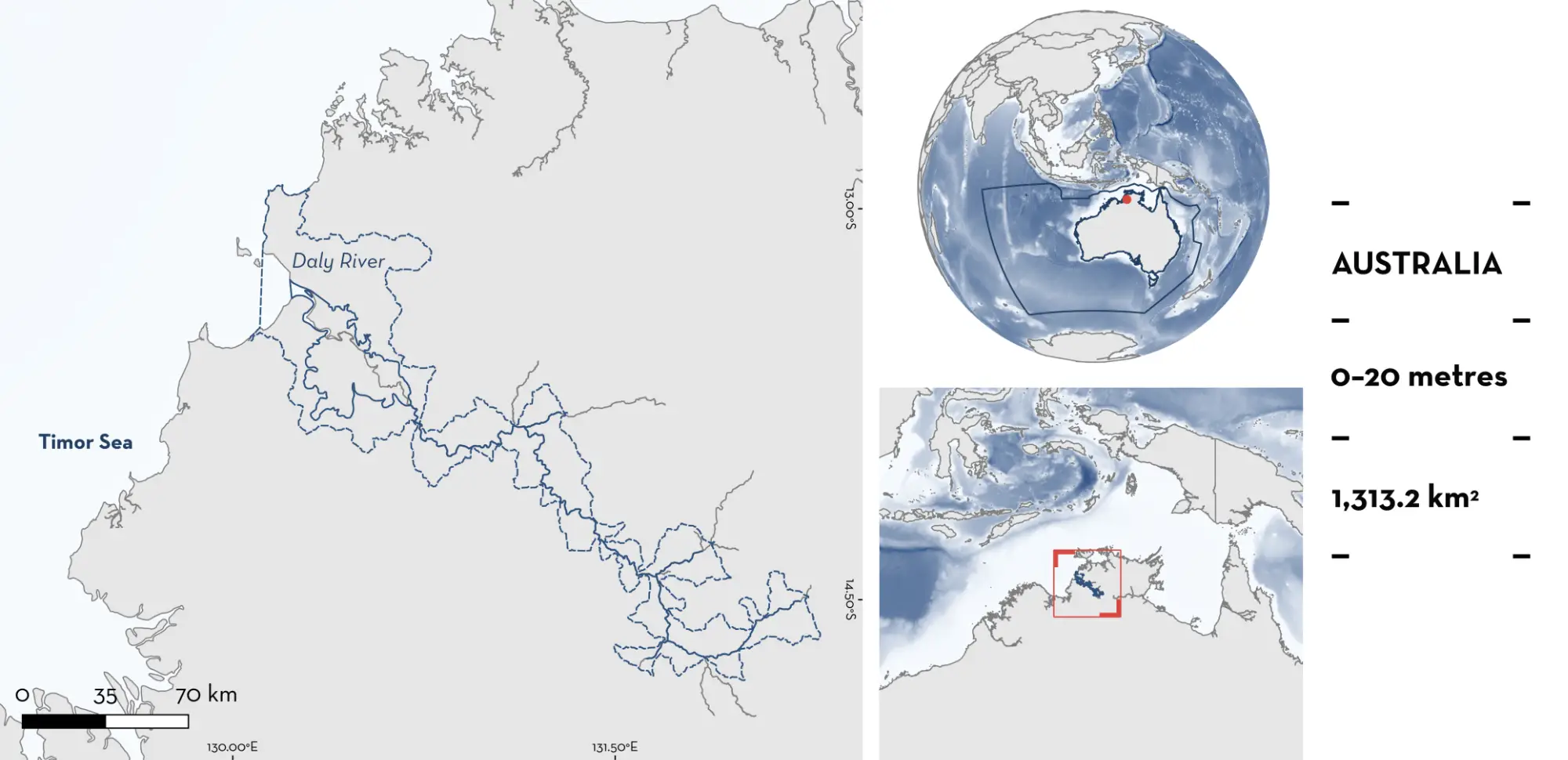
Daly River
Summary
Daly River is located in the western Top End of the Northern Territory, Australia. The area includes the estuary, perennially flowing main channel of the Daly River, extensive seasonally inundated floodplains, and major tributaries. It is characterised by mangroves and mudflats in the estuary and lower reaches, gravel and coarse sand substrates and sandbars in middle reaches, and a vast floodplain with drainage channels, shallow ephemeral waterholes, and deep permanent waterholes. The area is a highly dynamic environment influenced by the monsoonal wet-dry cycle, seasonal flooding and floodplain inundation, and a large tidal range in the estuary. Within this area there are: threatened species (e.g., Northern River Shark Glyphis garricki); and reproductive areas (e.g., Largetooth Sawfish Pristis pristis).
Download factsheet
Daly River
DESCRIPTION OF HABITAT
Daly River is located in the western Top End of the Northern Territory, Australia. The area extends from the estuary upstream to west of its confluence with the Katherine River, a major tributary. This includes the perennially flowing main channel of the river and its extensive seasonally inundated floodplains, the lower reaches of the Katherine River upstream to Low Level Bridge in the town of Katherine (~330 km inland of the river mouth), and the lower reaches of other tributaries (Douglas River, Edith River, Fergusson River, Fish River, Flora River, King River). The Daly River catchment area is ~53,000 km2 (Webster et al. 2005). The habitats that characterise this area are diverse, ranging from mangroves and mudflats in the estuary and lower reaches, to gravel and coarse sand substrates and sandbars in middle reaches, and a vast floodplain with drainage channels, shallow ephemeral waterholes, and deep permanent waterholes (Webster et al. 2005; Warfe et al. 2011).
The hydrology is characteristic of monsoonal northern Australia with a seasonal wet-dry cycle and ~90% of annual rainfall occurring in the wet season (roughly November–April; Warfe et al. 2011). The floodplain is variably inundated during the wet season depending on the duration and intensity of rainfall in the catchment. This inundation facilitates the dispersal of aquatic fauna onto the highly productive floodplain (Crook et al. 2020). As floodwaters recede, species are concentrated in refugial waterholes during the dry season, which may dry out or become reconnected in the following wet season. River height is highly dynamic, reaching >20 m depth during seasonal flooding and mostly <2 m depth in the middle reaches in the dry season (Webster et al. 2005). During the dry season, the main channel of the river is maintained by groundwater input from springs (Webster et al. 2005). Lower reaches are heavily influenced by tides with a maximum tidal range of 6 m and a tidal limit in the river extending 100 km inland (Wolanski et al. 2006). Salinity varies seasonally, with the estuary and lower reaches dominated by marine waters in the dry season and freshwater in the wet season following flood events (Wolanski et al. 2006). The Daly River is of hydrological and ecological significance given its perennial nature, which is rare in northern Australian rivers, and its relatively unimpeded flows (Webster et al. 2005).
This Important Shark and Ray Area is benthic and pelagic and is delineated from inshore and surface waters (0 m) to 20 m based on the bathymetry of the area.
CRITERION A
VULNERABILITY
Three Qualifying Species considered threatened with extinction according to the IUCN Red List of Threatened Species regularly occur in the area. These are the Critically Endangered Largetooth Sawfish (Espinoza et al. 2022), and the Vulnerable Bull Shark (Rigby et al. 2021) and Northern River Shark (Kyne et al. 2021).
CRITERION C
SUB-CRITERION C1 – REPRODUCTIVE AREAS
Daly River is an important reproductive area for two shark and one ray species.
Surveys for euryhaline sharks and rays were conducted in Daly River from 2011–2024 (Malak Malak Rangers & PM Kyne unpubl. data 2011–2024). This included: (1) Largetooth Sawfish surveys in-river and in floodplain waterholes; (2) specialised ‘sawfish patrols and rescues’ where drying floodplain waterholes are searched for stranded sawfish which, if located, are captured, transported, and released in the perennial main channel of the river before the waterholes dry up and the sawfish perish; and (3) river shark (Northern River Shark, Speartooth Shark) surveys in the estuarine lower reaches of the river. Sawfish surveys utilised 29 or 58 m long gillnets (4–6-inch mesh size); sawfish rescues used these same gillnets, cast nets, or capture by hand; and river shark surveys used rod-and-line. Animals were measured (total length; TL) and sexed. Additional support comes from environmental DNA (eDNA) surveys for Largetooth Sawfish (Simpfendorfer et al. 2016), recreational fishing catches, and direct observations.
Early life-stage Bull Sharks were caught incidentally during sawfish and river shark surveys and are regularly observed in the river and on the floodplains by Traditional Owners, recreational fishers, and researchers (Malak Malak Rangers & PM Kyne unpubl. data 2011–2024). The size-at-birth for the species is 56–81 cm TL and young-of-the-year (YOY) can be up to 99 cm TL (Pillans et al. 2020; Ebert et al. 2021). Between 2012–2019, a total of 69 Bull Sharks were caught, ranging in size 70–148 cm TL (mean ± standard deviation = 96.1 ± 16.5 cm TL) and comprised 11 neonates (15.9%), 34 YOY (49.3%), and 24 juveniles (34.7%). Early life-stages (neonates and YOY combined; n = 45) represented 65.2% of Bull Sharks and were caught in 2012 (n = 25), 2013 (n = 5), 2015 (n = 6), and 2019 (n = 9) (Malak Malak Rangers & PM Kyne unpubl. data 2012–2019). Following the 2012 field season, efforts were made to avoid capturing Bull Sharks as they were not a target species. Bull Sharks can be predictably observed in the river including below rock bars/road crossings (e.g., Beeboom Crossing, Daly River Crossing) and from vantage points such as the Daly River Bridge (all within the area). Observations and captures of early life-stage Bull Sharks have occurred from the estuary to the far upstream reaches of the area and on the floodplain within this area. Following large wet seasons, desiccated Bull Sharks can be found on the floodplain far from remaining water, demonstrating extensive use of the floodplain during wet season inundation (Malak Malak Rangers & PM Kyne pers. obs. 2011–2024).
Bull Sharks in Australia remain in river and estuary habitats for up to five years (Werry et al. 2011; Niella et al. 2022), highlighting that juveniles, in addition to neonates and YOY, are still largely restricted to the area, with the larger juveniles potentially making some movements into adjacent marine waters (Smoothey et al. 2023). Although there are numerous rivers across northern Australia that also regularly host early life-stage Bull Sharks, these river systems are individually important. Bull Sharks in Australia display natal philopatry, with females returning to particular river systems to pup (Tillett et al. 2012; Lubitz 2023). For example, half-sibling pairs were found within a river on Australia’s east coast up to seven cohorts apart, highlighting the long-term natal philopatry of females (Lubitz 2023). Therefore, individual rivers, such as this area, represent discrete portions of habitat that are important to Bull Sharks.
Northern River Sharks were the most common shark species captured during river shark surveys. Published size-at-birth for both Northern River Shark and Speartooth Shark is 50–65 cm TL (Pillans et al. 2009), and age-and-growth undertaken on Speartooth Sharks gives a maximum size threshold of 75 cm TL for YOY (Kyne et al. 2026). Age-and-growth data are not available for Northern River Sharks, but given a similar size-at-birth, this threshold is also applied to that species. Between 2015–2019, a total of 71 Northern River Sharks were caught during river shark surveys (Feutry et al. 2020; PM Kyne unpubl. data 2015–2019). Measured sharks (n = 70) ranged 59.5–168.5 cm TL (mean ± standard deviation = 108.9 ± 28.6 cm TL) and comprised 1 neonate (1.4%), 4 YOY (5.7%), 52 juveniles (74.3%), and 13 adults (18.6%). Early life-stages (neonates and YOY combined; n = 5) represented 7.1% of Northern River Sharks and were sampled in October 2015 (n = 3), November 2015 (n = 1), and September 2019 (n = 1) (Feutry et al. 2020; PM Kyne unpubl. data 2015–2019). The use of the area for reproductive purposes is supported by the spread of juvenile sizes/age-classes encountered.
Juvenile Northern River Sharks are habitat specialists of brackish, highly turbid waters of large tidal rivers and estuaries and remain in these habitats throughout their juvenile life-stages. Further, the Daly River population of this species is genetically distinct and reproductively isolated (Feutry et al. 2020). This demonstrates that early life-stages and juveniles are restricted to the area and highlights the importance of this area as a breeding location across their limited geographic range (northwest Australia and southern Papua New Guinea). The low number of neonates/YOY sampled is likely influenced by the timing of surveys, which were mostly early in the pupping season (~October–December; Pillans et al. 2009).
Largetooth Sawfish (‘Tyemirerriny’ in Malak Malak language) is regularly encountered in the river and on the floodplain within the area from research surveys (gillnets and environmental DNA [eDNA]), sawfish patrols and rescues, recreational fisheries, and direct observations. Size-at-birth of the species is 72–91 cm TL, and YOY are estimated to measure <130 cm TL based on growth curves (Peverell 2009). During gillnet surveys and rescues, 151 Largetooth Sawfish were caught between 2011–2024. Measured sawfish (n = 136) ranged 90.5–135.0 cm TL (mean ± standard deviation = 111.3 ± 8.0 cm TL) and comprised all YOY (one individual was marginally above the established YOY threshold of <130 cm TL but was known to be a YOY based on timing of capture and comparative sizes within the same cohort). Largetooth Sawfish were caught in October 2011 (n = 2), July 2012 (n = 1), September 2012 (n = 10), October 2012 (n = 7), November 2012 (n = 7), May 2015 (n = 1), August 2017 (n = 9), September 2017 (n = 45), August 2018 (n = 19), August 2021 (n = 6), September 2021 (n = 13), and September 2024 (n = 31) (Malak Malak Rangers & PM Kyne unpubl. data 2011–2024). Most captures were in the late dry season (August–November; n = 149 of 151; 98.7%), representing individuals pupped at the river mouth the previous wet season (~November–April; although the exact timing of pupping at the Daly River mouth is unknown).
Positive samples were detected in 7 of 8 (87.5%) floodplain waterholes during species-specific Largetooth Sawfish eDNA surveys in September–October 2014 (Simpfendorfer et al. 2016). Detections likely represent early life-stages/juveniles given the habitat. Direct observations of Largetooth Sawfish occur in floodplain waterholes and in the river on sandbars or below rock bars/road crossings (e.g., Beeboom Crossing, Daly River Crossing), and vantage points such as the Daly River Bridge (all within the area) (Malak Malak Rangers & PM Kyne pers. obs. 2011–2024). Largetooth Sawfish are also sporadically caught by recreational fishers at accessible locations such as Beeboom Crossing (e.g., iNaturalist 2025) and as far upstream as Katherine (M Gardner pers. comm. 2025; B Pickering pers. comm. 2025). Since Largetooth Sawfish leave rivers only upon reaching sexual maturity (Peverell 2009), the presence of YOY indicates that Daly River is an important reproductive area for the species. Furthermore, Largetooth Sawfish display female philopatry with rivers representing genetically distinct and reproductively isolated systems (Phillips et al. 2011; Feutry et al. 2015).
Download factsheet
SUBMIT A REQUEST
ISRA SPATIAL LAYER REQUEST
To make a request to download the ISRA Layer in either a GIS compatible Shapefile (.shp) or Google Earth compatible Keyhole Markup Language Zipped file (.kmz) please complete the following form. We will review your request and send the download details to you. We will endeavor to send you the requested files as soon as we can. However, please note that this is not an automated process, and before requests are responded to, they undergo internal review and authorization. As such, requests normally take 5–10 working days to process.
Should you have questions about the data or process, please do not hesitate to contact us.

