
ISRA FACTSHEETS
ISRA FACTSHEETS
AUSTRALIA AND SOUTHEAST INDIAN OCEAN
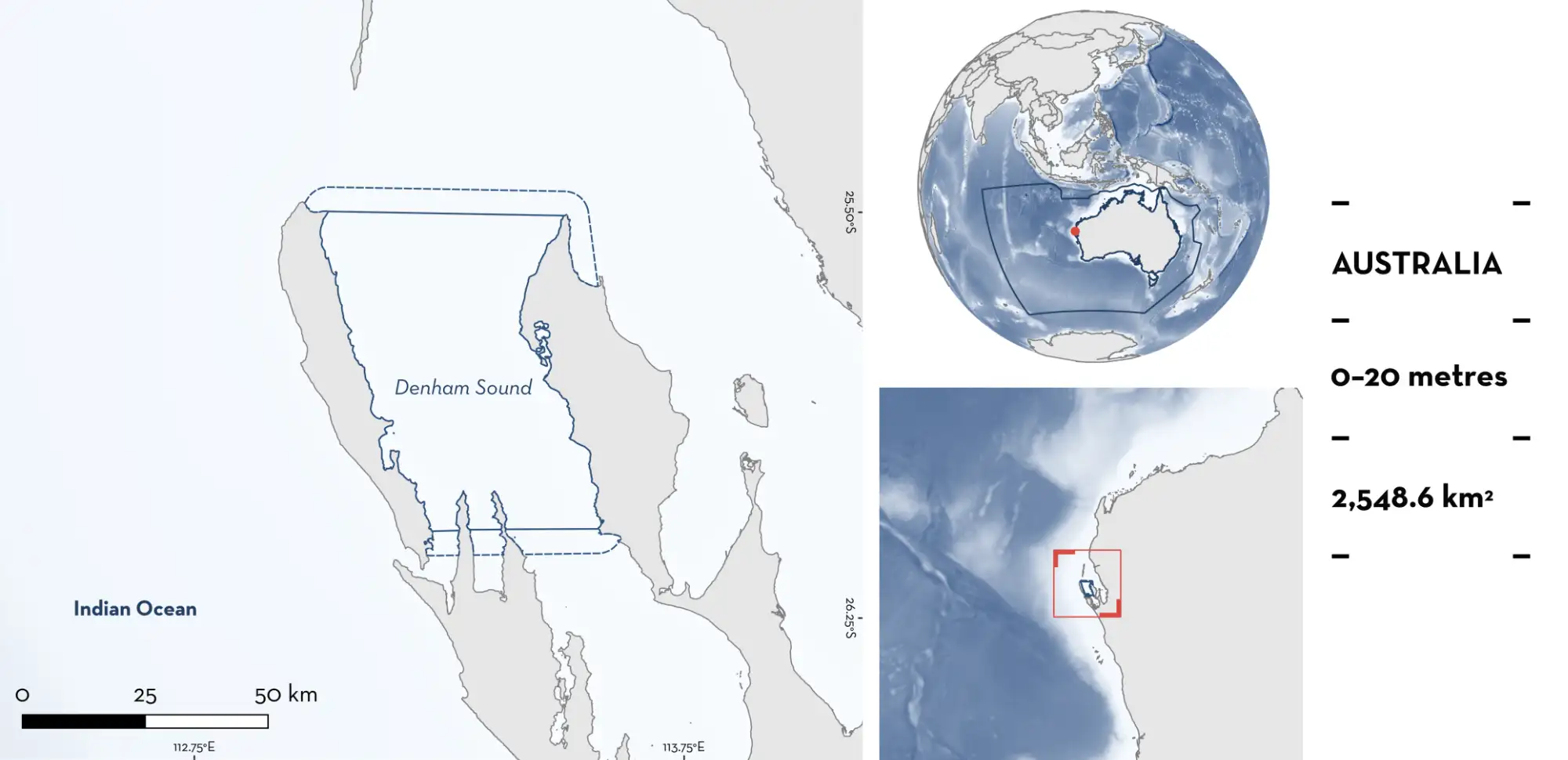
Denham Sound
Summary
Denham Sound is located in Western Australia, Australia. This area encompasses the western gulf of northern Shark Bay. It is characterised by seagrass meadows, fringing reefs, and limestone ledges, with offshore areas and channels. This area is dominated by persistent frontal features that enhance productivity. This area overlaps with the Shark Bay Marine Park. Within this area there are: threatened species (Reef Manta Ray Mobula alfredi); feeding areas (Reef Manta Ray); and undefined aggregations (Australian Cownose Ray Rhinoptera neglecta).
Download factsheet
Denham Sound
DESCRIPTION OF HABITAT
Denham Sound is located in Western Australia, Australia. This area encompasses the western gulf of northern Shark Bay. Shark Bay is a large semi-enclosed embayment primarily <20 m in depth (average = 10 m). This section is dominated by the world’s most extensive seagrass beds, primarily Amphibolis antarctica (Walker et al. 1988; Walker 1989).
This area has a semi-arid climate with warm austral summers and mild winters. The physical and biological processes offshore from Shark Bay are dominated by the Leeuwin Current, which flows southwards along the continental shelf break, but it is also influenced by the higher salinity outflow from Shark Bay (Nahas et al. 2005). Shark Bay functions as an inverse estuary characterised by elevated salinity (Burling et al. 1999). Density gradients, particularly those generated by temperature and salinity differences between the bay and the open ocean, are the primary drivers of frontal systems (Logan & Cebulski, 1970; Nahas et al. 2005). These frontal systems are located within the Bay at the two major oceanic entrances (one located in this area). These are stable and enhance local productivity (Nahas et al. 2005).
This area overlaps with the Shark Bay Marine Park (WA DBCA 2025).
This Important Shark and Ray Area is benthic and pelagic and is delineated from inshore and surface waters (0 m) to 20 m based on the depth range of Qualifying Species in the area.
CRITERION A
VULNERABILITY
One Qualifying Species considered threatened with extinction according to the IUCN Red List of Threatened Species regularly occurs in the area. This is the Vulnerable Reef Manta Ray (Marshall et al. 2022).
CRITERION C
SUB-CRITERION C2 – FEEDING AREAS
Denham Sound is an important feeding area for one ray species.
Aerial surveys were carried out in August–September 2012 using drones and in June 2023 using a piloted aircraft equipped with camera pods in northern Shark Bay (both the eastern and western gulfs) (DBCA unpubl. data 2025; V Lowson & A Hodgson unpubl. data 2025). Each survey followed a series of parallel transects spaced 4.6 km apart (Hodgson et al. 2023). In both years, the imagery captured a ~400 m wide strip along each transect, resulting in a survey intensity of ~10% of the total area. This area presented the highest number of Reef Manta Ray sightings (2012 = 48; 2023 = 29). In 2023, the high-resolution imagery enabled behavioural observations for all 29 sightings. Feeding behaviour (identified by individuals with unfurled cephalic lobes at the surface) was documented in 15 cases (52%) (travelling = 11; unknown= 3). During both surveys, seven aggregations were also observed, with 3–7 individuals recorded along single transects and spread over distances of 322–1,500 m.
Between 2020–2025, Reef Manta Rays were regularly and predictably seen in the southern part of this area chain feeding (i.e., a group-feeding behaviour in which manta rays align head-to-tail, forming extended horizontal chains of individuals that move together while feeding; Stevens 2016). Observations were from March to July with animals reappearing from late September onwards, however, this is variable based on water temperature (E Gosden pers. obs. 2020–2025). There is an estimated 70% chance of encountering rays when the individuals are deliberately sought out. Between 2022–2025, 31 aggregations were recorded in this area involving 2–50 individuals (average = 6–10) observed at the surface feeding with their cephalic fins unfurled during 30-minute visits (E Gosden pers. obs. 2020–2025; Shark Bay Eco Tours unpubl. data 2020–2025). The individuals observed are mainly mature and of both sexes. Multiple posts are regularly available on social media and confirm these aggregations and feeding behaviour with animals seen ‘barrel rolling’ (Instagram 2025). Historically, aerial transect surveys conducted in Shark Bay in 1994 recorded multiple manta rays, most probably Reef Manta Rays which are the most common species in Western Australia (Armstrong et al. 2020) occurring within the same core activity area identified in the northern part of this area (Preen et al. 1997).
CRITERION C
SUB-CRITERION C5 – UNDEFINED AGGREGATIONS
Denham Sound is important for undefined aggregations of one ray species.
Aggregations of Australian Cownose Ray have been regularly documented through aerial surveys and opportunistic citizen science observations within the area. Aerial surveys were carried out in August–September 2012 using drones (36 transects) and in June 2023 using a piloted aircraft equipped with camera pods (19 transects) in northern Shark Bay (both the eastern and western gulfs) (DBCA unpubl. data 2025; V Lowson & A Hodgson unpubl. data 2025). Each survey followed a series of parallel transects spaced 4.6 km apart (Hodgson et al. 2023). In both years, the imagery captured a ~400 m wide strip along each transect resulting in a survey intensity of about 10% of the total area. Aggregations were only recorded in this area: two aggregations of 16 individuals in 2012 and 325 individuals in 2023 (DBCA unpubl. data 2025; V Lowson & A Hodgson unpubl. data 2025). Between 2019–2025, 16 observations of ‘fevers’ (aggregations of 20 to thousands of individuals) of Australian Cownose Ray were recorded by local divers during tourism operations in this area (Shark Bay Eco Tours unpubl. data 2020–2025). The largest aggregation reported indicated that rays were visible as far as the eye could see, leading to an estimated abundance of several thousand individuals (E Gosden pers. obs. 2025).
Download factsheet
SUBMIT A REQUEST
ISRA SPATIAL LAYER REQUEST
To make a request to download the ISRA Layer in either a GIS compatible Shapefile (.shp) or Google Earth compatible Keyhole Markup Language Zipped file (.kmz) please complete the following form. We will review your request and send the download details to you. We will endeavor to send you the requested files as soon as we can. However, please note that this is not an automated process, and before requests are responded to, they undergo internal review and authorization. As such, requests normally take 5–10 working days to process.
Should you have questions about the data or process, please do not hesitate to contact us.

