
ISRA FACTSHEETS
ISRA FACTSHEETS
AUSTRALIA AND SOUTHEAST INDIAN OCEAN
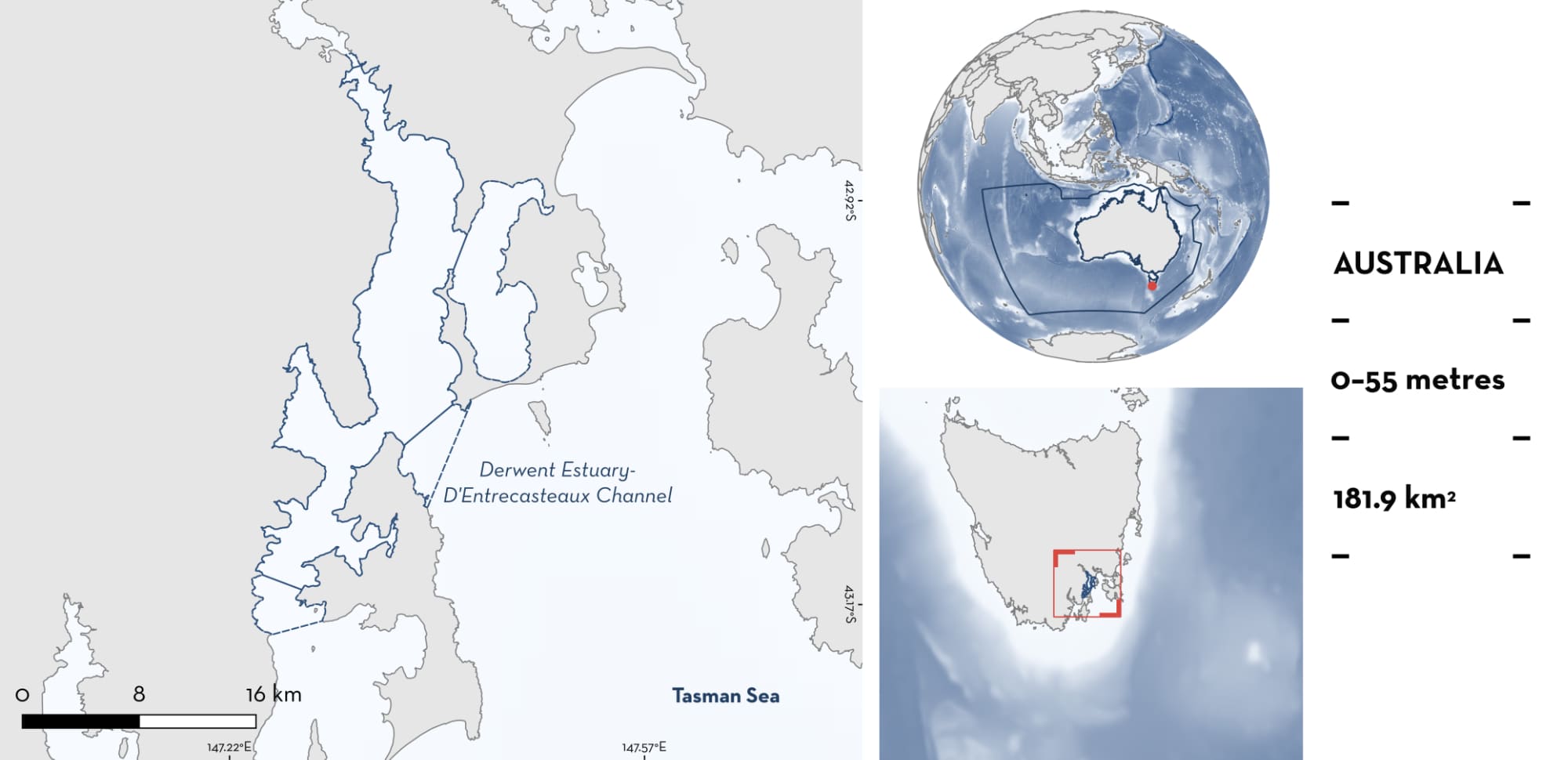
Derwent Estuary-D’Entrecasteaux Channel
Summary
Derwent Estuary-D’Entrecasteaux Channel is located on the southeast coast of Tasmania, Australia. It is an estuarine system connected with a channel between mainland Tasmania and Bruny Island. The area is characterised by sedimentary rocks, sandy substrates, saltmarshes, rocky reefs, and kelp beds. It is influenced by freshwater input from the Derwent River. The area overlaps with two Key Biodiversity Areas, a marine reserve, and two Shark Refuge Areas. Within this area there are: range-restricted species (Banded Stingaree Urolophus cruciatus).
Download factsheet
Derwent Estuary-D’Entrecasteaux Channel
DESCRIPTION OF HABITAT
Derwent Estuary-D’Entrecasteaux Channel is located on the southeast coast of Tasmania, Australia. This area encompasses parts of the Derwent Estuary and the D’Entrecasteaux Channel, two significant coastal systems in southeast Tasmania. The northern part of this area includes Hobart, the River Derwent, extending south to South Arm and Dennes Point on Bruny Island. The western part of this area connects the River Derwent with the D’Entrecasteaux Channel, including North West Bay in the northeast, and extending south to include Oyster Cove and northern Bruny Island. The area is characterised by seagrass meadows, sandy and soft sediments, saltmarshes, tidal flats, rocky reefs, and kelp beds (Derwent Estuary Program 2025; Parsons 2025).
The broader Derwent Estuary (including locations outside of this area) is a temperate salt wedge estuary, covering ~200 km2. The estuary extends 52 km from the freshwater inflow at the River Derwent in New Norfolk to its mouth between Tinderbox and the Iron Pot lighthouse. Adjacent to the estuary, the D’Entrecasteaux Channel is a sheltered waterway that separates Bruny Island from the Tasmanian mainland. It forms part of a micro-tidal system, with spring tides reaching up to 1 m. The channel’s coastline is primarily composed of dolerite and sedimentary rocks, featuring intertidal cliffs and gently sloping underwater terrain. The area is also characterised by basalt shorelines, especially along the western edge of North West Bay and the stretch between Gordon and Kettering. Most reef systems in the channel are located close to the shore in shallow waters, though deeper reefs are found off Bruny Island’s eastern points, such as Roberts Point. The channel supports a diverse range of marine habitats, shaped by its complex topography and varying environmental conditions (Derwent Estuary Program 2025; Parsons 2025).
This area overlaps with Bruny Island Key Biodiversity Area (KBA) and South Arm KBA (KBA 2025a, 2025b), Tinderbox Marine Reserve (TPWS 2025), the D’Entrecasteaux Channel Shark Refuge Area, and the River Derwent Shark Refuge Area (Tasmanian Government 2025).
This Important Shark and Ray Area is benthic and is delineated from inshore and surface waters (0 m) to 55 m based on the bathymetry of the area.
CRITERION B
RANGE RESTRICTED
Derwent Estuary-D’Entrecasteaux Channel supports the regular presence of Banded Stingaree as a resident range-restricted species. This species has been recorded in this area by citizen scientists through both Natural Values Atlas observations (n = 36 individuals; Natural Values Atlas 2025) and Reef Life Survey (RLS), which undertook underwater visual census along a 50 m transect line (n = 179 individuals; Edgar & Stuart-Smith 2014; Edgar et al. 2020; RLS et al. 2025; A Cooper pers. comm. 2025). Historical records (1992–2009; n = 123) were reported in 1992 (n = 2), 1994 (n = 9), 1995 (n = 1), 1996 (n = 1), 1997 (n = 5), 1999 (n = 4), 2000 (n = 13), 2001 (n = 4), 2002 (n = 3), 2004 (n = 1), 2005 (n = 4), 2006 (n = 10), 2007 (n = 5), 2008 (n = 21), and 2009 (n = 40). Contemporary records (2010–2025; n = 92) were reported in 2010 (n = 33), 2011 (n = 1), 2012 (n = 3), 2013 (n = 8), 2015 (n = 10), 2016 (n = 4), 2018 (n = 4), 2019 (n = 2), 2020 (n = 5), 2021 (n = 8), 2022 (n = 4), 2023 (n = 6), 2024 (n = 3), and 2025 (n = 1). Estimated body size data were available for half of the contemporary records (66.3%, n = 61). Banded Stingarees measured between 15–50 cm total length (TL) with most contemporary observations being of mature individuals (63.9%, n = 39) measuring = >30 cm TL. Four individuals were at an early life stage, measuring = <20 cm TL. The size-at-birth of the species is ~15 cm TL and size-at-maturity is 20–22 cm TL (Last et al. 2016). This area has the largest known cluster of historical and contemporary observations of the species in Tasmania, highlighting its national importance. Banded Stingaree is restricted to the Southeast Australian Shelf Large Marine Ecosystem.
Download factsheet
SUBMIT A REQUEST
ISRA SPATIAL LAYER REQUEST
To make a request to download the ISRA Layer in either a GIS compatible Shapefile (.shp) or Google Earth compatible Keyhole Markup Language Zipped file (.kmz) please complete the following form. We will review your request and send the download details to you. We will endeavor to send you the requested files as soon as we can. However, please note that this is not an automated process, and before requests are responded to, they undergo internal review and authorization. As such, requests normally take 5–10 working days to process.
Should you have questions about the data or process, please do not hesitate to contact us.

