ISRA FACTSHEETS
ISRA FACTSHEETS
NEW ZEALAND & PACIFIC ISLANDS REGION
Dreketi
Summary
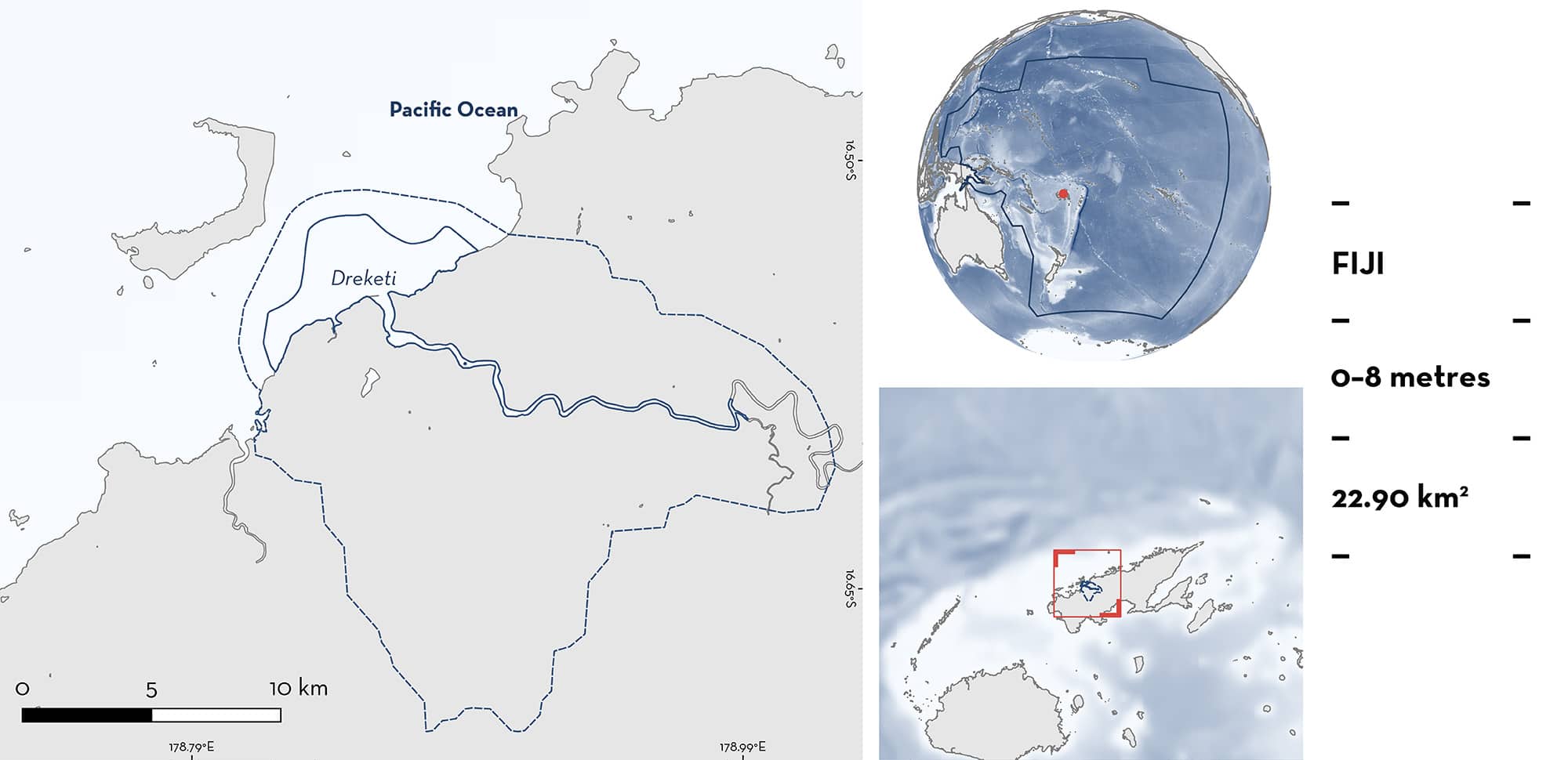
Dreketi is located on the north coast of Vanua Levu Island in Fiji. It encompasses a river and estuarine area which is influenced by a tropical marine climate with a wet (November–April) and dry season (May–October). The habitat is characterised by shallow, silty substrate and extensive mangrove forests. Within this area there are: threatened species (e.g., Scalloped Hammerhead Sphyrna lewini); and reproductive areas (e.g., Bull Shark Carcharhinus leucas).
Download factsheet
Dreketi
DESCRIPTION OF HABITAT
Dreketi is a river and estuary located on the north coast of Vanua Levu Island in Fiji. The Dreketi River has a large catchment of ~85,000 hectares and is one of the deepest rivers in Fiji with a depth of up to 4.5 m (Jorquera et al. 2020; Paris 2020). The estuary has a large alluvial fan that is usually shallow (<3 m) but with a depth of up to ~8 m. Extensive mangrove forests line the lower reaches of the river and the estuary coastline. The area is influenced by a tropical marine climate with a wet/cyclone season (November–April) and a dry season (May–October; Jorquera et al. 2020). Cyclones impact sediment discharge, with up to 40% of the annual sediment load linked to a cyclone event (Jorquera et al. 2020). Salinity levels recorded during a fishing survey in the area during January–February 2020 had a mean of 26.9 ppt (range = 13.3–31.7 ppt) in the estuary, and a mean of 18.4 ppt (range = 0–30.6) in the river (Paris 2020).
This Important Shark and Ray Area is benthopelagic and is delineated from inshore and surface waters (0 m) to 8 m based on the bathymetry of the area.
CRITERION A
VULNERABILITY
Two Qualifying Species considered threatened with extinction according to the IUCN Red List of Threatened Species regularly occur in the area. These are the Critically Endangered Scalloped Hammerhead (Rigby et al. 2019) and the Vulnerable Bull Shark (Rigby et al. 2021).
CRITERION C
SUB-CRITERION C1 – REPRODUCTIVE AREAS
Dreketi is an important reproductive area for two shark species.
In a study during January–February 2020, 47 Scalloped Hammerheads were captured from 75 bottom-set gillnets deployed in the Dreketi River (n = 20) and the estuary (n = 55) within the area (Paris 2020). Gillnets were 100 m long, 3 m high, and had a 10 cm mesh size. Up to two nets were deployed simultaneously and hauled in after 40 minutes for each deployment. All Scalloped Hammerheads captured were either neonates with a semi-healed umbilical scar (n = 14) or young-of-the-year (YOY) with a healed umbilical scar (n = 33) (Paris 2020). Individuals measured 49–58 cm total length (TL), with a mean of 52.8 cm TL. Size-at-birth for the species is 31–57 cm TL (Ebert et al. 2021). Most Scalloped Hammerheads (87%) were captured in shallow water (<1.5 m deep) close to the river mouth, but six individuals were captured 6 km upstream in the river, showing the connectivity within this area. Traditional Ecological Knowledge (TEK) gathered in 2010 through interviews with representatives from six villages from the estuary to 33 km upstream showed that hammerhead sharks (family Sphyrnidae) are commonly caught in this area, particularly at the estuary village (Rasalato et al. 2010). Respondents indicated that hammerhead sharks were generally <1 m TL, but larger individuals up to 3 m TL were also caught. Additionally, an interview survey in three villages in the area conducted in August 2024 confirmed the continued capture of Scalloped Hammerheads in this area (D Williams pers. obs. 2024). Combined, these data show that Dreketi is important for the early life stages of Scalloped Hammerheads.
A total of eight Bull Sharks were captured in January–February 2020 from bottom-set gillnets, with six neonates having open umbilical scars, indicating recent birth, and one YOY having a semi-healed umbilical scar (Paris 2020). Their size ranged from 74–100 cm TL, with a mean of 79.3 cm TL. The size-at-birth for the species is 56–81 cm TL (Ebert et al. 2021). All Bull Sharks were captured in the river, from near the estuary to 18 km upstream. TEK provides evidence that Dreketi has long been an important reproductive site for Bull Sharks. Fishers noted that they usually catch individuals <100 cm TL, with the largest individuals ~250 cm TL (Rasalato et al. 2010). Recent interviews confirm continued regular captures of small Bull Sharks in this area (D Williams pers. obs. 2024). Dreketi is the only known important reproductive area for Bull Sharks on the island of Vanua Levu, with other areas located on Viti Levu (Glaus et al. 2019).
Download factsheet
SUBMIT A REQUEST
ISRA SPATIAL LAYER REQUEST
To make a request to download the ISRA Layer in either a GIS compatible Shapefile (.shp) or Google Earth compatible Keyhole Markup Language Zipped file (.kmz) please complete the following form. We will review your request and send the download details to you. We will endeavor to send you the requested files as soon as we can. However, please note that this is not an automated process, and before requests are responded to, they undergo internal review and authorization. As such, requests normally take 5–10 working days to process.
Should you have questions about the data or process, please do not hesitate to contact us.