ISRA FACTSHEETS
ISRA FACTSHEETS
NEW ZEALAND & PACIFIC ISLANDS REGION
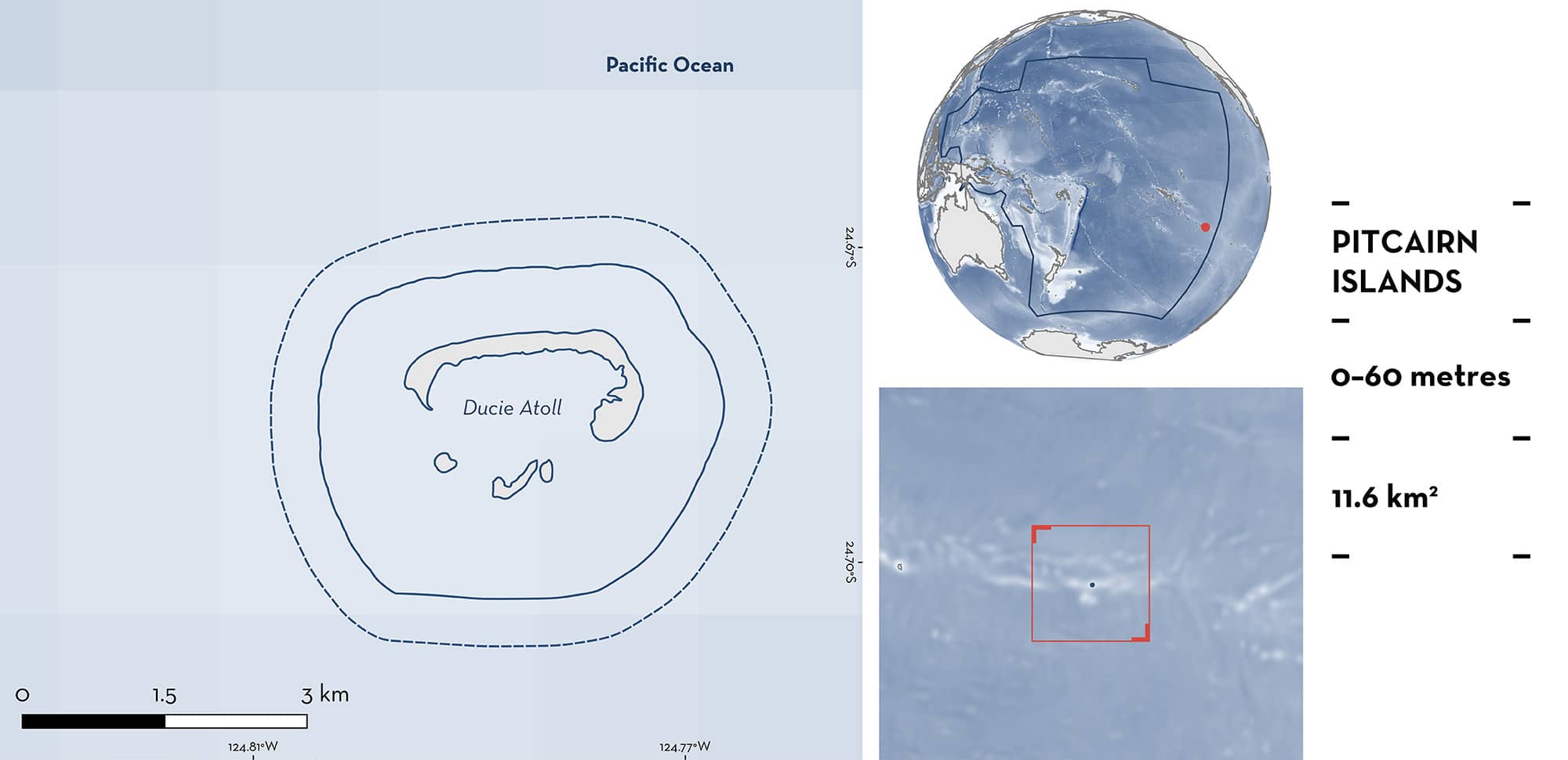
Ducie Atoll
Summary
Ducie Atoll is part of the Pitcairn Islands, a British Overseas Territory in the South Pacific Ocean. This atoll is the southernmost in the world and the easternmost limit of coral reef distribution in the Pacific. The habitat is characterised by a sloping reef with high coral cover. This area lies within the Pitcairn Islands Marine Reserve. Within this area there are: threatened species (e.g., Whitetip Reef Shark Triaenodon obesus) and undefined aggregations (e.g., Grey Reef Shark Carcharhinus amblyrhynchos).
Download factsheet
Ducie Atoll
DESCRIPTION OF HABITAT
Ducie Atoll is one of four islands that make up the Pitcairn Islands group, a British Overseas Territory in the South Pacific Ocean. This area is uninhabited and remote, located ~2,000 km southeast of Tahiti and 1,900 km west of Easter Island. Ducie Atoll is the southernmost atoll in the world and marks the easternmost limit of coral reef distribution in the Pacific (Irving & Dawson 2012). The Pitcairn Islands (i.e., Pitcairn, Henderson, Ducie, and Oeno Islands) are the only emergent parts of ancient volcanoes that rose from the seafloor 16–0.9 million years ago (Ozal & Cazenave 1985). Geologically, they are an extension of the Tuamotu and Gambier Islands (Woodhead & Devey 1993).
Ducie Atoll consists of a central lagoon surrounded by four islets. A well-developed reef encircles the whole of the atoll, with an extensive forereef projecting around the southern half (Irving & Dawson 2012). This area comprises the reefs which surround the atoll. The forereef gradually slopes from the shore to 25–30 m, whereafter it steepens sharply (Irving & Dawson 2012). Ducie Atoll has the highest coral cover (56%) among the Pitcairn Islands, with minimal algae growth (Salas et al. 2012; Friedlander et al. 2014). At depths of 20–40 m the forereef is covered almost entirety by branching Acropora spp. and the plate coral Montipora aequituberculata, in some areas with up to 100% coverage of the substrate (Sala et al. 2012). Prevailing winds and currents are dominantly from the east (Irving & Dawson 2012).
This area lies within the Pitcairn Islands Marine Reserve.
This Important Shark and Ray Area is benthopelagic and is delineated from inshore and surface waters (0 m) to 60 m based on the depth range of the Qualifying Species in the area.
CRITERION A
VULNERABILITY
Two Qualifying Species considered threatened with extinction according to the IUCN Red List of Threatened Species regularly occur in the area. These are the Endangered Grey Reef Shark (Simpfendorfer et al. 2020a) and the Vulnerable Whitetip Reef Shark (Simpfendorfer et al. 2020b).
CRITERION C
SUB-CRITERION C5 – UNDEFINED AGGREGATIONS
Ducie Atoll is an important area for undefined aggregations of two shark species.
Aggregations of Grey Reef Sharks and Whitetip Reef Sharks are regularly observed in this area, as documented by underwater visual censuses and baited remote underwater video station (BRUVS) surveys (Sala et al. 2012; Pristine Seas unpubl. data 2012; Pitcairn Government unpubl. data 2022).
In March–April 2012, 18 underwater visual censuses were carried out at 10 and 20 m depths, at nine sites in this area (Sala et al. 2012). During each survey, divers counted all sharks observed along three fixed-length (25 m) corridor transects. A few sharks were also visually measured. In September 2021, 15 BRUVS were deployed in this area at depths between 20–55 m on the seabed, and the maximum number of each taxon in a single video frame (MaxN) was recorded (Pitcairn Government unpubl. data 2022).
Ducie Atoll supported the highest biomass of top predators (1 tonne per 0.01 km2) compared to the other islands within the Pitcairn group (i.e., Pitcairn, Henderson, and Oeno Islands) where they accounted for 65% of the total biomass (Sala et al. 2012). Grey Reef Sharks and Whitetip Reef Sharks comprised more than 76% of the total biomass of top predators at Ducie Atoll (Sala et al. 2012). In this area, reef sharks were observed in 16 of 21 survey (76%) locations (Sala et al. 2012).
In 2012, underwater visual censuses recorded an average of 19 (SD = ± 59) Grey Reef Sharks per 0.01 km2. In six surveys (33%), 200 individuals per 0.01 km2 were recorded (Pristine Seas unpubl. data 2012). Grey Reef Sharks (n = 6) measured an average 174 cm total length (TL) (SD = ± 38 cm TL) with a range between 150–231 cm TL (Pristine Seas unpubl. data 2012). With females maturing at 120–142 cm TL, and males maturing at 130–145 cm TL (Ebert et al. 2021), this indicates that all individuals observed were adults. In 2021, Grey Reef Sharks were observed in 60% of BRUVS surveys, with a maximum MaxN of four individuals in one deployment, and an average of 1.5 per survey (SD = ± 3.0) (Pitcairn Government unpubl. data 2022). Grey Reef Sharks (n = 12) measured an average of 101 cm TL (SD = ± 30 cm), with 25% adults (range = 155–178 cm TL) and 75% juveniles (range = 68–98 cm TL) (Pitcairn Government unpubl. data 2022).
In 2012, underwater visual census recorded an average of 6.3 (SD = ± 35) Whitetip Reef Sharks per 0.01 km2 (Pristine Seas unpubl. data 2012). In two surveys, 200 individuals per 0.01 km2 were recorded (Pristine Seas unpubl. data 2012). In 2021, Whitetip Reef Sharks were observed in 67% of BRUVS surveys, with a maximum MaxN of five individuals in one deployment, and an average of 1.9 per survey (SD = ± 3.2) supporting the species aggregative behaviour within the area (Pitcairn Government unpubl. data 2022). Whitetip Reef Sharks (n = 10) measured an average of 130 cm TL (SD = ± 11 cm), with 90% adults (range = 117–148 cm TL) and 10% juveniles (one individual of 106 cm TL) (Ebert et al. 2021; Pitcairn Government unpubl. data 2022).
More information is needed to understand the function and nature of the aggregations of both species.
Download factsheet
SUBMIT A REQUEST
ISRA SPATIAL LAYER REQUEST
To make a request to download the ISRA Layer in either a GIS compatible Shapefile (.shp) or Google Earth compatible Keyhole Markup Language Zipped file (.kmz) please complete the following form. We will review your request and send the download details to you. We will endeavor to send you the requested files as soon as we can. However, please note that this is not an automated process, and before requests are responded to, they undergo internal review and authorization. As such, requests normally take 5–10 working days to process.
Should you have questions about the data or process, please do not hesitate to contact us.